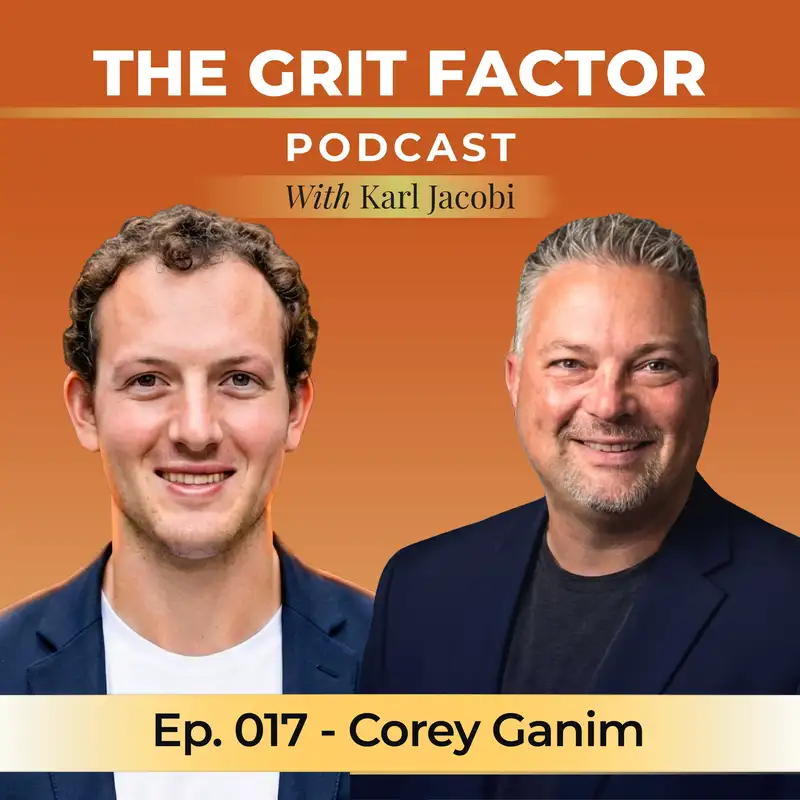
Episode 017: He Built a Sixteen Million Dollar Business and Walked Away From All of It with Corey Ganim
TGF Audio Ep 17
00:00:00 Speaker: Average is the enemy of greatness. Comfort is the enemy of growth. Welcome to the Grit Factor podcast, where we strip away the highlight reel and get into the darkness beneath it. The real stories, the real battles, and the battle plans used to conquer them. I'm your host, Carl Jacobi, combat vet, entrepreneur, resilience and performance coach, keynote speaker, husband and father. I've built, scaled, and exited multiple companies totaling over forty million in revenue. But here's what that highlight reel doesn't show you. Life has been smacking me in the face with a two by four since I was just five years old. Broken home, constant chaos. No playbook. No safety net. Just grit. And if you're anything like me. You know, you've got another level in you, in your business, your career, your faith, your leadership. You're just not sure how to get there. That's exactly why we're here. Be sure to follow me for more great content and check out my website. Success with Karl dot com. Now that's Karl with a K. Now let's get to work. Welcome to the show. All right. Today I am with an individual I've been following for a while. This is a young man that I met a few years ago at a conference in new Jersey. I've watched a ton of his content, and I gotta admit, I've I've learned quite a bit from you, man. This is the same individual that built a sixteen million dollar business in e-commerce space. Currently has over thirteen thousand subscribers on YouTube. It's one of the top influencers in his niche and a very well respected individual in this space. When I say this, I don't say this with any like hype. I like I've I've used to be in this space and I rarely if ever heard anything about, you know, her bad about this guy and especially in that space, there's plenty of it about almost everybody, right. So this is a very well respected person in this space. But man, he walked away from it. All of it, all of it. Not because it failed, but because he felt like this was the real failure. He felt like if he stayed at that in of itself was the real failure. So he burned the boat. Corey Ganim, my dude, welcome to the Grit Factor podcast. Carl, thanks for having me. And that was a nice intro. I appreciate it and looking forward to diving into it with you here for the next hour or so. Yeah, man. Yeah, it's it's it's nothing that's untrue. You know, I've been following for a while, man. And it's, it's really amazing to see individuals like you to be honest, forthright, even when it doesn't benefit them. Right. And I've never heard anybody say anything bad about you. And you've rolled out coaching programs, training programs, you wrote a book like you've done tons of things. You've given plenty of opportunities for people to, to, you know, complain and bitch and everything else. And man, you're just, you're just that dude. So all right, so Corey, man, most people here sixteen million top influencer, like I'm just painting this picture of like on paper, what success truly looks like. In some ways, I felt like I was reading my bio in a way, although I don't have that kind of subscriber count. And I think you had the dream. So set the record straight for us what was actually going on behind the scenes? Yeah, so there was, I guess, a couple different angles to that, right? So there's like financially what was going on behind the scenes and then mentally what was going on behind the scenes too. And I assume we're talking like through the frame of my decision to walk away from e-commerce. Is that right? Absolutely. Yeah. So, you know, there was a couple of things that led to me wanting to to make a change. And I'll start on the mental front. So, you know, by the time I chose to walk away from e-commerce and the world of Amazon and everything that I was doing there, which was, I guess October of twenty twenty five is when I made that clean split. So at that point, that had been almost nine years that I was in that business. And it, it had just gotten to the point for me where I wasn't passionate about it anymore. I didn't have I just didn't enjoy the process anymore. Right? It was one of those things where I was kind of saying to myself, I'm like, I'm when I sat down with myself one day and just got real honest, I'm like, listen, I'm really just doing this for the money. Like, I have no passion for this. I have, and honestly not a lot of belief in it either. So that's something that a lot of people in our space won't admit, especially people that were selling like coaching and courses and stuff like I was, because it's obviously in our best interest to paint the business and paint the business model in the most positive light possible. Because if we're out here saying like, oh, this business isn't a great opportunity anymore, then how are we going to convince somebody to buy our coaching and our courses? So yeah, so that was another factor too, is like the Amazon landscape had changed quite a bit, certainly since I had started nine years prior. But even over the last two or three years, it's just gotten a lot more competitive. It's gotten a lot more, um. I don't want to say dangerous because I don't know if that's the right word, but. Dangerous in the sense that like you're playing in Amazon's playground and they can pull the rug out from under you at any second. Yeah. And I saw it happen to so many people. So I it was just getting a lot harder for me with a clean conscience to say to somebody like, hey, pay me six thousand dollars to join my community and I'll teach you everything I know. But hey, by the way, you could do everything right and still get completely screwed tomorrow or next week or a year from now. So, you know, on the when it comes to like the mental factors, I think all of that, everything I just mentioned there is what contributed to me just not being comfortable in the space anymore and just wanting to, to make a change. That's honorable, man. That that is extremely honorable. And I remember watching that video when it was first released. Guys, if you haven't watched the video, go to his YouTube channel and check it out. You can sense the heartfelt message behind us. And dude, you could have very well stayed in the coaching space. You could have very well taken that knowledge and still done, you know, coaching, consulting and not necessarily consulting, but still sell things, you know, sell knowledge essentially. Right. But you did the honorable thing because you said, I don't have the conscious to not to, to sell something that I am no longer in a space for. Right? And that's honorable, man. That really is especially in a space where that's, you know, where there's certainly people taking advantage of that. And that's one of the reasons you and I have had this conversation. You know, that's one of the reasons why I've exited completely, right? Yeah. And, uh, man, I appreciate you sharing that because I, I know a lot of people can there is a shift in tides, you know, and there is a shift from just perspective, you know? Um, so take us back for a moment. I want to pivot because, you know, we do have a hard stop. So I want to make sure we're clear on both of our times here. Um, there is going to be a part two likely. So if you want to hear a part two, I'd love to hear your comments on this. But before we get to the business pivot, I want to go back to a period in your life period. Back in twenty twenty two, you lost one of your best friends. Take me there. Take me that moment, man. What happened and what did that event do to you? Yeah. So that was a really difficult period of life. And it's certainly nothing I've shared publicly before, but obviously that's why we're here to kind of get real and share some of the real, real sides of life. So, you know, that was, uh, one of my very closest friends that I went to college with someone that, I mean, at the time, I consider one of my best friends. And I remember I was sitting in my kitchen. I was living in Raleigh, North Carolina at the time. And, you know, I was kind of so it was kind of a precarious situation to begin with because it's like I'm living in Raleigh. I had some close friends there, but only like a small handful. So I was pretty lonely, just like in general. And, you know, I hadn't really had much many, like really bad things happen in my life up to that point. And I remember I was sitting there just working, uh, one day and then I got a call from one of my other best friends who said he was like, hey, you know, he kind of didn't know how to say it, but he's like, hey, like Jordan died. And I was like, what are you talking about? Like, I thought he was playing a joke on me. And you know, that it hit pretty hard. And so we talked for a couple of minutes and I remember I just like it didn't sink in at first. Like I didn't just like break down and cry. Like I kind of just was almost more, yeah, kind of in shock. And then so, um, so later that day, I remember I texted one of my close friends who lived close by and I just said like, hey, man, like I just got some really bad news. Can we just hang out? Like I just need to be with other people right now. And so he, you know, shout out to him. He, he like immediately was like, yes, come over like made cooked me a really nice dinner. Like he's a great chef and invited a couple of our other buddies over. So, you know, was able to kind of forget about it there for a couple of hours. But then it's like the next morning when I woke up, it kind of hit me like a train. And that's when I like that was the first time where like really broke down and cried about it. And then, you know, for the next, I mean, months, if not year or two was just in a really tough place mentally just thinking about, you know, one being like lonely and isolated and then dealing with this loss and not having a ton of people to process it with, at least not, they're not there close by. And yeah, just all around, just very, very, very tough time. Like easily the, the hardest time of my life is probably that year, year and a half period. Yeah, man. Dude, thank you so much for sharing it. And I appreciate your you being vulnerable and sharing that especially, you know, sharing the loss of a friend, dear friend. And that that's hard to process that, you know. And so thank you for sharing that, sharing it publicly because I heard you say that this is the first time you shared it. So I appreciate you trusting me. You know, enough to, you know, in the audience to share that. Um, man, I before I go forward, man, I would love to hear what was your favorite memory of Jordan? That was his name. Yeah. Yep. What was your favorite memory of him, man? Yeah. So he was just and it's funny too, because, well, it's not funny, but like it is in the sense that he, he's like the one guy that is like friends with everyone, like every person from every walk of life, like he knows them. Everybody knew him. He was just like the guy, like the funny guy, the guy who was friends with everybody. And, you know, I guess favorite memory, like I have so many, but there's one in particular that. So we went to college together and he graduated a year before me. And so it was my senior year. He's actually from Raleigh. So, you know, he'd already graduated, but I, I and all my friends who he was still friends with were still at school. And so he would come up and, you know, stay with us and like, sleep on our couch, probably like every other weekend. My senior year. And he was for a while there, it's like you didn't have a job. He was kind of just he's like, I'll figure, you know, he's one of those guys where he's like, I'll figure it out. And like he always did it. Always like the best opportunity would just fall into his lap. So it was one of those weekends where he was like, coming up to visit, visit us at school. And we were like, well, hey, are you coming? Like, it's five o'clock on a Friday. Like, we're getting ready to go out soon. Like, are you coming? And he's like, oh, yeah, like we're coming soon. We're just waiting on, uh, Brad, who's our other friend? He's like, we're waiting on Brad's mom to give us twenty bucks for gas so we can like, fill up the gas tank and drive from Raleigh. And that, like, that just stuck out to me because it's so funny. It's like, dude, you're like, how do you not have twenty dollars for gas? Like you, you're not in college anymore. Like you should have a job. Yeah. It was just one of those comments that he was known to make that was just like so nonchalant. And I just thought it was hilarious. And then, you know, an hour and a half later, he shows up at our doorstep with a case of beer and he's on our couch the whole weekend and we're just hanging out. And it was just, you know, one of those good memories that I like to look back on. Awesome, man. Well, thanks for sharing that memory of Jordan and thanks for sharing that, man. Thanks for sharing for all of us. Because, you know, in these losses, I think it's one of the most important things to do is to remember those good times, right? Remember the times that we had with them and just keep that memory, man, you know? So thanks for sharing. Yeah, absolutely. So you mentioned you were in a mental rut, you know, and for for almost two years, walk me through what actually looked like day to day, if you don't mind. Were you still running the business? Um, you know where people around you seeing it or where you perform? Fine. And I think you know what I'm talking about, right? I'm good. Right? But, you know, beneath the surface, you're not. Yeah. It was definitely a lot of that where. So it's, it's interesting because at that period, I guess like twenty twenty two into twenty twenty three was probably the best that my Amazon e-commerce business like had ever done financially. So it was like we were having, I think we had our best month ever. I think it was like July of twenty twenty two, and he passed in February of twenty twenty two. And we did like, you know, five hundred thousand something in revenue, you know, fifty something thousand as profit. Nice. I was like living in this little dumpy apartment, like I had my expenses were next to nothing. So it's like I was making a lot of money. But yeah, I just, you know, under, under the surface just wasn't doing too well and just was super depressed. I mean, I think I even mentioned in the, um, you know, the intake form, like I think you had asked, like, like, what were you doing at that time? And there was, there were so many days where just like, you know, I've always been an early riser. So like, I'd wake up super early, go to the gym and then come home and I'm just like, you know, just like totally not mentally there. Like I would literally some days just like lay on the ground for like. It sounds crazy, but like an hour, like I would just lay there, like I just didn't have the energy to get up or like do anything or think about anything or talk to anyone. And luckily I had a good team. Like I had two or three virtual assistants who were working for me at the time who were pretty autonomous. And, you know, it's like some some days my day would be I'd check in with them a couple of times on slack, and then I'm just like literally laying on the ground or like sleeping on the couch or like laying in bed all day, just like unable to function like mentally. And it was, it was like that for a while. Hey, real quick, before we keep going, if you've been listening to this conversation and something hit a nerve. If something we talked about made you pause, or you felt that little tug in your chest, like, man, that one was for me. I want you to lean into that for a second. Don't just brush it off. Because here's the thing. Conversations like this. Yes, they're great and I love doing this show, I really do. But if I'm being real with you, a conversation can only take you so far. At some point, you got to stop nodding along and actually do something with that feeling. So here's what I want you to do. I want to personally invite you to something we built called the Reforged Challenge. It's a live five day experience I created specifically for people like you, high performers who know they're capable of more. But something got knocked sideways in the old playbook. Just stopped working. Or maybe life smacked you in the face with a two by four that you just didn't see coming. Maybe the fire just dimmed and you can't figure out how to reignite it. Five days, five real identity shifts, live coaching, real community in the kind of honest conversations that actually move the needle, not just another thing you consume and forget by Friday. Listen, you're not broken. You're just in between versions. And I love for you to come see what we've built. Head on over to the reforge. Challenge comm again. Reforge challenge comm. Check it out. See if it speaks to you. And if it does, I'll see you inside. All right, let's get back to it, man. You know, as you're talking through this, this transition, if you will, right? This, uh, this mental rut, I would like to think a lot of people can resonate with this, but only because I've had so many conversations with just leaders in general, entrepreneurs, founders, business owners, parents. I mean, there, There is this commonality where we're chasing the wrong things, right? Right. We're in survival mode, you know. And that's what majority of us are programmed to do is just survive another day. If I can just get through another day, another day, another day, right? And that's what it sound like. You're operating system was ran off of, right? It's just surviving. And man, I could totally resonate with that dude. But, you know, I think if I understand correctly and correct me if I'm wrong, I think things started to change for you. You know, you you made a decision to to move to a new city. Um, you said that was the best decision you ever made. Um, even though it was the most difficult one in that moment. So take me to that decision. What made you finally say peace? I've got to go. Yeah. So it was, I guess this would have been, I guess. Was it middle of twenty or I guess middle of twenty two. Yeah. So around July of twenty two is when I actually made that move. Um, moved from Raleigh to Charlotte. And yeah, the, really, the decision making process was pretty simple. It's like, look, if I feel like if I stay here any longer, like I've got a couple of good friends, but I don't really have like a network. And yeah, you know, I don't like necessarily live. So like the closest friend at the time I lived still maybe like ten, fifteen minutes away. So I just didn't have a very good support system. And in Charlotte, I had like my two cousins live here who I'm really close with and I had other friends here. So it was just one of those things where I'm like, I just need a change of scenery. And I feel like if I stay here any longer, it, you know, who knows what's going to happen? But it's probably probably not going to get much better. Yeah. So, so yeah, I made that move and August or I guess July of twenty twenty two. And then I guess two months later, I met my now fiance. So that was. Dude, congratulations. Yeah. Thank you. So it's a very quick win there right off the bat. Um, met her through a mutual friend. And then I guess it was the following January of twenty three. So about five or six months later that I met, uh, Miles and Garrett, who were two other big names in the e-com space. And they had me on their podcast. And that's kind of what like that one interaction is what sent me down the whole rabbit hole of like making content and like putting myself out there. And, and yeah, so that I would be in a completely different universe if that hadn't happened. Man, I think you're speaking to a lot of people right now that are in that same, like, I call this the gap, right? The gap of in between your previous life or your current life that's trying to shed from you in this new life that's trying that your, that your soul needs, that your future self needs, right? And too to many people they got the sweaty palms, the racing heart rate and like, oh my gosh, you know, change of scenery, new, new everything, you know. And so what you're saying right now, I think, I think speaks to a lot of people that are in that transition in some shape or form, either in their relationships or in their, um, in their careers or businesses and so forth. Um, so I appreciate the acknowledging that. And from what I hear, it sounded like that was again, the best decision despite all the fear, despite all the what ifs in your mind. You said you, you acknowledge that was the best decision you ever made, right? Absolutely. Yeah. Because, you know, the easy thing probably would have been just to stay put in Raleigh and just like, try to muscle through it and figure it out and just stay put. But yeah, in hindsight, that would have probably been the worst thing that I could have ever done. And, you know, not to Jump too far ahead, but similar came to a similar, I guess, tipping point, if you will. This past year in October when it. Or really before that, when I made the decision of. Like, well, do I stay in the e-commerce world, something that I've always known and that I'm comfortable with and that I'm feel like I'm kind of at the top of my game? Or do I make a pivot into something that I'm basically starting over from zero, but aligns a lot more with what I'm interested in? That was kind of, you know, not as the circumstances weren't as dire, if you will, but it was it's similar decision making process, I think. Yeah. Thanks for bringing that up. I definitely want to dive into that right now. Let me acknowledge for a moment, especially in the space that you just left and even in the space that you you're now pivot into. We live in a world that is very much more virtual, even grammatically correct, but we have moved into a world that is so easy to get isolated, right? Especially in e-commerce, especially in online based businesses, it is so easy to get isolated. So when you're, you know, the, the less activity you have, the less contact you have, man. You just start developing stories. You start ruminating down the wrong path, right? So man, huge applause for you for, you know, having the courage, acknowledging the fear and still say, you know what? I'm going to, I'm going to risk it. I'm going to bet on myself. I'm going to risk it. And you, you went for it. And that was the best decision. Speaking of the next best decision, and again, this is something I completely relate with. Again, it's almost like I'm, you know, it's just my younger self I'm talking to here. Um, let's talk about this business pivot because, you know, again, you walked away from a very healthy business, a very healthy lifestyle. When I say lifestyle, I'm saying on paper, you had it all right. Uh, you know, the influence, you know, cash, cash flow, you know, cash flow and all of this stuff. So you grapple with that decision for months. You know, many sleepless nights have been there, done that. At what point did you actually decide, I'm done. I'm shutting this down. Take us to that moment. Was there was there a moment? Was there a conversation or a warning to just like, I'm doing it? Walk us through that moment, man. Yeah. So and it was a little more gradual. So I would say probably around like May of twenty twenty five, right around that time is when again, I just decided to get more serious with myself and, and just get more honest and be like, look, this is not something I enjoy. Like I've, you know, I have to come out here and, and put on a face, you know, on YouTube or on wherever and just be like, hey, this is great. And you know, here's how you do this business and this is why it's so great. And just, it just felt more wrong by the day. And so that's when I was like, look, I've got to get out of this, but I've got to do it in a way that I've got to do it in a way that makes sense. Like, I guess I was like both blessed and cursed in the sense that I can't just like shut down today and be out tomorrow. Yeah. Like one, I just had to be tactful about it because, I mean, one, I had this community that I'd spent the last two years building and I had, we had a great membership and people that, you know, looked up to me and trusted me to learn from me. Yeah. So I'm like, one, I've got to make sure that I take care of them and that I don't just like I can't just shut this thing down. And so, and then two, it's like, how do I time this in a way where because, you know, you mentioned the conference that you and I met at, right? Which is a great conference. I was already scheduled to speak at that conference, uh, you know, later that year that I made this decision and I was like, I want to be respectful to the host there. And I don't want to just like, you know, make this announcement. And then two months later, they had me speaking on their. Like, I would just look stupid if like, yeah, hey, this guy quit two months ago. Like, why is he speaking on your stage? Yeah. So I just, I think there was a lot of like moving parts to juggle and I just wanted to be really tactful and, um, and just thoughtful with how I did that. But I think I pretty quickly came to the conclusion that like, I have to make a transition now it's just like tactically, how do we do that? What's the timeline? And like, what are the loose ends that I need to shore up before we do that? Makes sense. Yeah. So thanks for sharing that, man. You made a transition that, you know, as people are hearing you talk about this, right? And now you shifted into something completely different, you know, in the AI space. What, what guided your decision into AI or, you know, or why not do something else? Why not do, uh, real estate or business acquisitions or. I mean, there are so many different things that you could have done, but you know, you've. However, decided like, you know what, I'm going to lean into AI. I see this opportunity, right? Walk us through that. What made you to lean into that and, uh, and proceed down that road? Yeah. So my, my decision making process was pretty simple. So when I made the clean break from Aecom and in October twenty twenty five, when I made that announcement and I was like, officially done. Yeah. Uh, there was two paths that I was interested in. So you mentioned one being real estate. Like I've always really been interested in real estate. I have some friends in the business. And then the other was AI. I think we all know how much AI is changing things. I felt like, so really those are my two options. I'm like, I want to go one of these two directions. And I was really having trouble deciding which way to go. So I'm the kind of person where I like to just try out a bunch of little things and then like, whatever clicks is what I kind of go deeper on. So the way that I was kind of pressure testing, both like a real estate venture and an AI venture is on the real estate side. A friend of mine is a very successful investor and I've gotten to be good friends with him. And so I basically said to him like, hey, man, like, I will happily work in your business and kind of help you with acquisitions. So what that looked like is that he kind of plugged me into his business and I'm, you know, talking to sellers and making offers and trying to like structure deals on behalf of his team. And, and so like, I wasn't really set to make much money off of that. He's like, yeah, for anything we close, you can get like ten percent, which might be at most like two, three, four, five grand. And those deals are. They're not happening every week. Right? So for me, it was more like a purely experience play of like, hey, I'm interested in this. Yeah, I'm happy to help. I have the time. And if we make money on it, great. But I'm really just here to determine if this is the direction I want to go. Sure. So that's kind of how I was testing out real estate. Like, is this something I enjoy? Is this something I want to do? And then kind of on the side, I was, uh, building little like AI automations for people. So I'm a part of a couple of in-person networking groups here locally. And a lot of the guys in those groups like their successful CEOs, but they don't know how to use AI. They don't know anything about automation. Yeah. So it started off just doing these like little one off automation projects and then, you know, doing some like AI consulting by the hour and around this time too, I'm starting on X specifically, I'm starting to tweet more about AI, like kind of talking about what I'm doing on the AI side, the stuff I'm building, just kind of my experimentation. And that really started to take off quite a bit like it probably. And it was probably about three months ago now or so that, um, on X in particular, my content started to pick up like people were paying attention. It was getting a lot of good engagement and it just seemed to be, you know, all the signals of the universe were kind of telling me like, hey, this AI stuff is probably the direction you should go. And you know, when it comes to real estate, like I still can invest with my friend, like I can lend him money. I can invest in funds, which like I do currently. So it's kind of my way of being able to do both with AI being more of like, you know, my, I don't want to say identity, but like, I'm my, my brand, right, is more associated with AI. So that's kind of, again, I know that was super long winded, but that's kind of what led me to, um, kind of what I'm doing now. No, that makes perfect sense, man, I appreciate that. It really gives, you know, some some meat behind of okay, it wasn't like you just said, you know, I'm going to chase AI because everybody seems to be chasing AI some degree, right? Especially if you look on YouTube or social media, you know, it's like everybody's chasing AI to some degree. Yeah. Um, where are the money chasers? I wouldn't say everybody, but, but the money chasers. Yeah. Well, ironically, on that note, money chasers, um, that is you felt your heart moving you in this direction, right? You felt passion there. You felt, um, I call this pull motivation where you're being pulled in that direction. Not necessarily because there's money there, but because there's genuine opportunity where you could come in and serve and provide an impact. Right? Um, so with that man, um, you kept seeing the same problem everywhere. You know, small business owners drawing, drowning in manual work, which, you know, I can resonate to some degree who, you know, AI can really make a difference and but had no idea where to start. Um, where did you find or when did you finally start to see that problem? Uh, clearly. Um, and when did you decide that's, you know, that's what I'm going to solve or that's the problem I'm going to solve for them. Yeah. So I would say it like kind of the light bulb moment for me was so I mentioned one of those, those in-person networking groups that I'm a part of. So this is, uh, a mentor of mine is the one who started this group maybe almost four years ago now. And we've been meeting once a month in person and it's like ten or twelve guys. All of them are successful CEOs here in the area. And I'm kind of the youngest in the group by a good margin. And so, you know, these are these are guys that are super successful. They they've been in business for a long time. That's the room you need to be in. Yeah, yeah. But then it's like you mentioned, of course, they all know like what ChatGPT is, but I would say the savviest one in the room, like the extent of their AI knowledge is like they, they have a couple of prompts that they use on a regular basis with ChatGPT, right? But like, aside from that, they have, they have no idea where to start. So when I understandable I came into that room one day, uh, this was, this was probably like late twenty, twenty five, right around when I made the transition from Amazon. And I was kind of just bouncing this idea off the group because I trust their opinion. I'm like, hey guys, I, you know, I pivoted out of the e-commerce world. I'm looking into the AI world. You know, there's a lot of things you can do when it comes to AI and these automations that you can build. And again, I was kind of just like, I think they could tell that I was just genuinely interested in this. And I just was kind of, you know, just talking about it in front of the group. And one of the guys was like, well, you know, hey, I, I don't know what you just said, but like, I, I think I need it. So can we talk about it? And like, can I pay you to set it up? And, you know, that led to a couple of the other guys kind of doing the same thing. And now I'd say four or five guys in that group have paid me for some sort of project, whether it was like an audit or an actual, you know, automation build. But it was kind of just that initial validation from that group that was like, oh, wow, this is something that like, I have the interest to go and learn and most people don't. So maybe it's something I'll explore further and can monetize because clearly there's a need for it. So I'd say that was like the main light bulb moment. Nice. Certainly understand that. Now. How did you feel? Right? How did you feel when when that occurred? So and I've told people this before, but I felt like and even still like kind of now because I'm still learning, like everybody's learning to a degree, especially in the AI world. It's so new, but I tell people that I feel the same way I felt when I was learning about Amazon in twenty seventeen, where it's like, you know, you're learning so rapidly and you know, I'll be kind of just like tinkering with the tool or like doing some little mini AI project, even just for myself. And then it's like, you know, you look up and two hours have gone by and it's like, you've got to jump on a call or you've got to go somewhere. And I'm like, all I want to do is just is like, finish this project or like, keep doing this. And then it's like on your mind the rest of the day, you know? So it's just kind of that, like you said, that pull of like, oh, this is just intrinsically motivating. Like I'm not doing it for the money. I'm just doing it because I genuinely enjoy it. That's awesome. And that's admirable. I, I can definitely resonate, especially in this season of life. You said something powerful that I want everybody you, you've kind of hinted at this a few times. We've both hinted at this a few times during our conversation, but I want to put a big old spotlight on this. And I want you to talk to this person for a moment. Right. He says something powerful. Doing something I'm no longer passionate about for the money is not worth it. Right? Mhm. Passion versus profit. A lot of people listening right now are stuck in that exact trap. Mhm. They know they should leave. They feel it, right? They feel it in their heart. Um, but their heads pulling them in a different direction, you know? So they know the passion's gone, but but the money is what's keeping them there. Yeah. So talk to that, Corey. Talk to that Karl, talk to that person. It's listening to us right now. Like, all right, what do I do? You know, what would you say to that person? Yeah. So I think a lot of people deep down that are in that position, it's like they know what they need to do. They just don't have the courage to to make the decision. And you know what? I tell a lot of people to do sometimes, like sometimes people will come to me and say like, hey, you know, I'm similar, like similar situation. Like I'm, I'm stuck between these two decisions and I'm really torn. What should I do? And a lot of times I'll flip it back on that person and say, if you were me and you were asking me this question, what would you tell yourself to do? Like, what advice would you give yourself? And like, sometimes just that reframe is all people like, I know me personally, like I've had people challenge me with that reframe and it's like, the answer is immediately clear. It's like, oh, I know exactly what I would tell you to do. So then that's probably what I should do. You know, it's like, I think it's just one of those mental blocks that people have a lot of times. But like really tactically speaking, if, you know, let's say you're in a job you hate or, you know, you've been building this business for five or ten years and it's kind of your identity, which it was for me. Um, then I think you yeah, you just gotta, you've got to put a plan like put a, a transition plan in place and like, put that on paper. What does that look like? What are. Because that's what I did. I even made a list of like, okay, if I were to walk away. What are all the things that I need to do, like tactically in order to make a clean break? And so like for me, one was, well, I've got to sell the community to someone who's going to. Take care of it, right? Yeah. Closing it down is not an option because I mean, frankly, we have people. Paying for year long memberships. And I didn't want to just like refund those people. And I also. I certainly wasn't going to just like cut them off halfway through their year. So the only option was just like, find somebody who can take care of them. And if that means that I need to take a loss or not necessarily a loss, but if that means that I need to sell the community for lower than what I was hoping to sell, which is what happened it to the right buyer, then then so be it. And that's exactly what happened. But I was I was like, I'd rather me take that haircut than the people that have trusted me for, you know, the last two years, but that, you know, kind of taking that inventory of like, okay, I've got to find a buyer for the community, and then I've got to, I've got to like determine what I'm going to do with my team. And like, we've got to sell through all the inventory that we have at Amazon, right? So just kind of making that checklist and then putting it to like a timeline of like, okay, I know I can do all these things and it's going to take me say ninety days. So like the goal date is X, Y, Z for me to make a clean break. Real quick before we keep going, if you've been listening to this conversation and something hit a nerve, if something we talked about made you pause, or you felt that little tug in your chest, like, man, that one was for me. I want you to lean into that for a second. Don't just brush it off. Because here's the thing. Conversations like this. Yes, they're great and I love doing this show, I really do. But if I'm being real with you, a conversation can only take you so far. At some point, you got to stop nodding along and actually do something with that feeling. So here's what I want you to do. I want to personally invite you to something we built called the Reforged Challenge. It's a live five day experience I created specifically for people like you, high performers who know they're capable of more. But something got knocked sideways and the old playbook just stopped working. Or maybe life smacked you in the face with a two by four that you just didn't see coming. Maybe the fire just dimmed and you can't figure out how to reignite it. Five days, five real identity shifts, live coaching, real community in the kind of honest conversations that actually move the needle. Not just another thing you consume and forget by Friday. Listen, you're not broken. You're just in between versions. And I love for you to come see what we've built. Head on over to the reforge challenge dot com again. Reforge Challenge dot com. Check it out. See if it speaks to you. And if it does, I'll see you inside. All right. Let's get back to it. Love it man. I really hope that people are listening to what you're saying and taking action. Um, because everybody that's listening to you talk about just just do. Right. In fact, a previous guest I had not too long ago, uh, said just that. Right? Stop thinking about it. Stop meditating on it. Just freaking do it. You know, have the courage. Yes, there is fear there. But move, move forward in spite of it. You know, this is why, you know, the successful people that you hold in the spotlight. That's why they're there. Because they acknowledge the fear, but they still move forward anyways. You know, they reminded themselves, what if it will go correct? Right. What? You know what? You know, they, they, they jack themselves up on that premise. What if they just go right? What if this does work? Not what if it goes wrong, you know? Um, but yeah, I appreciate you sharing it because there are a lot of people that are there. You know, they've been doing something for so long, or maybe they're being shown a sign like, hey, you know, Linda or you know, Brad or whatever, you need to pivot my man or gal, but they're refusing to acknowledge that sign. It's like bam, bam. Um, so thanks for sharing it, man. It really is at the end of the day, just having the courage to move. Take the first step. Absolutely. Well, awesome man. Um, as we start to wrap up, man, we're going to there's a couple of things I want to throw at you. Um, and one of this is I think, you know, for me, I can relate to this to some degree, but you said that you learned the hard way about doing business with friends and family, almost lost great friends, almost ruined relationships with close family. Well, of course, without dropping any names. Right. What happened? And what's the rule? You live by now? Today? Yeah. So I think just like general principles to live by when it comes to that is I like specifically when dealing with friends, I feel like I had the tendency to be too generous of like, hey, you know, like a very specific example of like, I had some affiliate partners that were friends of mine that I offered a very large affiliate cut to, you know, just to be very transparent, like, hey, you know, if you guys want to be affiliates for our, our product, great. I'll give you a, a large cut much larger than I would for the average person. And what I realized in hindsight is that it was almost, I was almost setting them up to fail because it's like if they produced a lot, then it's like the more they produce, the more money I would lose in that arrangement. Right? So So if I'm giving up eighty percent of every sale, like there's no way I can be profitable. So it's like down the road, they were crushing it, which is great. Like that's what you want them to do. But then you have to have the hard conversation of, well, hey, I was giving you eighty percent. Now we've got to cut that to fifty. And in their mind, it's like, well, why am I being penalized for being a good producer? Yeah. And so, I mean, that was just like that. That sucked. I had that had to have that conversation a couple of times and you know, it was one hundred percent my fault. Like I didn't need to offer them eighty percent up front, but I wanted to try to be a good friend and a good partner and, you know, help, not necessarily help them out, but just like give them a good deal. And so that, that just, I think when you're dealing with friends or just partners in general is like, you just got to, you got to be fair and you got to put things on paper too and just be like, hey, this is the agreement. And if at any point down the line, we feel like the agreement isn't is no longer fair, then that's a mutual conversation. But until we agree, until we both agree. Otherwise this is the arrangement. So I would have had the probably had the harder conversations earlier on to kind of summarize there. Love that man. As you know, I've been through my fair share of, of partnerships and some of them didn't end very well. And yeah, you know, I, I can resonate that to, to that to a large degree. So, um, before we close or as we start to move towards closing, I want to make sure I acknowledge something that you put on your, your intake that I really want everybody to hear. We did talk about it briefly, put the little spotlight on it, but I want you to I want to say it again because we didn't really quite say it black and white, but you said something that I want everybody to hear. No matter where you are in your life or business, you can always reinvent yourself. Your case in point, right? You move from an industry where you were there for nine years, I can relate. I was in the industry for twenty five years starting in nineteen ninety nine. Right? That's not an easy thing to do, right? But you're living proof of this. You're living proof that you can still lead with your heart and not your head. And if anybody's seen the the Tony Robbins and Alex Stamos video, you know exactly what I'm talking about. If you haven't, go watch it. Um, but for the person right now, who knows, they need to make a change but is paralyzed by fear. Just want to clarify, you're telling them to just move. Absolutely one hundred percent. Love this, love this. All right, so rapid fire. So we can, you know, uh, unfortunately in this, but in this season of life that you're in, what is your definition of grit? I'd say my definition of grit is just waking up and doing the stuff that it's like the stuff that you plan to do, the stuff that you know you have to do, the stuff that you know, moves the needle but just sucks. Like there's stuff that I do every day where I'm like, this sucks. I don't like doing it. I nobody's really going to notice if I don't do it, but I'll except me. And that's, I think what's most important. So it's just like doing the stuff that, you know, you've got to do even when you don't want to love it, man. Love it. So in my season of life, I've really had to focus on subtraction because you hear a lot of talk about adding systems, adding processes, adding, adding, adding, adding, adding, but also growth. Growth requires subtraction. So where in your life are you actively subtracting something? It could be a belief. It could be something you've had to unlearn. Friction point. What is something that you're moving so you can level up? So I would say being available to anyone at any time, like that's something that in the past, you know, I get a lot of people asking me like, hey, can we jump on a quick call? Or, hey, do you have a minute? Or, you know, just a lot of people tugging at your time. And I think just getting a lot, getting a lot more comfortable saying no or, you know, if not no, then it's like, well, yes, but like, I literally don't have availability until two weeks from now. And if the person's not okay with that, then that's their problem. And it probably wasn't that important in the first place. I hope everybody just heard that I can what you just described right there. I've mentioned this book several times is a book called Boundaries by Doctor Henry Cloud. I think I mentioned this on one of your LinkedIn posts. Um, that is probably one of the most profound books I've ever read. Impactful books as well. Um, I fell victim to that. And it's hard. It is really hard to do, man. Um, awesome. So this last question, I kind of, you know, prepared you for in the green room, what is when you're in the trenches, man, you don't feel like pushing through because you had a bad day. Bad week. You're just going through it, right? What is a quote or directive that you tell yourself to pull yourself through that moment or that season? Yeah. So the one that always sticks out to me is and I'm going to butcher the quote, but it's like, it's okay, you. You can always quit. So why, like, why do it today, right? It's like, oh, if you want to quit, then quit tomorrow. And it's like, you get to tomorrow. And then it's like, ah, quit tomorrow. So it's almost like you're procrastinating on quitting. And the next thing you know, it's like you've been pushing, pushing through for however long it you need to. So that's kind of like what I like to keep in my mind when I'm having a tough day. Love that. It reminds me of what Ed Mylett talks about the power of one more. Right? Quit tomorrow. Just quit, you know. Don't worry about today. Quit tomorrow. Yeah. Um. I love that man. All right, this last one's a two part. Um. I also kind of prepared you for this. For those that are listening. Brand New. I love to ask my guests or give them an opportunity to ask my next guest a question that they will love to ping their or to, to pick their brain on. And it's completely anonymous. There's they don't know the guest lineup. So while you're continuing to think about your question and remind me, because I may forget my previous guest had this question for you and has so far every single one has landed. Perfect. What gets you out of bed in the morning in this season? Oh, that's a good question. Uh, I would say just like the intrinsic motivation to build a life that is secure, like I feel like, you know, I feel like we all kind of have that number in our head of like, oh, once I have this amount in the bank or once I have this much income coming in, I'll feel secure. And I'm just so far away from that number right now. And, you know, every day it's like, well, until I hit that number, Like I have to get out of bed. Like I don't have a choice. And I'm sure once I hit that number, the it will have doubled by then. But for now, you know, that's just kind of the mindset. Awesome, man, I love it. Thanks for sharing that. So your question is, what would you like to ask my next guest? Yeah. So for your next guest, I would be curious to know. Um, I would say like, what are, what are they working for? Like realistic? Like really, what are they working for? It's, it's probably not the money. So what is it like? What it not? It's kind of a variation of what gets you out of bed in the morning, but it's like, what is your end goal with what it is that you're working on now? I like that. Love it man. And looking at my guest lineup, like I said, it's been perfect. Awesome. Perfect. Well, cool. Well, Corey, man, thank you so much for not just coming here and giving us the highlight reel because that's the easy thing to do, right? It's easy to come in here and talk about, you know, the dollars and all of this stuff, but you came in here and gave us the darkness behind the scenes, the loss of your friend. And in that mental rut that you're in for two years and, and finally having the courage to say, you know what, I'm going in the direction of my heart. I'm going to reinvent myself. So, man, I respect you, you know, for that, for showing us that it's possible, reminding us that it's possible. And I truly hope that everybody is watching and or listening right now can get that and please execute. So again, man, thank you for joining me, dude. Thank you for having me, Carl, I appreciate it. Yeah, absolutely. All right. For the person who wants to connect with you, especially if they want to learn AI, because I know you offer AI services, they want to take advantage of AI assessment. Do you have for business owners? Where can they learn about you? Where can they connect with you at? So I would send anybody who's was interested to my podcast, which is called build with AI. So that's going to be on any podcast platform and then on my personal YouTube at Corey Ghannam. So just search for build with AI anywhere you get podcasts. Love it man. Thank you so much for sharing. I'll definitely be dropping those on the show notes. So thank you again to those listening and watching right now, as you well know, especially if this is the second or more that you've heard, the gap between average and excellence is just action. You heard Corey say this several times today. It's just action. Just move even if it's imperfect action. Don't just listen to Corey. Please just take one thing that he shared today and use it and be the reason someone doesn't quit today. Don't keep this to yourself. Share it with the loved ones. Share it with your friends. Share it with your team. Do this because they need you to show up in their life again. My dude, thank you for stepping arena today. Thank you for having me, Carl. Absolutely.
Creators and Guests