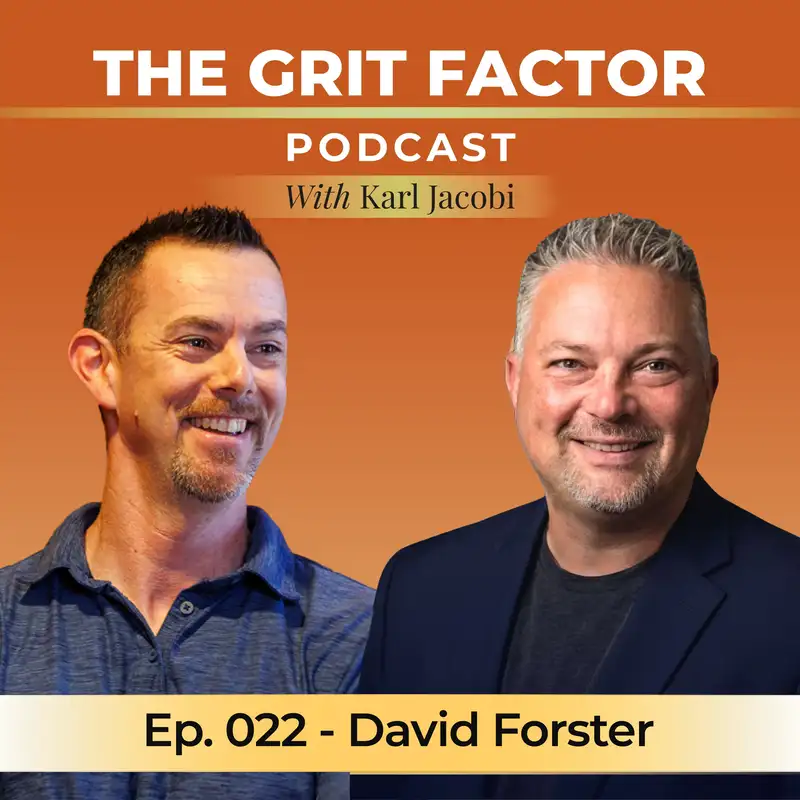
Episode 022: His Wife Threatened to Sell the Bike. That Ride Changed Everything with David Forster
TGFP Audio 22
00:00:00 Speaker: Average is the enemy of greatness. Comfort is the enemy of growth. Welcome to the Grit Factor podcast, where we strip away the highlight reel and get into the darkness beneath it. The real stories, the real battles, and the battle plans used to conquer them. I'm your host, Carl Jacobi, combat vet, entrepreneur, resilience and performance coach, keynote speaker, husband and father. I've built, scaled, and exited multiple companies totaling over forty million in revenue. But here's what that highlight reel doesn't show you. Life has been smacking me in the face with a two by four since I was just five years old. Broken home. Constant chaos. No playbook. No safety net. Just grit. And if you're anything like me. You know, you've got another level in you, in your business, your career, your faith, your leadership. You're just not sure how to get there. That's exactly why we're here. Be sure to follow me for more great content, and check out my website success with Karl dot com. Now that's Karl with a K. Now let's get to work. All right, we are back for another episode today. We have an amazing guest. A third generation farmer grew up on a cattle farm in northeast Kansas. I spent some time in Kansas. And bless your heart. Started working in the green industry at just ten years old. Apprentice under one of the best stonemasons in the Midwest. Uh. By the time he was eighteen years old. Studied landscape management at K-State. K-State definitely holds a place in my heart. Move to Kansas City in two thousand and six and founded his first company, Able Lawn and Landscape, built it up and then step out of ownership for a season to put his family first, which is something I can definitely applaud. Came back in twenty thirteen and founded Monumental Outdoor, then opened a bike shop in RI or I'm sorry, Raymore, Missouri. I hope I said that correctly. Basically, creating three sellable companies, two decades of building, operating and scaling. But the real story isn't just the business itself. It's what the business had cost him. And this is something we're going to dive in quite a bit today. In addition to things he's passionate about today, and what he found, uh, being on a bike had actually given him back. So Today. Fast forward today. He is a certified brain performance coach and I love bringing out on things. Yes. Pun intended on that. And he's also the founder of Bike It Out, a platform helping high output entrepreneurs rebuild their mental capacity to actually lead the life of what they or they lead the life they've been built for. So Dave Forrester, my dude. Welcome to the show, my man. Hey, Carl, thanks for having me. And, uh, that was a great intro. Thank you. Yeah. Thanks, man, I appreciate it, dude. I try to, I try to give the best highlight reel possible for anybody that comes on the show because, uh, I want to paint the picture because we only have an hour or less, right? So I try to cram as much like a magnificent information that I can about the guests and about the person I'm spending time with today. Um, so that, uh, if they want to connect with you, you know, they can connect with you, but they need to know who you are, right? The life you get to live and the life you built, and so forth. So let's get into it, my man. So, David, take me back to the farm. Right. Northeast Kansas. I was stationed at Fort Riley, so I okay fort like, you know, so I definitely know the Kansas area for well, yeah. And even spent time at K-State. Um, so, you know, cattle operation, third generation. What did life look like for you growing up? What did it teach you about work? And, and in those times, did you know you were going to build your own thing, be, you know, build three companies and live the life that you have today? Um, yeah. I mean, so kind of starting at the beginning, it's different than you probably imagined from, from how you're the way you're describing it and probably what people are envisioning. Um, so my great grandparents owned land that my parents bought from them to build their home before I was born. Uh, I'm the youngest, so some of my siblings were around at that time, but, uh, my dad was a mailroom guy at Santa Fe Railway. Uh, went to night school, worked his way up to being a mainframe computer programmer, which is, I don't know, next to gone nowadays, but yeah, um, you know, in the eighties and 90s was a huge thing. And so he worked his way up, was there for twenty plus years. Um, they ended up merging with Burlington, Northern, BNSF, all that stuff happened when I was a kid. And so my dad didn't want to get moved. So he, he took the other options and, um, was, uh, was a programmer full time until he retired. But on the side, my dad's side hustle was like a fifty head of cattle, one hundred acre plus farm side hustle. Nice. Right. And with like, I think back to him. And so just it's just farm life, right? I mean, you just do what you got to do, right? So there was Saturday mornings for us. Yeah, there was some cartoons, but it was also jumping in the truck with dad to either go to the farm store or the lumber yard. And we were building something, doing something, fixing something. Like the man just rarely ever sat down. Right. So, um, set a great example, uh, for work ethic and just no excuses. Um, he grew up in a house of, you know, like, I think five or six boys. Um, and, um, just, you know, not, not well off by any means and just learned to fight for everything he had. And um, so he, he set a good example there. But what I will say is he some limiting beliefs came around for, um, you know, money and business and what that looked like. And so no, I didn't see myself as being a, even though I kind of like had, I was a big dreamer as a kid, you know, I was always like, I like nice things. And I had posters of Lamborghinis and stuff on my wall in my room and stuff like that. And so like my son. Yeah. And so I was, uh, you know, I went through that, that whole phase of like trying to understand what is it going to take to actually achieve that? Or is it even realistic? And blah, blah, blah. So, um, very early, like you said, ten years old. Um, I mean, there's way more than three businesses on the list. I usually say eight, but I don't like as a kid, I don't know how many that as a kid you would call like a kids business, right? Like I, yeah, yeah, I had a hamster operation for a while that accidentally popped up and I was selling them to the pet store for a dollar a piece. Um, you know, I was cutting, cutting trees out of the neighbor's pasture at a dollar a piece. And I was like, you give me an axe, I'll send you the bill. Um, so that that's kind of where it started with that stuff. But, um, I just, I was just a hard headed, stubborn, creative kid that was in the hallway more than I was in the classroom. Um, I kind of learned how to work the public school system and made it through with great, great grades. Um, but I wouldn't say that I learned as much as I could have. Right. Um, I just, I think I can resonate with that. I learned how to get it done and get out of there. Yeah. Um, and so then, yeah, to, um, several businesses that generally, um, got to a certain point where I was just, I, you, a lot of people would say burned out, right? Yeah. Um, and I wanted to make a pivot. I wanted to do something different. It just wasn't, you know, and so, uh, thankfully I had enough work ethic and grit that they were sellable. They were good. Um, great reputations. I believe in quality, integrity, relationship. Um, yes. And so in those moments that wasn't bad pivots. Um, but the reason behind it, I just couldn't put my finger on for a while and, uh, until I went for a bike ride after my wife said, if you don't ride that thing, I'm going to sell it. And I had a really nice carbon road race bike that, you know, several thousand dollars that I just hadn't been riding. And, uh, I've been, I've done motocross, BMX, all that stuff as a kid. So I love bikes. Oh, and, um, when I went for that ride, it was just something different. Right. Um, and that's like every, every, I usually say everything fell off. Like all the pressure, all the stress and anxiety that was weighing on me from business, the customer's team, uh, you know, leadership decisions, financial decisions, all that stuff. When I first went out, I was kind of feeling guilty about by the time I came back, it was all gone. And I had solutions in my head. And, um, led me to ask myself, like, what? Why? Like what just happened? Right. And so yes, I went to K state for, um, it's kind of getting to be a long story. Sorry, but, um. That's okay man. Went to K state for landscape management, but also for kinesiology and exercise science. Um, and I'll be the first to be the first to admit I'm a college dropout, but most of the stuff that I didn't take was the lower level, um, prerequisites. And I was just aiming for classes that intrigued me and that I wanted to learn. Right? It wasn't, it wasn't what I did before where I just got through and got it done. Now I was like, I want to learn this. And yeah, um, I love biology, love, um, understanding why some people handle stress, different anxiety, depression, all of those things. I've had family members that have struggled with it. And why do some, why do some have prescriptions for it and others don't? What's the difference? How do they handle it? Is it, you know, hormonal? Biological? What is that? Yeah. Um, so that triggered a, a thing in me to figure out what the bike riding had done, what was going on, and, um, still don't have a perfect scientific answer. But man, it works. Yeah. Yeah. No, those that's that's a great story and I appreciate you sharing all that, especially. Yeah. You know, with you going out biking and enjoying a hobby. Um, by the way, I knew there was another reason I liked you. Um, BMX motocross. So yeah, my grandfather started motocross in nineteen fifty five, um, on a triumph Catalina or not. Catalina, but in Hollister Hills. And then, you know, my dad raced one across, I raced motocross and my son, uh, got into motocross and man, we're so close. I say we he, you know, but, uh, we just got burnt out, man. And it's not a sport that's cheap, bro. It is. No, especially in today's times. It's it's it's on another level, man. We did the whole BMX thing. I raced BMX and my son, my all my kids race BMX and, uh, I can definitely understand where you're coming from, you know, getting out in nature and. I can probably talk to not just, you know, being on wheels, but, you know, any environment where you're only focused on that, you're able to escape, right? You're able to escape that burnout, that grind in that day to day stuff that you're just exhausted from to unplug. Because when you're, when you're riding the hills or you're, you know, uh, going in, you know, through some rats or some hoops or whatever, hitting a triple you're not worried about, you know, the sales call that went sideways yesterday. No. Right. Exactly. No. Uh, or if you're just riding on, on a road, man, you're not worried about it. You're just you're focused and you're, you're, you're in a completely different world. And I think you're this is probably what you can speak to, man. You're probably using a different part of your brain, right? Um, you know, your creative side. And this is where I try to tell every one of my clients, like, you've got to find a hobby, you've got to find, do something to, you know, to have that release, man. So great stuff, man. Great stuff. I definitely want to dive into more. Um, so you spend your, your teens and your twenties and in the green industry building towards, you know, multiple companies, um, based on what I've heard, you know, operation cracking up on that one. Oh my gosh. Total accident. They were supposed to be both girls and that was not the case. So. Hey, man, at least, uh, it worked out for you, right? You know, turned into an enterprise for you, right. Um, so you you painted a pretty good picture, you know, of what that season looked like, right? Um, you started to navigate into the season where you start to get burnt out, right? You told it, maybe you can dive more into this, but you told us this season that that shaped you, uh, or that had shaped you when you started on your, your bike adventure here, right? Um, that means that something was already going wrong. Um, so take me into the months before that bike. Um, what did your head feel like? Um, what did you know, what did you stop being able to do? Like just walk us in that moment or in that season? Like, how did it feel, man? Um, you know, I felt and just to be raw with you, like I felt like a loser, right? Like I could build a business to a certain level. Um, but for whatever reason, you know, and I know now, right? It was my, my leadership ability, my ability to delegate, my ability to bring clarity to the team. Um, yeah. Paint the picture of what was in my head and the actual clarity that they could understand and utilize and, um, set them up for success. Right. But at the time, I just didn't have all that figured out quite right. My teams love me. I was a great leader. I was, and um, could get a lot out of my teams. Very efficient, very system driven. Um, but when I would go to go to the next level and I would want to hire somebody that was kind of a next level person to be either a foreman or a project manager or something like that. They were always excited, but they never accepted. And I just, I couldn't put my finger on it. Right. And so I just started asking the questions around like, okay, like, how do I need to change? What's really what's wrong with me? Right? That's why I say I felt like a loser. Yeah. Um, because it had been multiple businesses and each had gotten a little bit better and a little bit better. But, you know, I was getting into my early thirties and was not where I thought I was going to be. Right. Um. We never are, right. Yeah, exactly. Not like all the all the, like, kind of young and dumb and in a hurry. Impatient. Stubborn stuff. Right. Of that time. And. Yeah. Um, so that's, you know, I was in, I had a lot of limiting beliefs. Um, I had a lot of, um, just wrong mindset around identity and who I was and, and what I was capable of. And, and yeah, real quick, before we keep rolling, maybe life hit you hard. Business fell apart. Career isn't working out. Relationship ended. Health took a dive. And now you're standing in the rubble. Trying to figure out what the next move even looks like. Or maybe nothing blew up at all. On paper, you're winning. Sure. But on the inside, something's off. If you're not in crisis, you're at a crossroads. in the playbook that built the life you have is not the playbook that builds the one you want. Either way, you're stuck. Not broken. Stuck between who you were and who you're becoming. Most self-help just piles more weight on the load you're already carrying. I do not want to do that. I put together a free video series called the Grit Code Exposed, and I want to invite you to check it out. Seven short videos. That's it. The five laws that change everything for me. In every client, I coach the same five that every person who's ever come back from the fire has walked through where they had a name for it or not. No fluff, no ninety minute webinar, no bait, just the free video series. You can start it tonight. Grab it at grit. code exposed dot com one more time. Grit code exposed dot com. It's free. You don't need any more hustle. You need the next version and this is how you find it. Check it out. See if it speaks to you. And if it does, I'll see you inside. All right, let's get back to the conversation. Yeah. Now this is this is so good right here because what you and this is probably something we could probably spend hours on, man, but you hit this threshold right where you could no longer continue to operate in the previous version that you were right. And so I see this as so many and I saw it myself, right? I mean, I felt the same way. I felt like I was a failure. I felt like I was a loser because what worked previously no longer works in this next version, this next season, this next chapter. Right? And I see so many people get tripped up in this because they feel like that disoriented state, right? That disorientation that they're feeling right there. It feels like that because you're never, you don't know, like, right? Like, man, what the hell is wrong with me? Because what worked yesterday is not working today. Yeah. What worked last week isn't working today. Yeah. And to your point, yeah, you're you're a great leader, right? But because we're a great leader in that season doesn't necessarily mean we're going to be a great leader. Right? You know, in this next future or this next season that we're in. And so I call that disorientation, you know, where we get disoriented, you know, and in that disorientation, yeah. Because we we mistaken that as a label of failure or to what you're saying as a loser. And, uh, you know, I want to talk to, to the listener and or the person that's watching right now that if that's you, listen to what you know, David and I are sharing because that is just a mislabel, right? That that is just a mislabel because what worked previously is not going to work to get you to this next level, right? It's not going to just because it worked at one million dollars a year in revenue or in sales, it's not going to take you to ten million in revenue. In sales, you have to have a new set of beliefs, new new, not new set of new values, but a new playbook, new foundation, new vision, new fuel. Right. You know, so. Man. Great points dude. Um, what was the final turning point for you when you said enough is enough, right? Like there had to be some type of maybe not like, oh, type of moment, right where you see in the movies, but what was that moment for you? Like, man, something's got to change. There had to be something, you know, you know, tell us, what was that moment for you where you're like, I've hit rock bottom, Enough is enough. I need to do something different. Yeah, I think there's been multiple, honestly. I mean, you know, without hopefully not sounding like I'm bragging, but most most people never start their own business. Agree. Agree. You're right. And most people don't do multiples. And if they do multiples, they generally are either like, you know, snowballing something and like kind of stacking things. Yeah. Um, but every one of them that we have started, we started from ground zero didn't exist. And we, we did everything we had to do. So, um, it was just a different, different kind of journey than some people. And so I've done that so many times that I feel like, yeah, I've kind of hit that rock bottom a handful of times where I'm like, oh, a mistake. Maybe I am, you know, like, what am I doing? Yeah. And there's two points that really stand out to me, though, is one, was that bike ride, right? I realized like, my head cleared so much that like I was just living in a fog right? Of the, um, you know, the enemy will give you lies about who you are and what you're capable of and what. Yes. What was your intention behind what you just said? And it's like, oh, no thanks, but no thanks. I don't need that. Like, yeah. Um, but in that fog, that's what you're like. You can't tell where it's coming from. You can't tell where you're going. You don't know where to take a step. You're afraid to step because you might fall off a cliff. Like I don't know where like anything. And you can't even tell where that voice is coming from. Right? Yes. And so on that bike ride, it was like that fog lifted and I remembered who I was, whose I was, and where I was headed, like the promises that I had in my life. And, um, all like it was just everything opened up. Um, and at that time though we'd been, you know, that was our whatever business, um, number wise, but, uh, we started the bike shop not long after that. Um, it was actually just a couple of months after that. I thought it was going to be a couple of years. We'd wrap up the landscape company a little bit better, get it sold. We'd take that and invest in the bike shop. And it didn't happen that way. We actually, two months later had a grand opening, um, sold the bike shop or sold the sold monumental like five months after that because I thought I could run both. And that wasn't a good idea at the time. I can understand, I can relate. We still didn't have kids, we'd been married however many years, had tried for years and had really no answers that were quality about having kids. So we just thought at that point, that's just our life. We're not going to have kids. We started building community at the bike shop, and that was kind of our legacy that we were building. Okay. Um, nice. Lo and behold, uh, about the time we had our fifteenth anniversary, we also had our daughter, who's now three. Um, and awesome now also have a three month old little boy. And so they were also that other like, okay, now I got a different reason. Like, yep. Now like my lifestyle kind of matters a lot less. And really the legacy and what foundation that I build for them is way, way more. So I kind of hit that rock bottom of like, okay, it's been too much about me and us. Now it's about this is bigger. Yeah. Um, yeah. And so that was a big driver as well. So nice dude. Congratulations, man. Thank you. Yeah, man. Um, it's, it's always good to jam with parents, especially of youngsters, man. I've, I've got four of myself, one from my previous marriage. He's twenty six, twenty seven. Um, have horrible memory. So don't judge me. And uh, and my current marriage, uh, a nineteen twenty and twenty two. Okay. And, uh. Yeah, man. So in this season, you're in right now, man. It's like, ah, those are the good old days. But it's also, you know, I'm glad we're in a season that we're in. Yeah. Um, but, uh, I, you know, you already know this man, but, you know, to, to all the parents out there, take this time that you have with your kids may be intentional with them. Yeah. Um, you know, especially in, in the era that we live in and the times that we live in where we are distracted so much with social media and, and so many different things and so many different things, pulling it in our direction, chasing money, chasing fame, chasing whatever. Right. And meanwhile, uh, uh, our kids, you know, they need us, man. And, uh, especially for us dads, you know, they need, they need our dads or their dads, you know? So. Well, awesome, man. You know, I'm loving this story so far, you know. You went on this bike ride and you got clarity and, uh, you started to realize, man, you know, this is. I forgot who I was, right? I forgot, you know, what I stood for and the promises I made to myself. And he took action, you know, and, uh, he started to build other things. So. To, to the people out there that are listening to your story and maybe they're going through their season of burnout, maybe they're going through this season of life that they're like, David, man, I hear what you're saying. That sounds all nice and well and good, but, um, I just don't see myself, you know, going out for a bike ride or. Yeah, it's this or it sounds woo woo to me, you know, whatever you want to say, right? Right. Um, what, what do you have to say to that person that's hearing and listening to what you're saying, but they're not quite buying it. Right. Um, I will tell you that I'm, I am the furthest from woo woo. You're going to meet, right? I'm, I'm a, I'm a farm kid. And I, and, uh, I lived in Missouri long enough. We're back in Kansas now, but I lived in Missouri long enough to have a little bit of the Show-Me state rub off on, on my attitude. Okay. Yeah. And, um, that's the, that's the thing about it is I didn't understand it either. I had studied kinesiology and exercise science and the physiology around, you know, brain inputs and outputs and hormones like cortisol and, and dopamine and all the things. Right. Um, and I still was like, yes, I've done weight training, I've done running, I've done all kinds of different, I've always been active, fit, you know, working in the field with landscaping. Um, I'm the first one to tell you like, man, strength is different than gym strength. Like, yes it is. There's real muscle and there's show muscle and, you know, they're all like, so yeah, when it comes to that kind of stuff, like I'm, I'm, it's down to earth as you're going to get on it. So I really wanted to dive in because I love science. Right? Yeah. Um, and the thing I love about science is it's built to be proved wrong and, and continue to learn. Um, yeah. And so, um, when I dove into that and started understanding really how my brain works, um, that a lot of the things I thought were broken were things that could be fixed, could be, um, improved and about like my, my own self, my own identity, the things that I thought were my weaknesses were things that, um, that through different ways of doing things I could, I could improve. And when I saw just little by little those things and understanding how that compounds over time, small little movements and consistently, um, because I'm, I'm more the type of guy, like a lot of people like I want it fast now. Yes. So I'm just going to do a big burst of something. And then if I don't get what I want in like thirty to sixty days and it kind of starts to wane a little bit. Yeah. Um, but that's when I started to really understand that law of compounding. Right. Mhm. Um, some people understand it better in finances. Some people understand it better in relationships. Yeah. Um, and so the way I really started to learn it was in like physical movement and understanding, like, okay, I can because I'm not a big guy. Like I don't, it doesn't matter. Like I don't, I shouldn't say that I probably could get bigger if I put in the consistent effort of lifting and food and everything altogether. Yeah, yeah, yeah. Um, but that that's just different than what I wanted. Right. Um, yeah. And everybody wants to be Arnold Schwarzenegger, I understand. Right? Yeah. Um, and yeah, so this, if they're wondering, you know, this sounds all good and grand and whatever. Um, it's not going to be, it's not something that you can just try for a week and it's going to fix it and you're going to move forward. This is it's it's consistent and long term, but small. It's nothing that's difficult. It's the simple things, the little details that a lot of people overlook done consistently, monotonously, boringly, all the time. Yeah. And man, they stack up. So they do. They do. And what you just elaborated on this a little bit reminds me. In fact, I just talked about this, uh, yesterday or day before with another guest. Uh, she's running for state representative in Arizona, uh, Barbara Engel and, uh, she, she mentioned something. She's got a very amazing story. And, uh, she mentioned something, something to the effect of what you just talked about compounding effects, you know, because she, she had an amazing or, I wouldn't say amazing, a very difficult Season where she had a pivot. She had no choice. And, uh, I'm like, it sounds like a James Clear. Um, you know, something out of a James Clear book, Atomic habits. And she's like, yes, but yeah, to, to your point, man. I mean, this is, uh, we, we often think, you know, if we don't see the results within a few days or weeks or whatever, it's not going to work. Right. Um, it's no different. And I'm glad you brought up health because I think I'd love to hear your thoughts on this. It works the same way in our health journey, right? We didn't get fat and overweight and out of shape overnight, right? So to now get on a journey of to have some type of health goal, whether it's to lose weight or, or, you know, to get to be like Arnold Schwarzenegger. It happens because you're consistent every single day. Yeah. Right. And, uh, obsessively like, yeah, to be, to be the best at something that that consistent little simple stuff is, it's an obsession to be at that level. Yeah. And this has to align with your where you want to go, right? I mean, uh, I see a lot of people, and I'd love to hear your thoughts on this man chasing disciplines that are not in alignment of where you want to go. Right? And I'll give you a very simple example. For a while, people were talking about cold plunges. Oh, I could do cold plunges. All right. Other than, you know, freezing, you know, for a handful of minutes, what is the end goal with this? Because, you know, you might do it once or twice. And after that, you're like, screw this. It ain't worth it. Yeah. Right. When it's a, like, it's a good mindset that that specifically, like in my mind, it's a good mindset thing, just like the discipline to like do something hard that you don't like doing. It does have some inflammation, like benefits. But when a lot of a lot of people weren't talking about and finally everybody figured out was if you're trying to build muscle and you do that right after you work out, it's a bad idea. It actually stops all of the inflammation that's needed for muscle to grow and tear itself down and build it back up. And so it's like, oh, wait, so like you said, if it's not in alignment with what you're doing, you're actually just totally negating your goals, chasing something that sounded pretty. Yeah. Yeah, exactly. Um, you know, I was talking with a client yesterday. He was, he bought a shake plate. Uh, he's had it for a while and I'm listening. I never heard call a shake plate, um, like a shake plate. What the heck are you talking about? So you stand on this thing and it shakes you? Oh, yeah. Yeah, yeah. Okay. It's for your, you know, lymphatic drainage or whatever. And I'm like, oh, that's a thing. I was, I was, I was starting to laugh, but I'm like, no, he was being serious. I'm like, oh shit, I'm starting to feel a little bad. Um, but you know, if you're not careful, you. Before you know it, man, you can start getting into all of these different routines and do all these different things and not know why you're doing it for if you're doing it for the right reasons. Right. Um, you know, whether it's buying a shape plate or, you know, sitting in a sauna, you know, before you know it, you've got a five hour morning routine because you're trying to do all of these things. Right? Right. Um, I love the leverage into your, into your background. Uh, we'll call this brain fitness. Yeah. Um, you know, uh, brain fitness and transformation and so forth, because you didn't just stop at, you know, cycling feels good, right? You dove into this. You figured out what was actually happening in your brain. So, you know, let's geek out. Let's nerd out for a little bit. Talk to, to, to the well, talk to all of us that don't quite understand what's happening in our brain, but you figure this out. So talk to us about that, if you don't mind. Yeah. Um, so first off, I think everybody's familiar with cortisol these days. It's kind of a buzz word. Um, and you know, most of the time right now it's used as like cortisol is bad. It's going to hurt you. It's a bad thing, right? It's actually really good because we naturally produce it. It's really good in the right context. Um, when it's used to, um, direct brain activity and get your body doing neurologically what it needs to do, um, which is generally more in like a fight or flight type situation. Um, and so, you know, if you're, if you're about to, you know, be run over by a herd of horses or something, you'd probably like the fact that cortisol is getting produced and gets your brain working the way that it is saying, oh crap, let's move quick. Yeah, right. But, um, our brains don't know the difference between, you know, being run over by a stampede, getting attacked by a tiger, or the fact that the, you know, the payrolls due in three days and you don't have the money, right. Like that kind of a situation is going to feel the same to our brain as like, I might die. This is a bad thing, right? Yeah. And so when you're constantly living in a world and a life around, um, heavy decisions, whether it's, whether it's actually like, I'm not going to make payroll or I do, I fire this guy this week. Mhm. And if there's another decision tomorrow that's got kind of the same weight to it, and you're worried that, hey, in ten years, is this business going to produce what I told my family it was going to produce? And are they going to have the things that I told them they're going to have? And am I my fulfilling all the promises? It's just the entrepreneur's lifestyle that is just constant stress, right? Yeah. And so that over time, your brain rewires itself and you stop operating out of. And if we get real nerdy here, the prefrontal cortex, which is your executive function, they call it the CEO of the brain is where, um, creative thinking, decision making, um, inhibition. Yeah. Is that. And so your brain rewires back to your amygdala, which is the fight or flight mechanism basically. And, um, you're going to be basically living with like making decisions out of is the tiger going to eat me? Or how do I survive? And this is so good. After a while, um, it actually starts to do physical damage. Your what's called your sarcomeres. Um, or kind of like, I love the description where they're like the tip on the end of a shoelace. Yeah. Um, and they start to break and fray at the end. So you can imagine a really old shoelace that you can't put through the hole because the thing is all broken and it's frayed out and you're fighting with it. Um, and that is a part of what connects neurons to neurons and sends signals. And so that starts to break down over time. It's kind of like rust on an old bumper. It's just like, wow, that's fascinating. We used to think, right, like when I was going to school as a kid, like if you kill a brain cell, it's done. You're not getting any new ones. Yeah, yeah. You're born with the maximum amount. Well, now we know, like even elderly people can create new connections, new neurons, new synapses. Um, yeah. And so yeah, the, the bad news is like, if you're living in chronic stress, like that's why you're making decisions like that. That's why you snap at your team because your inhibitions aren't there anymore. You're not making decisions out of the part of your brain that can help you have those, those inhibitions and stop those like bursts of anger. And yeah, um, you're just living like life trying to get out of this, the grasp of this tiger. Right? Um, side, side note, I love there's a, there's a little meme thing I have that says, uh, everybody thinks it's great that I own a business, But somehow I got a lion and I'm over here thinking like, how did I get a lion? And how do I keep it from eating me? Right? Like, yeah. Um, yeah. So the good news is though, we can rebuild those. And, um, it's a mostly done through a compound called Bdnf, which is brain derived neurotrophic factor. Um, basically Miracle-Gro for the brain. And it's the best way to get a burst of that is through, um, like consistent aerobic like hit training, HIIT, high interval, high intensity interval training. Um, and that during those times, your brain will release this Bdnf and it starts to basically pull things back the way that they should be. It reduces cortisol and allows that to flow. Um, that's so good. Yeah, it was really cool. Like, I don't know, I love this stuff. So yeah, no, this is extremely fascinating. And I love the timing of this conversation because personal story, I mean, I'm prior military, um, and most of my life I've done some type of physical activity, uh, martial arts at a very young age or mixed martial arts before it was actually what you see today, right? Yeah. Um, and, and then of course, BMX motocross wrestling. Um, so I've always been active to some degree, but a lot of my focus wasn't endurance related. It was more of strength related, functional strength and just strength related. And of course, over time, it evolved into, well, you know, how much can I put up on a bench press and squats and this, that and the other. And, uh, in the last year or so, I've been battling, you know, some pretty significant. Well, I must say significant, some health challenges. And, um, so I've really gotten back into functional health and fitness and true fitness, right? Not to, you know, bulk strength isn't fitness. You know, that takes a quite a bit of discipline and training and so forth. So, you know, no hit there. Uh, so, you know, guys don't don't come after me, but, um, but in this season, uh, and what provoked this to is my youngest daughter, uh, Adriana, she, uh, she challenged her. Yeah, she challenged me. She said, hey, dad, can you, uh, you want to compete with me at a, at a high rocks event? And I'm like, sure. Not knowing where, what a high rocks event was. So, I mean, what dad's you know what? Dad's going to turn her, you know, daughter down, you know, so, um, so I, I looked at it was I'm like, oh, shoot, I just signed my death warrant. Um, so I'm like, I'm gonna vomit at least once or twice throughout this endeavor. But I, I, well, I must say, I think I, I think you're, I know you're on to something here because I joined a F forty five program. I don't know if you're familiar with F forty five. It's a functional training program. Yeah, he oriented and so forth. And man, I, I felt, man, I don't think I felt really good. Well, afterwards I felt good. Yeah. Yep. During I freaking was wanting to kill somebody. Um, but yeah, to your point, man, I, I felt better, right? I didn't just feel good body wise, but I felt good mentally. Yeah. You know, and, uh, I definitely recommend some type of hit training for sure. But now you're explaining there's science behind why you should have some type of yeah, you know, hit training that man, that's, that's, there's, there's a lot of trends, um, around, uh, discipline and, um, you know, different things like that, but within a lot of those programs, um, there's a lot of big name ones where it's all the, the, their main topic around it is you got to live a disciplined life, right? But in those programs, you look and it's like, well, you got to work out at least twice at least forty five minutes, twice a day. Sounds like ninety five hard. Right. Yeah. That's, I mean, obviously one of the best known ones, right? Yeah. And whether whether they realize it or not, like there's a reason why that improves discipline, right? Some people just try to go out and force discipline on themselves, and then they think that they're broken and they're a failure, or they're just not going to make it. They're just not meant to be this. And they just don't realize that they're not putting all the pieces together. And, and your brain is the key piece of everything that you operate on. So yes. Um, so good. I, I agree, man, uh, it's, it's funny you mentioned what you didn't say seventy five directly, but, you know, um, I love that by the way, I think, I think it's a great program. I agree, I agree, uh, I, I, uh, I stumped a good friend of mine, Jimmy Smith. Uh, Uh, we used to do a lot of businesses together, and, uh, he brought it up one day. He said, this is twenty nineteen, just before the world got stupid. And, uh, he's like, hey, man, I'm going to do this program called seventy five. I'm like, what the heck is that? And, uh, he's like, well, you gotta do, you know, two forty five minute workouts and read ten pages and here to, you know, some type of, uh, you know, not eating protocol, but some diet program, um, you know, that's leading to health goals and, uh, drink a gallon of water and take a picture every day. I'm like, oh, man, that sounds kind of hard. It's the name, right? Right. Exactly. So I'm like, well, shoot. All right, I'll do it with you, you know? So, um, we did it. Um, I, I actually failed. He, he did it, you know, he could play it. But um, over the last several years, I completed it three times and, uh, and, and I attempted to whole live hard program. Right rate phase, uh, phase one, two, and three. And yeah, I, I didn't, I didn't make it the whole way through. Um, but it's man, it, it could be a life changer, but you got to make sure that you're doing it for the right reasons and not just following it because it's a fad. Right? Um, and, and I even tell people, I said, dude, this won't do. Commit to one thing every day, you know, because I'd love to hear your thoughts on this man. Because one of the, one of the things I believe is, you know, a lot of these people that see seventy five hard to get this dopamine hit like, oh, you know, I'm going to go do this, right? And they fail day two and their failure. Well, I mean, you're, you live the sedentary lifestyle for so many years or however long you ate like crap. Um, probably never drank water, probably even know the freaking element of a water. Um, and day one, you're taking a picture, you're reading ten pages, you're doing two forty five minute workouts and this. And it's like, yeah, of course you failed, you know, um, yeah, you know, to, to change, you know, to change that drastic overnight. Too many people have failed. And this is where people get sideways. They think they're a failure. They think they're a loser. They think they're not made for it. Um, so I often just tell people, just start with one thing. Just do one thing and build a compound effect on that, right? Yeah, yeah. I love habit stacking. That's what I would call it. There you go. Yes, yes. Um, and honestly, I mean, that's, that's a big core piece of the program that I use is, um, you know, even when I'm just helping people that aren't in the program, it's, you know, let's go through, there's four pillars around brain performance, right? There's movement, sleep, nutrition, timing, and, uh, say that one more time, nutrition timing. So there's movement, sleep, nutrition, timing and stress recovery. Those are the four. Um, and stress recovery is like prayer, meditation, quiet time, think time, whatever you want, whatever you want to do with that type of, uh, breathwork, those kind of things. Yeah. Um, and so movements, the one that everybody obvious, right? Like, okay, yeah, exercise is good for stress, blah, blah, blah. There's certain types of exercise that will actually do the scientific pieces that we're looking for. Uh, sleep is a pretty obvious one that, you know, if you're not getting enough sleep, your, your body's not going to recover properly. That's when your brain clears all the waste out that you. So even if you do the exercise and you lower the cortisol and you clean your brain up and whatever, that waste is kind of still there. And if you don't get enough sleep, it's not going to actually get rid of all of it. Mhm. Um, nutrition timing, you know, you might eat, but if you don't eat at the right times, you got a big meeting, a big sales call, you got a big decision to make and you decide to push through instead. Your brain uses a boatload of glucose. It uses like twenty, twenty, or twenty five percent of the glucose that your body burns is your brain. Um, and so if you're operating with low octane fuel or no fuel, you're going to be making some poor decisions. Um, and then just taking that quiet time just to think, right. Like, yeah, however that looks so, um, but um, don't really remember where I was going with that, but those are the, oh, the, the, yeah. The program of, uh, starting with one. Right? So I've got my brain performance index tool that you can go through and kind of choose statements that match where you're at and it'll score you and it'll say, hey, here's where you, where you line up on all these things. Here's what we would recommend. Um, your first thing this week, focus on this. And if sleep is the lowest thing, it's like no devices after seven. And, you know, like just a couple tips on how to, how to to actually line yourself up for consistent sleep. Real quick before you go. If you're still with me this deep into the episode, something in it hit you. Maybe it was the guest. Maybe it was one line. Either way, you're still here. And that feeling in your chest right now, that's the signal. Most people get a signal like that and do absolutely nothing with it. They close the app. Life rushes back in. The moment's gone. Six months later, there are the exact same spot. I don't want that for you. So I put something together. I want to invite you to check out a free video series called the Grit Code Exposed. Seven short videos. The five laws. I walk every client through. The same ones that rebuilt me when everything else fell apart. And if you listen closely today, you heard them running underneath the entire conversation because everyone who's come back from the fire walks through these five laws. Some find them on their own, some get help, but the laws don't change. Free video series. You can start it tonight. No fluff. No ninety minute webinar. Just the series. If you're going to do something with what you heard today, do this before life talks you out of it. Go to grit Code exposed dot com one more time. Grit Code exposed dot com. And hey, before I let you go, thank you for riding with me this long. It means a lot more than you know. Thank you. I love that man. Go from there. I think a lot of people you say, you know, um, I forget exactly what you said, but I think, uh, a lot of this, a good portion of this is common sense to some degree, right? Like sleep and nutrition and so forth. But too many people, so many people sleep on us. Pun intended. Slight pun. Um, you know, sleep, nutrition, uh, all of this stuff that you just share with us. Uh, and some of it may not be as common sense. I get that, but some of it is kind of common sense because we've heard it from numerous places, sleep and nutrition. And then, um, you mentioned something else in there. Oh, breathwork, you know, doing breathwork and meditation. You know, to a lot of people that sounds, you know, foo foo, right? Like what? But I've done breathwork, I've done meditation, man. It, it's, uh, it's a game changer, man. And I think a lot of people sleep on it because they don't realize the impact they can have on your cognition, especially when it comes to big decisions. Like, I don't think a lot of people understand how much, how taxing it is on a brain just for like decision fatigue, right? Oh, God. Just thinking about what you're going to wear. Uh, when are you going to eat? Think about all of the decisions that you make throughout the day and how much energy your brain is consuming, you know, all these different things. This is why I don't make a whole lot of decisions. I, I wear a generally the same thing every day or same colors and stuff, right. I'm, I, you know, I try to minimize the amount of decisions I try to make throughout the day because I want the, the decisions I do have to make be the best decisions possible, you know? Yeah. And, and go ahead. I was going to say something that I think every, every listener out there can relate to. Um, is, well, maybe, maybe not every, but, um, my wife and I have had so many conversations. It's a topic for us now around like when I would get home and she'd say, well, what do you want for dinner? Uh, like I. Oh, man. I don't care. Like there's, there's about I and so we, it was a whole season where we had some battles over that. Right. And we've worked out now that's everybody's everybody's way that they work together is different. So don't take me as like, I'm the guy that goes, comes home and wife's got to make dinner. She loves to do that. That's she's like, she loves to serve. And that's a love language of hers. And she loves to do that. And so she wanted to fix something that she knew I was going to love, right. Um, and I was like, there's like twelve meals that, you know, that I will eat no matter what day it is, I don't care. And if we had the same thing yesterday, I wouldn't care. I'm pretty easy, you know, but, um, but it was just one more decision that I was like, are you serious? I don't want to make. I've been making decisions all day. I want to come home and sit and we can talk, but I don't want to have to be the one to make the call. Like, oh man, so, so I is yeah, it is. And that's so funny. You bring this up because this is, this is an area my wife and I, you know, we don't get into heated arguments, but it's just like, to your point, man, dude, it's like every day, all week I make decisions. You know, the last thing I want to figure out is what do we want for dinner? Or where do we want to go for dinner? Right. Yeah, just and you know, when I suggest places like it's like, okay, you, you just mentioned a place, you know, you tell me, you know, because to you, I'm a very I'm not a picky eater. Uh, you know, um, I, I've eaten a lot of things and some of the things that people can't even probably pronounce because of the countries I've been in and, and, uh, but, uh, I, I've, I've learned to not be a picky eater, you know, so yeah. Um, well, dude, you know, you, you, you talked about some, some good stuff, some good tips and, and I think you, you alluded to the fact you've got some frameworks or some programs. You know, I'd love for you to talk about these programs. Um, you know, either through your structured cycling program or, uh, because I know there's a lot of people out there that want to know more about how they can increase the performance of their brain, right? You know, so talk to that person right now, you know, in the next five or so minutes that we have, you know, what can people do to increase the performance of the brain? What kind of tips do you have for that person who either is either getting ready to be burned out or is burned out, or maybe they want to increase the performance of their brain. What can they do? Man. Perfect. Yeah, I'm glad you said it that way. Um, because I've had seasons of both. Right. Like you're, you're about, you are burned out and you're just looking for something to, like, put the flame out, right? Just like I'm burned out. There's nothing else to burn. But the fire keeps going. Could it leave me alone, please? So. Yeah, exactly. Whether it's that or whether you're you're a high performer and you feel like, you know, there's more there. And for whatever reason, you keep hitting a ceiling and you're just not quite sure how to get that next edge. It's the same protocol, right? And I'll just tell you exactly what I do. It's super simple. Um, that's not complex. I'm not some like, uh, you know, whatever cyclist that rides hundreds and hundreds of miles. I've done, I've had seasons of life like that. Uh, and I do most of my riding indoors now, um, because I do it, especially with the little ones and, um, just like the timing of which I have to do it. And it's, it's still scientifically, neurologically, it does the same stuff because I've structured it to, to do what I need it to do. Um, so I ride three times a week. Um, I have a recovery ride that's around thirty minutes. Um, I, and that's just a steady state, like just, you know, doesn't really even like burn the legs, but it gets my heart rate up. Yeah. Um, and I'm sweating and that's why I go for about thirty minutes. Um, I have a interval or a sprint or a climbing type route that I'll do. I have a virtual riding thing. Um, and so I do that for about thirty to forty minutes. Uh, and then I have an endurance ride that I do that's um, forty five minutes to an hour. Nice. Um, a little more steady, but I try to make it with some elevation change and maybe a couple sprints in there, just a little bit of mix in there, but something that's going to push me. Um, and then I have to also then maintain it. Um, and so recovery hit h I, I t the high interval stuff. Um, or, and then endurance ride. So I just do mine Tuesday, Thursday, Saturday at like five, five thirty in the morning. I do that consistently. The other days I do circuit training with body weight and a few dumbbells. Um, that's my, that's my whole thing around that. Um, and then I have my, my personal protocols around when devices are off. When do I eat? What? What do I eat at certain times of the day? Um, like I don't eat heavy. At the end of the day, I eat my biggest, my biggest consumption is breakfast and then lunch and then dinner. We try to, uh, have like a heavy salad or something like a big salad with greens and spinach and eggs and stuff like that in it. But, um, yeah. And then I do have my morning routine that that does those things. So that's, we build that into the program, um, a community of like minded people that just hold each other accountable. I'm, you could think like I'm the guru on the whatever when we do calls, but really it's just I'm part of the community. And I wanted a community of people just like me that are going through the same stuff to hold me accountable and I can hold them accountable. And, um, that's, that's the biggest part of it. I love that you mentioned that accountability, especially with community. I think that's actually where the growth occurs. Right? I'd love to hear your thoughts on this when it's by yourself. There's it's easier for you to to back out on stuff, right? It's easier for you to, um, to, you know, I'm not going to do this bike ride or I'm going to go binge out on these donuts. But when you've made a commitment to somebody else or to a community and or when you're leading a community, the game changes for you. You know, and I'm the belief I love to hear your thoughts on this. When you're in that environment, you're much more likely to. And I know there's statistics out there to support this. You are much more likely to succeed when you're with accountability partner, or when you're in a community that will hold you accountable. What are your thoughts on that? One hundred percent. Um, it's, uh, you know, it's not only a place where you can learn from other people's mistakes and celebrate, but it's that place where that people won't let you back down. Right? Um, I think there's a lot of communities where you could just kind of go, go silent and go hide. Um, and then just kind of nobody knows you're gone. And then you just kind of do it anyway. Um, but the, the, the right community is the community where if when you're gone, they notice somebody reaching out going, hey, buddy, what's going on over there? Yeah. Like you said, you said this was going to happen. Is it still happening? And so that's, that's, uh, when I, when I say community, that's what I like to build. And, um, that's what we did around the bike shop. Um, we just, it was a retail environment and we had hundreds of people that would come to a weekly ride, everything from casual to the racer guys, everything in between. And it was cool to see them hold each other accountable to just things that they had done, made up themselves. So that's awesome man. Yeah. That's awesome. This is all part of what you're, you're building right now, right? It's part of the bike bike it out program. Yep. Nice. So where so the person that's listening to you right now, they're like, okay, I want to learn more about what Dave is up to or Dave is up to and, uh, or this biking out program or they want to geek out more on your brain stuff. I know I do. Um, where can they learn more about your programs or your community and just what you're geeking out on, man. Yeah. Uh, Instagram is an easy place. If you want to come follow me on Instagram at David Forster. Um, that's where I share a lot of this type of stuff. Uh, and then the website is d Forster dot com. Um, and that's where you can see some details about the program. You can use the, the brain performance index. You can take that right there on the website. It's like five questions. It's super easy and it'll give you kind of a breakdown of here's some next steps. If you just want to get started and do it. Nice. Yeah. Guys, don't sleep on this because I will tell you, you know, the these indications and this this tool that he's offering, you can make a night and day difference. And we oftentimes sleep just on how important our brain is. And we take these things for granted. Um, throughout our day to day affairs, because we're so like emotionally charged into what we're doing. We're just going throughout our day and we really don't pay attention just how important our brain health is to our lives, not just for us, but for people around us, right? Our wives, our spouses, our kids, and so forth. Because if you're not training your brain correctly, if you're not, uh, you know, paying close attention to your brain, uh, you know, it's going to come to a point where you're not going to have a choice but to if it's even not too late at that point, right? I mean, um, so, you know, again, you know, guys in Dave, if you don't mind, share this website again, because I want to make sure people understand your website and where to find you. Take advantage of this free tool, man. Yeah, it's, uh, d Forster dot com and there's a link right there on the home page. It's my, my, my first initial and then my last name. Um, so the letter D Forster dot com. And, uh, if, if you have any trouble with it, um, just DM me on Instagram the and mention the grit factor and I'll just send you over a link and that'll work too. Awesome. Man. I appreciate that, dude. Guys don't sleep on us. You know, brain health is something I've been paying a lot more attention to. I've definitely got some value on this. Uh, Dave, I'm definitely gonna hit you up on, on some stuff because I, I liked what you said there about, um, you know, getting more into hit training and, um, so appreciate you sharing that value, man. Yeah. Alright, so you know, man, I know we could talk a whole lot longer on this and geek out some more. Um, maybe a part two, right. You know, we'll see. Sure. Um, because this is, this is fascinating stuff. I mean, this is fascinating stuff that we need to know more about because I'm of the belief that we don't have enough information about brain health and, uh, true health, not just your, your, um, what your healthcare system is healthy, uh, or has this healthy. Right. Right. Um, all right, so a couple of questions as we come to a close rapid fire, at least as fast as we can, um, in this season of life. What does grit sees? What does grit mean to you, man? Oh, what does grit mean to me? Um. I have a picture of it in my head, so I got to get words for it now. Um, right. The it's really the times that like. Not that I get lazy. Um, but it's just reminding myself like who I'm doing this for. Um, just seeing the, you know, there's, there's times that just isn't fun. Um, yeah. And there's the pieces that, you know, especially as a leader, there's the stuff that's hard, right? It's just do it anyway. Kind of like it's, uh, the stuff that you have to do that isn't fun. Yeah, I'll just say it that way. No. That's perfect man. I love that. It reminds me of a quote from Mike Tyson. Do the things that you don't want to do or do things you hate doing as though you love it or something like that. I like that. Yeah, man. And, and any level of or any area of success, you're going to have that mentality, man, because, you know, too many people get fascinated by the dopamine hits, you know, of creating something new, you know, and they don't stick with the routines. They don't stick with the things that were working for them. Um. Great man. Great answer. All right. So, um, I kind of, I, I did kind of, you know, give you some heads up on this. So the last two questions I have, um, you know, one of which is a two part, uh, but the other question or the first question I have is what is, or when you're in the trenches and you're in the thick of it, you're, you're going through some stuff, whether it's for a season, a moment or so forth, what is a quote or directive or something that you tell yourself to champion yourself through that moment or that season? Um, this might catch some people off guard. It's a unique, uh, it usually does when I bring it up. Um, I usually think to myself, So I believe that I'm a steward, right? Like I'm a steward of everything I've been given. Everything I have is I'm not I'm not taking any of it with me. So I don't really. And when you look at it that way, like you really don't own anything, you're just stewarding it for the moment. Um that's true. It's a good point. And so I think to myself, if Jesus came back today and asked for the keys right now, would he be pleased with what I did? Um, you can think about the parable of the talents or whatever, but yes. Um, literally thinking of that, that one pushes me, right? Especially like, uh, in business, like, have I handled the finances well? Have I handled my team well? Have I like, so when it gets hard and I'm just like, ah, I just want to burn this thing down, right? And I need to go for a bike ride. Um, I just think, okay, if he came back right now and asked for the keys because everything's his, then is he going to be pleased with what I did with it while he had it in my hands? So I love that dude. I love that man. I think that's been the best one yet, because at the end of the day, you're correct, man. We are just stewards. And it's not just the finances, man. Too many people just have the, you know, just pigeonholed it to finances. But it's our talents. It's our gifts. It's our story. It's time. Our relationships. Yes, yes, one hundred percent, one hundred percent. Man. Yeah, man. Thanks for yeah. Thanks for sharing that. All right. Last question. Two parts. I'll ask the first or the last part first because I usually forget the last part. Um, so I, those who are listening for the first time, I love to give my guests an opportunity to ask my next guest, what would you love to ask them if you were me? Um, the guest lineup is completely anonymous. So you know, David, you don't know who my next guest is. Um, and so with that, what would you love to ask my next guest? I was struggling with this one because I don't, um, what comes to mind is, um, and I think the reason I'm struggling is that it's kind of along the lines of part of what we talked about today already. So, but just what, um, was there a unique moment or a unique, um, tool in, in your season or in your journey that cleared the fog for you? Um, and looking at my guest lineup, I'm telling you, it's been perfect so far. And this is no exception. I love that man. Clear the fog. I love that man. Well, awesome. Well, my last guest had this question for you. It was, uh, Barbara Engel. Amazing guest, um, running for office in the state of Arizona for state representative in her district. And she had this for you. What is your why? For doing what you're doing. Um. They say that your greatest struggle is your greatest victory, right? And I, I just wish that not wish. I don't like that word anymore, but, um, how could, how would my life have looked different if I had somebody that could have told me this stuff and with, with the fire and the passion earlier, um, and held me accountable to it rather than just having to figure it out on my own on a bike ride one day because my wife threatened to, to sell my bike. So. Um, and I know that I just know that, uh, you know, I had, uh, some strong promises, uh, that between between me and the Lord, um, of what, what I was supposed to do. And, um, this this is the thing that it keeps coming back to. So nice. Nice. Thanks for. Thank you for that answer, man. It's very, uh, very revealing and honest, man. Um, and I, I know in some flavors I can resonate with that. And in fact, I know a lot of people that can resonate with that. So thank you for sharing, man. Yeah. Well, awesome. I dude, well, man, thank you for spending this last hour with me and audience and, and really just giving us a mass value, uh, you know, massive value on your, your, uh, your framework and, uh, banking it out, you know, and, uh, getting out there, getting out of get, just get out of your own way, you know, clear the fog, get out there and bike or do something, uh, to, to get that, uh, cortisol hit, you know, to allow your brain to recover and get the nutrition that it needs. Get the sleep that it needs. And really dive into that. So, uh, thanks again, man, I appreciate you. Yep. Thank you. Yeah, man. So guys, if you're listening right now, I'll be dropping everything in the show notes, his website for this free tool that he was talking about. Get in that tool, guys. Do not sleep on this. It's no, you know, it's nothing to go in there and spend a few moments. And if anything, it's intriguing just to see where you stand and what you need to do to increase your performance of your brain. So with that, guys, if this if this is the first time you're or if this is the not the first time. You know, I always like to add this saying to those listening and watching the gap between average and excellence is just action. That's it. Not perfect action if it's only just imperfect action, right? So don't just listen to David here. Uh, I want you to take In fact, I'm going to challenge you just to take one thing from this show, from this episode, and adopt it into your into your life. Just take one thing, right? Go for a bike ride. Go to a gym and get some, you know, get some, get your, your blood pumping. Get some good sleep. Um, do something that David has shared today, put it into your life and also be the reason that someone doesn't quit today. Share this episode. Don't keep it to yourself. Someone in your circle needs this right now. Send it to him, please. David, my dude, thank you so much again for sharing your time with us, sharing your wisdom with us. Man, it's been an honor to have you on the show. And, uh, man, I'm definitely looking forward to connecting with you more and, and, uh, maybe have back again, you know, for some more, uh, nerdy stuff, man. Absolutely awesome, man. Well, thank you again so much. I appreciate you having me, man.
Creators and Guests