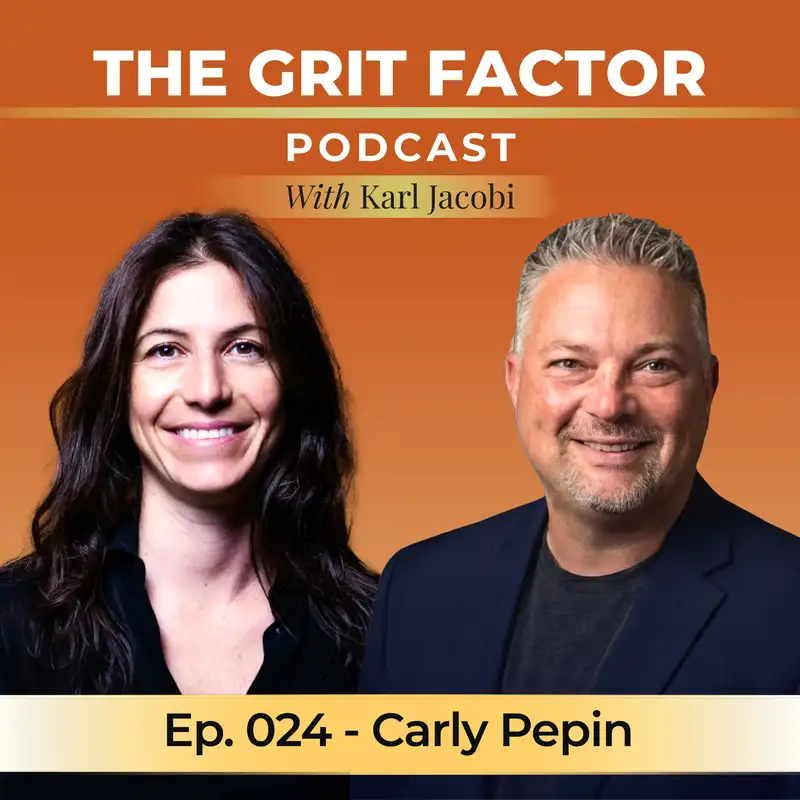
Episode 024: The Thirty-Five Dollar Co-Pay Wasn't Working. So She Bet on the Four Hundred Dollar Coach with Carly Pepin
TGFP_Audio_Ep24
00:00:00 Speaker: Average is the enemy of greatness. Comfort is the enemy of growth. Welcome to the Grit Factor podcast, where we strip away the highlight reel and get into the darkness beneath it. The real stories, the real battles, and the battle plans used to conquer them. I'm your host, Carl Jacobi, combat vet, entrepreneur, resilience and performance coach, keynote speaker, husband and father. I've built, scaled, and exited multiple companies totaling over forty million in revenue. But here's what that highlight reel doesn't show you. Life has been smacking me in the face with a two by four since I was just five years old. Broken home. Constant chaos. No playbook. No safety net. Just grit. And if you're anything like me. You know, you've got another level in you, in your business, your career, your faith, your leadership. You're just not sure how to get there. That's exactly why we're here. Be sure to follow me for more great content, and check out my website success with Karl dot com. Now that's Karl with a K. Now let's get to work. All right. Welcome back. Today I have another amazing guest. Yes, I say this quite a bit, I know, but bear with me because I strive to provide the best content, the best value, and just overall, the best impact on the show. So today is not going to be an exception to this. So with that being said, I have a human behavior specialist based in LA. In fact, we were just talking in a green room about a small world because I was born in Westlake. Those of you who don't know, and I spent some of my childhood in Newbury Park, Thousand Oaks area. So definitely some heart there. But she's also a founder and senior advisor at the West Coast Growth Advisors, where she partners with CEOs and founders, scaling her companies under the Scaling Up methodology, which we're going to learn more about. She's a certified DeMartini method facilitator. That's a mouthful. Anything more than one syllable I get tripped up on. But, uh, and everything. Disc authorized partner hosts her own podcast, Built for This, where she sits down with entrepreneurs who are growing companies without losing themselves in the process. Definitely resonate with this one. She's also founded Lake Arrowhead Rentals SoCal. Yogi, if I said that right. International speaker. And underneath all of that, credibility is a story that most people in our client book have never heard. So the story of a woman who stole or tried to fix her life by moving to the other side of the world, and we get to get a glimpse of it. So. Carly. Pippin. Pippin. Apologies. Welcome to the show. Thank you so much for having me, Carl. I really appreciate it. Thank you. Um, whenever I do my intros to I like when there's too many words, I stumble and I'm like, whatever. That's what it is. Yep. Anything more than one syllable? I'm ho. So with my last name. Yeah. I'm definitely a host. Yeah. And then all the things that we've never said before. And we're just doing it and we're like, okay. Yep. Exactly, exactly. Yes. So, Carly, thank you again for for joining me. I'm really looking forward to this conversation. And we only get to have an hour together. So let's get to this. So, Carly, take me back before any of this, right before West Coast Growth Advisors, before the certifications, before the coaching work that you're doing. Paint me the picture of this young Carly in LA. Um, what was life like? What was the thing that you could feel was wrong long before you could make or before you can name it? Um, yeah. Okay. So when I go back, I was like, what is this thing that was wrong? Before I could name it, I'm like, what was it? It's a great question, by the way. And I'm like, I'm not thinking about this. Okay. So yeah, when I, when I look back at my life, like way back when, it was definitely understanding my own values, I would say would be the thing that was really disconnected where, you know, you get stuck in your head with all the shoulds, the have do's, supposed to's, because I'm getting all this like advice from the outside world and drew me wrong. It's also can be great advice and it's things that really worked for someone else, but also they have a different value system. They function a different way. They even think differently. So my set of values, I see the world the way that I see the world because of what is meaningful and purposeful to me. And I didn't know that back then. And so I really struggled like internally finding my way. So there's a lot of noise, right? And yes, I would say that was a huge gap. And even just when I uncovered that, it really helped me in life, not just for myself, but relationships. And, um, you know, now in my business, it's, it's one of the staples that I utilize because it's just, I find it to be that valuable. Mhm. Agree, man, that that is gold right there. And we even got into the heart of the episode because there is a lot of noise out there. Right by the peanut gallery is what I call it, because everybody's got their. And to your point, I agree. There is some good advice out there. Um, some. Right. But you've got to look at the work they're doing. You got to look are there you know, is their input in alignment of your core values, your beliefs, your systems and your. And at the end of the day, where are you trying to go? You know, and have they done the work? You know, I, I seen the other day somebody talking about, uh, uh, what was it? Oh, uh, he was getting some energy drinks, you know, and I have my own beliefs about energy drinks. I don't think they're good for you. Um, you know, if that's something you want to do, you know, that's your your own peril, right? But don't have a cart full of Twinkies, you know, when you're saying this, right? And so yeah, as he's describing a story for me, I'm actually picturing this person right now with a shopping cart full of Twinkies, you know, talking to this dude who's extremely fit, um, you know, getting to energy drinks. I'm like, yeah, that that's ironic. So, Um, awesome. Well, you're in LA, right? You're you're grinding away. And from the outside there is always a version of your life that looks fine. And I think so many people can resonate with this. I know I can, because for so many years I could, you know, because I was grinding hard in my companies, you know, not just one, not just two, but several. In addition, trying to being a father, trying to be a husband and trying to be a general human being. Right. So for you, what does surface look like before the cracks are showing? Right? Because the story that everyone hears about, you know, especially in Australia and a breakthrough, I want to go before that, like what were some of the things that, uh, the cracks started to appear? Um, yeah, I think that main dynamic was what was it? Uh, am I trying to think? I definitely, I think I just one of those people where my my shit comes out. It just is what it is. It's all good. Uh, what did people think? Um, I had even working at companies, uh, I've reacted as an employee. I've reacted as a manager. I don't think that I was the best at hiding things. Let's just put it that way. Um, I really was not the best I it was obvious, like, I loved fashion and I don't think that people thought of me as well presented. And we're all constantly well put together and refined as a result. I think that they were like, she likes fashion, she likes to dress great, but you know, she's got some edge to her. Um, she can be a little rough around the edges. And when very challenged and asked to do things that I don't want to do, the biggest freak out was when, uh, I worked, I quit that company fast. It was when I was requested to create a false invoice for a quarter million dollars for a client, and I freaked out, man. Yeah. I don't blame you. At the office, I was screaming, uh, I did quit. So we were like, what was on the surface? I was like, I think I was kind of me. Uh, just. Yes. And I attribute that to my lovely parents who really raised me in a way that, um, they really challenged me and they didn't over support me too much. They really taught me like, you know, kind of get your shit together. Like they're like, I know you're having a hard time, but you have to get your shit together. It's not a choice. Like, this is just how life is. And we're going to push you really hard and we're going to freak out on you if you push us too far. And it was actually like a really great relationship. I have taken that out with me a little bit more, but I could see that that could be a little bit jarring. Sometimes I am who I am. I could definitely relate to that. Um, there have been some seasons of my life. Um, you know, I was told essentially the same thing. Hey, dude, get your shit together. Yeah, get your shit together. Yeah, that might be the title of this of this episode, by the way. Get your shit together. Get your shit together. I like that. Um, but, uh, that's so that's so true. You know, especially I, I don't know if you have any kids or if you're in a relationship or, uh, we didn't really dive into that. But for me, I think one of the biggest struggles as of late is being the type of parent who's not trying to always be the go to. Right. Uh, or the savior was. I guess what I'm trying to say is let them fall, let them get their lessons right. Let life, life them. Um, because at the end of the day, us parents, we're not going to be around forever, right? And, uh, my wife and I got into a conversation not too long ago, you know, talking about, you know, uh, giving them the things that they need. And in her mind, it was the financial aspect, right? The financial legacy. But, you know, in my belief, I think what's more important isn't just the financial aspect. It's the intangible soft skills that we have to develop and nurture through life. Right? Um, when two by four slaps us in the face by a relationship or a business struggle or somebody asks, you know, hey, I need you to forge an invoice for a quarter million dollars, you know, and you're like, uh, pardon me, I don't, I don't think that's a good idea. Right? Yeah, I don't either. That's not one I can condone. So, uh, if anybody asks those who are listening or watching, some may ask you to do that, um, please run far, far, far away. Um, and, you know, amazing. You did right. You ran away despite of the potential ramifications that occur because, my gosh, you know your employer sister and asks you, hey, um, Carly, I need you to do me a favor. Wink, wink. Right. And you're in that position like, well, how do I respond to this? You know, because that's your income. That's your livelihood. That's your right. Um, and you had the courage to say, uh, nope, I'm not doing it. So yeah, kudos to you. Kudos to you. Help me in that instance. Help me like what was going through your mind? I want to dive into that for a second now. What was going through your mind when you're you're being asked that. Other than saying, hey, you're just really caught off guard, I think it's just those situations that you're just you're very caught off guard. Um, it's just something that you don't think about that's going to occur in your day, right? You just don't think about it. And it became an argument. It just turned into an argument because it went back and forth. Um, and that's when I just, I, like I said, I was yelling, I totally freaked out in the office. Um, totally freaked out in the office. But it just it's one of those dynamics where you just don't expect it. So when you're sitting there, you kind of, I would say you don't really know what to think. You start acting and reacting, you know, and again, I think that's where we have unrealistic expectations on ourselves to not have reactions when we're put in challenging circumstances and situations. Um, so it's not that I'm not going to react, but like, I could be really sweet, very nice, very gentle, very kind. If you're supportive, I'm one of the, I was like a great, I genuinely was a great employee. I was like an entrepreneur within the company, right? Entrepreneur. But then yeah, entrepreneur. And so I was a great employee. I'm the wee girl. I'm rooting for the team. So but and I'm that I'm the best. I'm the best person for you. You love me. But then when you challenge me, I become the worst, right? So you just challenge something that's important to me. And the funny thing is, is like people are doing it all the time, right? Like it's actually people do it all the time. And in some places, it's like standard practice to take a little bit here and take a little bit there just based on my values and what's important to me, because I really value business, like business is definitely like linked to life purpose dynamic. And for me, for a business to stand the test of time, we want to do the best we can on the back end. And so these little things for me are not, it's not even about it's not even about like the morality of it. It's like your company is just not going to last. Everyone here is like not going to be able to work here in the future because something like this can like take your company down. Um, that's how much I love business. And I just think it's so important what people do because it's a service, it's a service. It's products that give other individuals something inspiring. Um, it gives jobs, you know. And so for me, it was like, how could you do this to like a business. Business is so important. And that was my personal internal dialogue where someone else will have a different internal dialogue because something else is important to them. You know, like, and so it's, it's interesting because it's fun to see. Um, it's fun to see. And, and especially as I get to work on human behavior now, I, especially with my clients and stuff like when they get things stolen from them and they're put in that position, it's interesting to see what their dialogue is. It's completely different than mine. They have a completely different perception. It triggered them in a completely different way. And it's quite fascinating to see how the human mind works so differently just based on what's important to you. So that's what's important to me. Yeah, yeah. That's awesome. I appreciate your intake or your take on that. Um, real quick, before we keep rolling, maybe life hit you hard. Business fell apart. Career isn't working out. Relationship ended. Health took a dive, and now you're standing in the rubble trying to figure out what the next move even looks like. Or maybe nothing blew up at all. On paper, you're winning. Sure, but on the inside, something's off. If you're not in crisis, you're at a crossroads. And the playbook that built the life you have is not the playbook that builds the one you want. Either way, you're stuck. Not broken. Stuck between who you were and who you're becoming. Most self-help just piles more weight on the load you're already carrying. I do not want to do that. I put together a free video series called the Grit Code Exposed, and I want to invite you to check it out. Seven short videos. That's it. The five laws that change everything for me in every client I coach. The same five that every person who's ever come back from the fire has walked through where they had a name for it or not. No fluff, no ninety minute webinar, no bait, just the free video series. You can start it tonight. Grab it at grit. Code exposed dot com one more time. Grit code exposed dot com. It's free. You don't need any more hustle. You need the next version and this is how you find it. Check it out. See if it speaks to you. And if it does, I'll see you inside. All right, let's get back to the conversation. I love geeking out on how the mind works and the brain works, especially in the season of life and the things that I'm doing. I'm always intrigued by how our brain works, you know, works for us and against this at the same time, you know, and I know we're going to dive more into, you know, more of the specifics of your work in the sense of, you know, what you do, because I'm really intrigued by this, but, uh, you know, for the person that's listening out there, that's, you know, navigating their own, um, response, right. Um, and that's something I'm often reminded by my, you know, my, my corner, my coaches and people that support me and I'm reminded of my clients is you can only focus on the controllables, right? Your thoughts, actions and beliefs, you know, and, uh, and yeah, to your point, nobody can, you know, be ready for a conversation right from the get go of, you know, that magnitude, you know, something that somebody doesn't just expect, you know, um, well, cool. Well, you know, walk me through was this before I think this was, you know, was leading or led up to your trip to Australia, right? Um, now, this wasn't a vacation. This was an actual decision. So. Take me to the day you bought the ticket. What was the specific moment that made you do it? Um, what were you telling yourself about what Australia would do for you? I just really wanted a transition. It's funny because I grew up in LA and I love the city now. It's one of my favorite places in the world, but I kind of had disconnected from it. Yeah. In the sense that like, um, I just felt like it was the root of my problems. I felt like I wasn't dating because I was meeting people from LA. I felt like, um, I wasn't able to like have the life that I want or work in the career that I want because everyone was like LA. I was also working. That was a different job. I was working in the fashion industry at the time and it was like fashion celebrity. And um, it was, I actually had like a great time, um, like a really great time. I was so much fun. I look back and I was like, that was one of the best jobs that I had. Uh, but like, I don't know, I just, I got so in my head, it was crazy. It was just so in my head. And so my solution was something must be better. I had visited Australia and it just felt kind of chill and sort of beachy vibes. And I am a little bit of like a SoCal like I just did this little beachy girls inside of me. One hundred percent. So he's very drawn to the eastern side of Australia by the coast. Uh, so yeah, it just became, that was the idea. It was like, I should just move there and see what life is like. Um, just went all out. I did, I did well, it was great because at the time, and I don't know if this is still available, but you could go for a year without having to have a job because I could work from home at the time, which was great. And so I could go for a year without having to have like a job and have a year visa. And I was like, what a great opportunity for me. And you had to do it before you were thirty. And I was twenty nine. So I was like, I could do this now, and I can't do it next year because next year I'll have to get a job and it'll be harder for me. The stuff that I did, I was like, it's like contract work, so I'm not going to get sponsorship. It wouldn't get me a visa. Um, and the only other way to do it was to like go do labor on a farm and stuff. And I'd already, you know, I'm already in like management positions and stuff. I didn't want to do that. Excuse me. Yeah. You're good. Yeah. It's like digression in a way, a regression. Yeah. So I didn't want to do that. So, um, that was it. That was like, now's now's the time. Now's the time. Yeah. Nice. Well, that takes a lot of courage, right? I mean, I'm seeing some, some trends of taking some courageous action because there's a lot of people in that situation that would always go towards the comfortable side, right? Instead of saying, you know what, you know, I need to do this before I'm thirty. I need to do it now or it's never going to happen. And, and I can resonate with this for a lot of things that I look back on, like, man, I wish I had done X right, I wish I had done this, or I wish I had visited like my wife and I, we used to live in Germany for a period of years when I was in the military. And, and, uh, we stayed there after, uh, I separated from the military and, uh, I was there as a civilian contractor for the military. And, uh, we had the opportunity to literally travel anywhere and everywhere with over a weekend, right? I mean, we could hop on a train and go to Italy, Spain. And we did do some travel. We didn't do enough, you know, and of course, we're young and, and young. I'll say that. Um, yeah. So, um, so, you know, if I'm understanding correctly, you know, you're inspiring people to say, you know, listen, you know, you may not be promised tomorrow. Do it now. Right? Do this now because you don't know what's going to happen tomorrow, next year, five years from now, when life is different, you're not going to have the same opportunities, you know? Absolutely. Yeah. Love it. All right. So walk me through this real quick. You land in Australia, right? The jet lag wears off. Weeks pass months. Uh, and the thing that you ran from start showing up again. When did you first start to feel it? Um, was it the moment you realized that the problem had followed you, or was it something different? You figured out pretty fast? Like it didn't take long. Uh, when you move to a new country, you don't know anyone, so you're not really distracted, and then you're working from home remotely, which people understand more now. But this is decades ago. So we're at home remotely and on a different time zone. So it wasn't even like I was communicating with my colleagues. Uh, so it was really different. Uh, so I just like I had one friend and he is, um, he's a marine engineer, so they work like five weeks on, five weeks off. And like a week after I landed, he had to go to work. So I just thought it was it, I was just alone. That was it. So when you're alone like that and you just have no distractions and, you know, I don't have the gyms, I don't have the places to go. Like you're not settled. It just happens so fast. So I actually almost left after the first month. I had a really hard time and a friend of mine encouraged me. She's like, just stay. She goes, just put out a couple months and stay. Um, and it was helpful though my friend, he, he got me into yoga, which, uh, he just introduced me to a great teacher that was all like, yoga sucks when you don't have a good teacher straight up, but when you have a great teacher, yeah, it just sucks. It's awful. Um, it's crap. You're going to get injured. It's just a bunch of it's just really crap. Um, but when you have like a really amazing teacher, yoga is amazing. It's really wonderful. And so he introduced me to someone there and I remember my I was having a really hard time still, but my car stalled. And I looked up at this like bulletin board and I was waiting for my friend, the yoga teacher, to give me a jumpstart. And when I looked up at the bulletin board, it just, it listed all these things like that someone helped with. It was the first time I had ever heard of a coach or seen that thing. And the thing that really struck me was like, she's like, I got to the other side, right? And I was like, huh, I'm gonna give her a call. So like, I take it cause I was like, I've talked to like therapists and all these people, but nobody's ever actually overcome this, you know? So I was like, how do you overcome this? And I signed up, you know, I took a risk. It was, yeah, it was crazy because it was four hundred dollars an hour, which like coming from only doing copays on therapy, like I'm used to spending thirty five dollars. Yeah. Oh, I know, trust me, I hear you. It was huge. It was a huge difference. Um, but when you have it not hard of a time, like you just you dive in. And she was genuinely like, amazing. Like it was phenomenal. And it was life changing. And she really helped me just turn things around and get really reconnected with myself. And I actually was getting transformations and shifts and results like, yeah, she was amazing. That's awesome. I appreciate your insight on this because you, I extracted a few things in what you said here that, you know, you're used to paying, you know, thirty, thirty five dollars co-pays for therapy sessions versus ten X that, you know, for coaching sessions, right? Um, which reminds me of something I consistently tell people with is like, okay, um, what are you going to show for the most? Are you going to show up for the thirty five dollars, you know, session? Or are you going to show up more for the four hundred dollars session or the one thousand dollars session? You know, and, um, I have yet to hear person say, well, I'm going to show up more for the thirty five dollars session because I'm going to get their money's worth, right? They're going to get their transformation. They're going to get every ounce of that squeeze right. Um, but you said you saw some transformation. Walk us through like what, what, what was being revealed in this transformation? Like what was, what was surprising to you? What was also not surprising to you? Like walk us through this journey of this transformation. Yeah. It shifted. It was different than anything that had been explained to me before. She was the first one who introduced me to values, and understanding my personal values is actually why I'm a DeMartini facilitator today, is it's the DeMartini values. I love it so much, which I have it on my website too. I have yeah, I have a link to John's stuff on my website. If you go check it out. Um, it's the values assessment, but it's a very clear indicator of what's truly meaningful for you. So she actually just started with that and we had a conversation about it. She helped me figure out what mine were. We kind of went through the tests, and then we made up a game plan about just living by them daily. And that already changed my life. Like it was phenomenal. Um, when I say it's, it's funny because he's done like a lot of cool stuff. John. I love John. He's a friend now, but he's in a lot of cool stuff. He's a cool dude. Uh, simultaneously is one of the coolest things he's done. Like, um, just that alone started to shift my anxiety and I had been taking like Xanax every day. But what I didn't realize is I just, I was anxious because I genuinely wasn't living my values. So here I go, and I'm starting to implement all this stuff. And, um, I got off anxiety meds. So after being on them for years, it was, uh, it was not difficult for me. And that was really wonderful. And that was really a special thing. And then she also helped me at the time with the eating disorder I had. And that was really cool because it just was a different approach. It wasn't like there was no food logs. There was no like going through all the things that you did and shaming ourselves for it. Like it was. It was pretty amazing. Like the approach though, it was a different coaching approach. And as a result, like, like I don't have to not have food in the house anymore. Like I don't have to worry about it. Before it was, I had to control the environment. So you would come over and people would laugh because they're like, you never have any food in the house. But I couldn't have food in the house where now it's like things spoil and go rotten. When I throw things away. I'm very grateful. Like sometimes people are like, I don't like to waste food. And I'm like, dude, I love having leftovers that I throw away. Because in the past, I just, I used to eat it all, you know, and I'm like, I love it so much. The first time I threw food away, I told her, um, I was like, I threw away food. It went bad in the fridge. And she's like, that's amazing. And I was like, thank you so much. Uh, it's a little thing like that that you don't realize how difficult it can be for, for people. So, um, Yeah, it was a different approach and I just I didn't have to be afraid of it anymore. She's she really helped me a lot. And that's why I started coaching actually, because I was like, I just remember sitting here and being like, you're getting paid for this. This is amazing. And you're learning and you're growing in the process. I was like, it's even helping you. And she's like, yeah, she's like, when I help you, it helps me. I was like, I want to do this. Yeah, that's that man. I want to put a pin in this for a second because you, you brought up some interesting points. Um, and thanks for sharing this, especially on, on the food wastage because as I'm here, I understand what you're saying, but I'm kind of cringing. I'm like, I'm the person who hates wasting things, right? Because, you know, I'm trying to be very conscious of, you know, being a good steward of, you know, our, our resources financially and everything else that we have in our possession. You know, and two, I think there's also still a mental imprint. You know, years ago when I was young, you know, when I lived, my mother. My parents were divorced when I was five, and during my time in the house with my mother, it was a very difficult time. Uh, tons of, you know, different types of abuse, not physically, but just emotionally, spiritually, um, you know, and so forth. But we hardly ever had food in the house, hardly ever. Um, and so I think that stuck with me for so long, you know, and, um, so I, I appreciate you bringing this up because a lot of people are like, is this girl crazy right now? Is she cray cray? AM a little bit. Aren't we all? I mean, we can't be normal. There's we are, you know, we've got if you're normal, you're probably not being yourself. So yeah, let's get that out there. Yes, yes. Love it. Agree. I, I, every person I talk to, um, you know, there's something that comes up about normal. I'm like, no, no, no, you got to be your true authentic self. That's what the world needs, right? Um, but let's kind of go back to what you were saying just a moment ago, because it it sounded like it inspired you to go down this road that you're living in now, right? You know, helping other people coaching and so forth, which I can resonate. Um, it just took me a lot longer to realize this is what I was made for, right? This is, you know, I had to go through this fires I had to go through seasons to so that I can impact other corals have also been through similar things and, and so forth. Um, but I think a lot of people need to understand about what you said. It helps both of you is we grow both ways, right? A lot of people think it's only a one way transaction when we, you know, do the things that we do, but it actually goes both ways. Like we grow up when we're working with people, but it also fills our cup, right? It gives us us that fulfillment Knowing that we're doing what we're called to do, right? What are your thoughts on that? Yeah, it's definitely it's definitely really fulfilling. It's also really challenging. You know, it's a, it's a little bit of both because there's that dynamic where, you know, I was like, okay, now I want to be a coach. And obviously I was like, where did you get certified and where she got certified? It was twenty five thousand plus a trip to Scotland. Um, and I was living in Australia. So for anyone who has ever looked up a flight from Australia to Scotland, that's like forty hours. Um, so I did it right. So I figured out how to get the cash, which was not easy. It was really difficult. And then I had to go all the way to Scotland for the first week. And then um, it was great though. Like, I'm really grateful I had that opportunity to do the in person sort of intensive. And then you have like a year long program where you talk to them and they, they work with you. So it was really, it was really fascinating. And it was very hard. Like it was very, very hard because now all of a sudden you're building a business. And it was difficult, like it was genuinely difficult. And, um, the woman I was first working with, we're actually friends now, so referred to as my friend. So my friend, she, um, she had started in a gym and it was easy for her to connect with people and meet people because she was also a fitness trainer before. I don't have any of that stuff. You know, sometimes people start and it just like kind of translates into these various dynamics. I don't, I don't have that. And so because I don't have that, like, I just am genuinely starting a business from scratch. Scratch. Yeah. And so when I say it was hard, I mean, it was really hard. I didn't know about marketing. I didn't know about networking. I didn't know about any of this stuff. So it took me a while to figure out how to do it. But when you're doing things that you really love, like, um, you, you spend the time to actually make it happen. Like you really do spend the time. Yeah. Yeah. And then simultaneously, like once I got, like my coach said, because I was having such a hard time, they're like, we got to just get you started too, though. So they're like at one of the networking groups, give away something, give away like a session just to get you started so you could get a feel for it because they really wanted to make sure like they're like, is she really like it? Is that why she's not getting clients? And then I did it and I was like, okay, I love this. Um, I was like, I love the coach. I was like, I do like this, all right. I was like, I love it. Um, how do I do more? Right? And so yeah, I know that feeling. Yeah. But I'm glad they did. I'm really glad they did that. Um, because it pushed me to make sure that I was inspired by what I did. So it took me a while to get there. And in the meantime, I just got creative and, um, there were yeah, definitely times. I remember one time I actually, I just wanted to work so bad and get more work under my belt. I started doing donations. Some of the donations I got were hysterical, but also I was like really loving just Working. I just really loved working and I just I really appreciate it so much. One of my clients, she was a photographer. She gave me a really beautiful photo. I still have it. And that was her donation. Um, but I still have it because I was like, she knew I loved photography, she knew I loved animals and she's this beautiful photo and I still have it in my office because it's like, it's really special. Um, so even though, yeah, it was like kind of a weird beginning before I actually started to get paid, paid. I got paid in some pretty cool ways. And that was a special one. Yeah. That keeps you going though, right? I mean, yes, the, the, the, the little certificates of appreciation aka dollar bills. Those help. Right? We gotta have those. But aside from that, you know, giving gifts from the heart. Yeah. You know, like the, you know, picture that you got that right there is probably what energizes you more to keep doing what you're doing because that's, that's hard, right? I mean, that's gifts from the heart. That's people giving you something that you just can't buy off of, you know, shelf anywhere else, you know? Yeah. Um, and I want to go back for a second because you said something. I want every person that's listening or watching to take note of because I heard a clue in here that gave an indication that this was really, really important. So you found a way to do it. And what I meant by that is you said this, you, you, you had to invest like twenty grand or twenty five K or something like that. Plus travel plus, plus plus. Right? I ran into a lot of people, when they hear the price tag, they, you immediately look in their bank account like, ah, and they disqualify themselves, right? Mhm. And you know, for, and I'm reminded of a story, I don't know if you know who Myron Goldman is, but, uh, you know, Myron rep. I say rep street. Um, I don't take that literally. He spoke by an hour and a half north of me in Tampa. Uh, but Myron Golden, uh, told this story. I think it was Myron. Uh, I'll give him credit for it. If it's not, I apologize, but he told this story where he went to this. He was talking to a potential client, or he was somebody he was talking to. Uh, he gave the analogy of a fifty thousand dollars Mercedes. Right. He was looking at Mercedes. This was back. You know, when they're fifty grand, they're no longer fifty grand. You need to add a one to that. Um, but, uh, you know, the salesman that told him it was fifty grand, he was like, wow, man, I just don't know. Then the guy said, well, you know, if if somebody had kidnapped your daughter, you know, would you still hesitate or would you do everything you could to get that fifty K to, to do, you know, to for the ransom? You'd figure it out. Yeah. You'll figure it out. Right? And that begs the question. Or not really the question, the belief that if your mind is focused, as I like to hear your thoughts on this. because this is something I've really been driving. Driving a point on is whatever you focus on will flourish, right? If you're focusing more on solutions, guess what? You're going to find solutions. You're going to find opportunities. However, conversely, if you're looking for ways of how it's not going to work or why it shouldn't work, guess what? That too shall appear. Right. What are your I mean, what are your beliefs or what do you have to say on it? Yeah. Um, I think it's wisdom to just look at both sides, like, because there's ways that things aren't going to work, you know, but that also wakes us up to the reality like that. There's challenges that come with these dynamics and there's challenges that come with like the investment, right? So I could look at how it's not going to work, but that also gets me realistic with like, okay, I'm taking this flight. Okay. I'm going to be in Scotland. Okay. Like I still am. Like, I'm not taking time off from work. I'm working from home at the time. Like, how am I going to do that? So if I look at all the ways it's not going to work, I actually prepare myself for the challenges that are going to come. And then I see like, what does that look like? How does this how does this, how does this function for me? Can I actually come up with solutions? And I could write, I could. So I was like, all right, well, let me move forward. Um, I didn't understand business enough to understand like how challenging it would be to start the business, but that's fine. That came later. You'll learn. Yeah, I learned that. I learned that through experience. But, you know, you can't figure out everything beforehand. But at least I shared enough with all these different things that when I got the challenge, this is what I like to do. It is I'll prepare enough for that. I know, so that when what I don't know comes, like I don't have to be struggling with all the things that I already know. So that's actually I, I like to look at the things in the downsides of what I'm doing, the challenges. Um, and then there's the other dynamic of just the meaning it has to me and like, how much meaning does this thing have for me? And so whenever I invest in something, it's because the meaning that it has for me is valuable, like it's meaningful. And so like, if you look at how I spend my money, right, it's going to be different than how someone else spends their money and even my time, but I spend it on things that are meaningful to me, right? And so yeah, it's like with the coaching, that was something that was meaningful to me. I just had gotten such great experiences with it. And I knew that investing another year with her teachers who, you know, were more advanced and stuff, like I'd get a lot more. And it was great because I don't really use their methods to the same degree as they didn't. They had some big gaps. Big gaps, really love them. They're fun, but they just had some major gaps which got filled in later, which was great. But when it got filled in, it was like, oh my God, is this such a relief? This was the missing piece. So it's really grateful when I got that. Um, but yeah, it was like even I couldn't, I couldn't be an expert in what I was today without them drilling me on some of these base components, which was awesome. Right. So I basically paid that to get this foundation that made me more masterful at what I do today. Like I have that because of that, which was cool. So you see all these like stepping stones that you take. But again, it's like, what is the meaning to you? Yeah. And so we'll invest in things that are just massively meaningful. And I like to ask that question, like, what is this going to give me? Sometimes it gives you a financial ROI, right? Which is easier to. Yeah, it's easier to look at and evaluate. But if it's not giving you a financial ROI, what is the ROI it's giving you? And how does that actually serve you? And you see it. It's funny because it's like chiropractic. I love, I work with a lot of chiropractors too. Like it just is what they really love personal development and the mind body connection. So I think with coaching, you tend to attract a lot of that, but it's fun because even them, yeah, they're awesome. They're awesome. My page. My target market. Now after this, I love chiropractors. I love chiropractors so much. They're so fun. Um, they're very, they're very, they have a lot of wisdom as well. And again, they just really like that dynamic. But it's cool because if you look at the, uh, this, this personal development component, when they're doing adjustments, like chiropractors aren't selling you an adjustment, you get an adjustment, you can feel better, but most people don't actually care about their physical body. They care about what they can do with it, you know? So it's like, yeah, it's like, okay, you're coming in because you want to be able to hold your child. You want to be able to pick them up without being in back pain. Like you want to be able to swing them around. Like that's why you're actually getting the adjustment. You're not getting it, you're not really getting it because you care about your body. And there's nothing wrong with that. Not everyone cares about it. Not everyone's like some crazy elite athlete. We all don't have that value. But you place the meaning on what's important to you. So you'll go to a chiropractor, not because you're an elite athlete and you need to take care of your body. And you think about that stuff. You're going because you want to hold your kid. You know you're going because you want to go, you know, for a hike with your partner. You're going because you're going to Italy and you can't walk right now. And you know, if you get the adjustment by the time next year you go to Italy, you'll be able to walk around Rome, right? So it has nothing to do with the actual chiropractic. So that's why I say it's like when you're investing in something like what is the real meaning behind it, especially these larger investments? And is it actually something that's meaningful to you? Because if it if it is, it's worth it, you know, and if it's not, don't do it. You don't have to. Nobody has to. Yeah, yeah, that's a good point. I agree one hundred percent. Yeah. And that's the at the end of the day, you have to look at the, the impact of that investment financially or the pain that you're trying to solve. Right. And, uh, in this season, I've been, you know, investing in a wide variety of things, you know, for my own health, I've invested and coaches to help me, you know, on a on a fitness side, health and fitness side, I've got a personal development coach who keeps me, you know, sharp and build my, you know, build the things that I'm building. And plus, you know, personally to write to build up my mind. And because as the, as the phrase goes, new levels, new devils, right? Um, you know, uh, having people in your corner, whether it's a coach, a mentor or anything of that nature, having people to keep you growth oriented, keeping you focused on your priorities and the things you want to achieve, especially when there's so much noise out there, especially today, you know, is really important to do this. So let's fast forward a little bit because I really want to dive some of this. I want to nerd out for a little bit. I call this nerding out because this is an area that intrigues me so much. Um, you know, you refer to this DeMartini method. And this is something I that I dive into with my own clients in the sense of core values and going through that assessment, you know, and it's and I think what trips people up is they feel like they have to find their core values. And it's like, no, you're not necessarily finding them. They're already there. Yep. Right. So, you know, you use this DeMartini method with clients. And so for the person who's never heard of it, I know I never heard of it until just, you know, I was going through your bio. I'm like DeMartini. I actually know somebody by last name of DeMartini. Coincidentally, he's in Spain. I used to work with him overseas. Probably not the same dude. Um, but for the person who's never heard of it, give him the sixty seven sixty second rundown of this. What is it? You know, what does it do? Uh, you know, what is, you know, just walk us through that. Yeah. Um, so it is a tool to help us transform our perceptions. So anything that we're going through that is in the way becomes on the way. Uh, So, you know, whatever struggle, whatever challenge, whatever has occurred. You don't have to be upset about it anymore. You don't have to be angry. It doesn't have to take up. I call it valuable real estate in your mind that nobody's paying you rent for. Right. Um, so it's yeah, letting go of these things and actually coming to gratitude for it. And gratitude is not I forgive you if you forgive them, you're not grateful. Um, so it's actually be going beyond forgiveness and saying, I actually don't need to forgive you. I love you, I genuinely love and appreciate you for challenging me in this form. And it's interesting because it goes from, you know, little arguments and fights to extreme circumstances. Yeah. So I had like a sexual experience when I was a kid with my best friend's dad. Right. It happened that way. And so I did this process on that. And now I don't need to forgive him for it. I don't need to be angry for it. I'm actually really grateful it occurred. It was wild because after you go through it, we laugh because he's like, people are going to think you're crazy because you're going to go out and you say, I'm grateful for this experience. And I'm like, but I really am, so I don't want to lie about it. Yeah, I really am grateful. Um, I love and appreciate him for the life that he's given me today based off of the challenge that I had in the past, and I wouldn't be who I was today without that experience. And the DeMartini method gets into all the very meticulous details of what that looks like so that there's no more trauma. Um, and I really appreciate that. Yeah. So I love that. And after having such profound experiences with it myself, it was like, I just, I just don't want to not do this for others. I can't imagine like not giving this to the people that I work with, you know? That's so good. I, yeah, I appreciate you, you know, one, you know, being vulnerable and sharing some, you know, of that story with us. Uh, I think there are a lot of people, especially the women that can resonate with you and what you just, you know, very briefly shared. And, uh, I think a lot of people that are hearing you right now, they're like, okay, that sounds all well and good, but lady, you're cray cray. Yeah. You know, that's okay. You don't ever have to talk to me. Then I really don't care. Nobody's gonna change and take away that gratitude. I don't care what anyone says. I'm fucking grateful. And when people get upset with me, I'm like, you do what you need to do. If you need to be angry and you need to be upset, you do you, but you're not taking this away from me. This was like freedom. Yeah. No, there is freedom, right? Because that's why I want to dive into for a moment, because that person is sticking this right now. They're not thinking about the other side of this. The mental, the freedom of energy, the freedom, the freedom of the real estate. So good that you're expanding. And when you're saying forgiveness, this is something I learned, um, last year, year before, uh, through a church that, uh, it's called a freedom series or freedom conference, whatever. Um, you know, forgiveness isn't that you're letting someone off the hook or any of that. You're releasing them, right? You're releasing the emotion, you're releasing the real estate and everything that is charged behind that event. So you can move on. You're not letting them off the hook. You're moving on. You're, you know, freeing that space up. And I could just hear it in your voice. I could just hear it in you that you have truly freed that real real estate up. And I think so many people need to hear this because there are a lot of people out there experiencing their own versions of some type of trauma, either, you know, similar to what you experienced, or maybe they experienced it in, you know, their business. Or maybe, you know, I'm prior military, you know, several combat deployments. There are a lot of veterans out there that need to hear this, right? And whether you fall in those categories or not, they need to hear this because staying mentally charged and keeping those emotions does nobody any good. It's like lighting somebody else on fire. Right. Or lighting yourself on fire and having them try and experience the pain. That was the way it was. They're not there. Right. Yeah. We never see them again. And that's that's why I say like this. Nothing is like me saying, um. I'm not. I'm not even mad. I'm not mad at him at all. So me saying that, like, I, I'm not ever gonna see him again. I actually don't even know if he's alive. I have no clue. Never. I haven't seen this man since I was like, seven years old. So it's like, and but he's in my life and in my head and I'm sitting here and I'm confused and frustrated, and it's impacting my nervous system. And it's like, so it's the work is never about the other person. We use the other person because they're involved. So we want to help you get to the other side. And I'll utilize them because they're involved in the situation. But we're getting to gratitude for you, you know, for you. And it's interesting because I would say the very visceral physical effect it had, like, I have two great examples is, um, before I did this, it was I was doing a private yoga session with my teacher and I had never done one before. I'd just been like too scared, which was really weird. And I couldn't figure out why I was scared. I was like, you go to all these classes like, why are you scared? You know? And so I was like, fuck it, I'm just gonna do it. So I show up and I do it. Yeah. And I was like, fuck it. And it's a yoga. It's a private yoga class. Like, what is the big deal? Yeah. And so in between every posture, I would get in a posture I love, I love him, he's amazing. He's so good. And he would go through all the details and I would be fine. Then I'd get out of the posture and I start crying and I was like, Chad, I don't know what's happening. I cannot stop crying. But Chad being Chad and you know, he's an actual yoga Yogi. Um, he's like, let's just keep working through it and we'll get in a posture, and then I'd get out and I'd cry, and we'd get into posture and get out and cry, and I'd be like, this is the weirdest thing I've ever experienced. I said, I don't even know what's happening. And I couldn't control it. And I had no idea. The other thing that was interesting was like, when I had first met John John DeMartini, I couldn't talk to him like I was shaky and I couldn't figure out why. I was like, why am I like shaking? The guy's like really down to earth, by the way. Like he's a super chill dude. So I was like, why am I all shaky? But I would shake and my voice would get really low and I couldn't talk to him. And I was like, this is so weird. And I didn't understand it. So then after I did the process on this, I can be alone with my yoga teacher all day, any day now. He's the best I could do it. There's no more tears. There's no more shaking of the body. It's gone. Um, he's a friend, right? It just is what it is now. And then, even with John, um, all that's gone, John is genuinely now, like a friend. Like, um, he tried to come to my wedding, but he couldn't get back for his appointment in Spain fast enough. So he came on like video and he was like live streaming with his daughter, like at my wedding. That's awesome. I know here you go from like, not being able to like hang out with these people to like, they're like genuinely friends now and all because I did that process and that my nervous system got out of fight or flight because any person that even remotely reminded me of that individual, whether it be that they had the same eye color, whether it be they had the same hair, they were around the same age, you know, and there was different variables that each of these mentors and friends of mine had that reminded me of them. And so I couldn't actually connect with them. And to think of the amount of people in the world that had that, that I've avoided up until that point is phenomenal. So when I like when we talk about like working to get to the other side, there are things that we can't even see that our subconscious is protecting us from and keeping us safe, that our amygdala goes into this fight or flight dynamic. So when I say it was freedom, I genuinely mean like this freed up a significant quantity of experiences in my life. And I would not be able to do business coaching today without getting to the other side of this, because I can't be in a room full of men by myself without like with having this trigger in charge. There's no way. There's no way. Yeah. And so that's when I think about it. That's the investment that I make in myself. Like that's why I love what I do. You know, it's genuinely why I love what I do. And you see it with other people too. When you get to give that to someone else, like it's life changing. Yeah it is, I agree and it's life changing on both spectrums, right? And you remind me as you're talking through this, I'd love to hear your take on this, but the body truly does keep score of the things you go through, right? There's a book even entitled I don't remember the author's name off the top of my head. Um, but your body does keep score of all the things that you go through. And we just, we just don't think of it. Right. Um, and honestly, I didn't think of it for well, up until like a year or two ago. Um, you know, processing through some of the trauma I've been through as a child and military and other events that I've had in, in my life. And, um, your body does truly keep score, you know, and this explains why, you know, we're, for example, you're talking about the different poses and it's like, what on earth is going on here? Because it's like I'm this little baby in a certain pose and. Right. And, uh, you know, there was a viral video, uh, I don't remember her name, Leann Rimes or something of that nature where, you know, she was going through, you know, some Poses and doing some types of movements, and she was just uncontrollable crying, you know, things that she had to process through and stuff. And it's like, yeah, um, you can see the freedom that, uh, that transpires right there. So real quick before you go, if you're still with me this deep into the episode, something in it hits you. Maybe it was the guest, maybe it was one line. Either way, you're still here. And that feeling in your chest right now, that's the signal. Most people get a signal like that and do absolutely nothing with it. They close the app. Life rushes back in the moments gone. Six months later, there are the exact same spot. I don't want that for you. So I put something together. I want to invite you to check out a free video series called The Grit Code Exposed. Seven short videos. The five laws I walk every client through the same ones that rebuilt me when everything else fell apart. And if you listen closely, you heard them running underneath the entire conversation because everyone who's come back from the fire walks through these five laws. Some find them on their own, some get help, but the laws don't change. Free video series. You can start it tonight. No fluff. No ninety minute webinar. Just the series. If you're going to do something with what you heard today, do this before life talks you out of it. Go to grit Code exposed dot com one more time. Grit code exposed dot com. And hey, before I let you go, thank you for riding with me this long. It means a lot more than you know. Thank you. Let's fast forward a little bit because we do only have an hour, Fortunately. Um, you know, because I feel like we could talk so long about this, right. Um, so let's fast forward a little bit because I, you know, I want the person, uh, that are sitting in front of you, either listening to you right now, you know, you're an international speaker, your, your consulting with CEOs and founders on scaling, you're hosting, you're built for this podcast, all these different things, right? Um, what, you know, what is the work you actually do today? What rooms are you in? Who are you serving? What is the scale of the mission right now you're involved with? Yeah. So that one is, you know, my, my goal with the company is I really want to help people bring their vision to life, right? So that's the mission of West Coast Growth Advisors to bring your vision to life so that you can actually have a physical experience of it and continue to expand on it. So the way that that's broken down, there's definitely going to be personal development with me. You just can't avoid it. It is what it is. I love it too much. So so I know sometimes when you're in a business engagement, they don't do that. But and maybe they have a different personal development coach with me, it's part of the package. You don't like it. Don't hire me. Just don't do it. I get it. Yeah. That's a really bad idea. Yeah. Bad idea to hire me if you don't want to do it. And also if you don't want your employees to engage in it. Because no matter what we're doing, we're going to have this conversation. So when I think about the business side, you know, what I realized at a certain point is we can do so much with the mindset, but then there would be things that we would get stuck in, like in the business strategy. So I'd get off a call and then we'd work through whatever internal stuff, but then the business wasn't coming in fruition. And then when I would look, I would be like, we're actually getting stuck in like the strategy. There's a culture issue. So it was a lot of like really technical stuff and operational stuff. And so that's why I was like, all right, it's time for me to like dive in and do those dynamics. So now that looks like in-person meetings, like we go and we have the quarterly meetings where we do like two to three days on site or off site, lots of offsite too, because that's really nice for, for people to just get out of the office and the leadership team to have a different perspective. And we actually do deep dives into what's going on in the business. What's their main focus for the quarter? What do we need to like look at like, are we focusing on culture? Do you guys have your values set? How are you incorporating them and really getting everything put in place? And it just, it's a lot of stuff. Like it takes a long time to get a business to that organization and structure and then get it to grow, like really grow. And as you grow, we focus on the growing pains and we work on strategy operations. We're making sure cash flows are a really big thing. Like we really want to make sure cash flow is healthy, right? So that you can scale and that you can grow. So that's a huge dynamic too, and making sure all that's happening as you grow the business. And then simultaneously, like I said, the personal development is, is just going to happen. Like you want it to or not. Doubts and insecurities and personal challenges that are distracting you. Whatever it may be, whether it be as small as like, I just can't focus because like, I'm really struggling at home with my wife or my husband. And it's like, well, let's work on that. Let's, let's get some relief on that. So you could focus because you're in a sprint right now. You know, little things like that and just getting that vision alive. Like I want them to experience it. Love it. I, I'm glad you brought that up because I think what a lot of people don't really realize is when you level up, right, when you're, when you're in scaling mode, there, there is another layer of demons that you have to battle with, right? There's a layer of beliefs. There's, there's so many different things that what worked at that point, right? What worked up to, you know, up to this point or just before that is not going to work at this next level, right? What got you here is not going to get you. There is the common phrase we hear, right? Um, Carly, you said this, you know, you know, many times, right? Uh, in different ways. Every person, regardless of background or resume, is held back by their own interpretation of themselves, which, uh, I can deeply resonate with if the audience only walks away with one teaching from your entire body of work, what is the message you want them to walk away with or carry? Um, say it the way you would say it in the rooms that you're in. Yeah, you spot it, you got it. Uh, it's as simple as that. Whatever you see on the outside, you have on the inside and it's the things that you admire, but it's also the things that really piss you off. Like, um, we deflect the things that piss us off because we don't love that part of ourselves. And that's part of our own journey. And work is actually to love those parts of ourselves. But then those parts of ourselves that you're also deflecting or the things that you admire on the outside? You know, if you think someone's a great speaker, it's like you're a great speaker, too. You're just not identifying where you do it. You know, everyone's a great speaker when they talk about things in their value system. If I talk about things, something that's. Yeah, when I talk about something that's meaningful to you, you will not shut up. Right? That's just my goal is like, let me you'll interrupt me. You'll keep changing the subject to it. You don't want to shut up. And if you talk to someone like, like someone talks to you about something that's not meaningful, like you just don't know what to say. Like you sit there and you become an introvert. So you it's this goes to anything that you see in the world, anything. So yeah, whatever it is, you spot it, you got it. And work on your pride's, work on your shames and just go out there and be yourself in the world. You don't have to be anyone else. Everyone else is taken. I think that was Emerson is everyone else is taken, right? Just be yourself. Because yeah, I think it was Emerson is a good one from him. Mhm. Yep. Uh, a funny way I like to say this, um, we have, uh, kids and, uh, this movie that came out a long time ago, B, I think it's B movie, uh, Seinfeld's in it and a few other well-known actors, but throughout the movie, he would, uh, this little B was like, just be yourself, right? So every time I say it, that's all that's the it comes out that way, right? Right. Yes, exactly. Yeah. Yep. Yeah. I have nieces and. Yeah. Yeah. It changes the game. It does. Yeah it does certainly for sure. Oh my gosh. Yeah. Well when I, when I initially reached out to you, as we start to wrap up, uh, when I reached out to you initially, I used a phrase, I think it captures what you're really building. And I think what really encapsulates your work. Right. Um, and this is something I can deeply appreciate because I've been there and it's something I still, you know, navigate here and there, you know, ensuring your business fuels your life, right? Rather than draining it. That's it, isn't it? I mean, at the end of the day, you know, that's the whole game for founders and people that you coach or CEOs that you coach. Yeah. Awesome. So what does it actually look like in practice for someone that's reading this or listening to this and in their business that's currently draining them? Um, there's things that you're doing that it's time to delegate. There's genuinely like, you're not meant to do everything in a company. And so if something's exhausting you, draining you, it's probably something that it's wise to delegate. So taking a look at that and taking that off your plate. There's also the dynamic of the businesses draining you. Like, I don't know what it looks like, but maybe it's overwhelming. Maybe you can't get your employees to like get back on track. Maybe, um, I don't know what's happening, but there's also probably going to be a problem or a challenge that requires solving. And there's the double fold component with that. Like, and this is I actually use personal development to. Figure out like what the roadblock is. So I asked questions to see like why this is occurring. And once you figure out why it's occurring on the greater, grander scheme and you become grateful for it, like grateful enough that you're like, wow, I'm actually really grateful this is happening right now. Like without this, this could be a bigger problem. So when I can get someone to their, the funny thing is, is like, I'm like, okay, now that you're grateful, now we'll solve it because now we have the answers that we needed. So I utilize the personal development to figure out what the roadblock is. And then you put in a strategy to solve it. Like I was just working with someone and their roadblock is their management team. Once the management team gets to management, all of a sudden they're starting to slack at these various like locations. And so when we looked at it, there's not enough in the standard operating procedure, and there's not enough in the employee guidelines for the management team to be able to make sure that they understand the roles and the tasks that they are required to do on a daily basis. And because they get paid on commission, they're making so much money that they start to just slack off, you know, not realizing like, these are the rules. And if you don't follow them, you're out within this time frame. And that's a big chunk of cash to lose. So he's, he's basically we worked on what was going on, why the problem was there, made him feel better about it. And now he's energized again. He went from being really drained to like, he's energized. He knows how to solve the problem. And now he's putting things in place and excited to go. You know, we're we get really drained when we can't see an outcome to a problem, we get so drained. I get so drained. It's probably like one of my most challenging personal qualities is like when I can't see the other side, I'm like, oh my God, this is so hard. Yeah, that's what feels hard to me. So like seeing that other side is what I love to give to people. Yeah, I, I struggle with the most personally. I think a lot of people do more than I care to admit, to be honest with you. Yes. You know what I heard there? And I want to bring this to this. I want to put a spotlight on this. You teach them how to ask the better questions, right? Yeah. You know, ask the questions to get the better answers instead of being, you know, instead of the, the victim mindset type of question is more of the victor type of questions. All right. What can I learn from this? What is the opportunity that I need to learn so that I can grow to the next level? And that was, you know, why is this happening? Why is the world against me? Why, why, why why why? Right? You gotta start learning how to ask better questions. Even that dynamic of like, I need to protect myself, I need to do this or that. I had a client. He had, he, he literally had ten million dollars stolen from him, you know, but what was wild is like when we went and we got to gratitude for it. Now he will tell you that was one of the best things that ever happened to me in my life. Um, it brought his business to the trajectory and the place that he wanted to go and ensured that he. He didn't want to retire, but he was subordinating to all these other people that said you should retire, but he actually doesn't want to retire. So now he's building the business the way he wanted to build it. He's scaling it the way he wanted to scale it. And he's thinking about like, after this one is done because he knows that this one he wants to sell is like, what are my next steps in life? Because I don't want to retire. You know, so he can sit there and he said it was a, it was a ten million dollar thing that saved my life, you know? And so it's like, you don't have to be the victim. If you see why it's there, like, then you can move forward into the, the action that you're meant to take, not the thing that you thought it should be or supposed to be. And we have big lessons in life, you know, we all have big lessons in life and it may not be ten million dollars for you, but there's things out there. Every person on this planet has something that felt like that ten million dollars, like challenge every person. And when you find the meaning, there's things that amazing on the other side Agree wholeheartedly. You know, what you just said right there? Reminded me of an episode I did a couple about a week ago, actually. Um, Barbie Engel, she's, uh, running for political office in in, uh, Arizona. She she gave the reference what you just reminded me of, of, you know, she doesn't pay attention. You know, boulders are dropped, you know, these lessons, right? Um, so it taught her to pay attention more of the pebbles, the little lessons, so she can avoid as many of the boulders as she could potentially avoid. Um, and, uh, I agree with you. Uh, we do have to take these as like, okay, what is, what is it that I need to take from this situation? You know, what is it that the universe or God or the creator trying to guide me in this decision or in this opportunity? Because obviously I'm not supposed to go in that direction, right? It wasn't ten million, but I definitely have had a significant amount of money in the six figure range stolen from me nearly bankrupted me. And, you know, people that were dear to me, and it did change the whole trajectory of my life. But had that not happened, I would not be doing what I'm doing right now. It wouldn't have like, we thank the person. It's like, did you thank him yet? Probably not. No, I haven't, so I'm not going to say it by name, but I am going to take this opportunity. And I know he's probably going to be listening to this podcast, this episode. So unlike what you just said, my dude, I thank you for doing what you did. I do thank you for that because thousands, tens of thousands, hundreds of thousands of lives are going to be changed because of the stunt you pulled. So, um, so thank you. You know, I appreciate that. And the challengers are the catalyst. Yep. Agree. Uh, man, that. This was good. This was good. Carly. Uh, you know, we're all right, so let's give some, uh, get some wrap up here, because I know we could talk for a while here on this, but, uh, for, for the person that's listening or watching, um, you know, who is running a company, they feel they're the bottleneck. Um, where do you want them to go? Like they hear what you're saying. Like, I, I need a, I need to call this lady or I need a, I need to, I need to get in touch with her. Where can they find you? Yeah. Website West coast growth advisors dot com. Um, you just contact me directly. You go on LinkedIn, contact me directly. And those are the best ways because email is so special. So sometimes email doesn't always come through, but LinkedIn is reliable and the website contact form is incredibly reliable. Oh, that's so amazing. Yeah, I, I, I'm with you there. Uh, me personally, I've gotten to the point I, I do, I despise emails. I have an assistant who just, if there's something important that she can't handle, she lets me know, but I. It drains me. It really does. I, I love doing you delegated it, which is great. Yes, I love doing this. I love having conversations. I love pouring into people. I love helping people win. Um, and, uh, doing some of the stuff that, uh, that we do. So. All right. Well, let's, let's start to wrap this up. I'm going to go through some rapid fire things. Um, because, uh, you know, I love to hear your insight on some of this in the season of life. Cali, what is your definition of grit? Uh, what is my definition of grit? I think grit is a very natural thing that we all have and really comes forward when we're pursuing meaningful things. Yeah. Agree. Love that answer. I don't know if you can resonate with this, but in a season of life I'm in, I'm focused on something that doesn't require necessarily addition. What I mean by that is you hear all this talk about adding systems, adding SOPs, adding strategies. Adding. Adding. Adding. Adding. Adding. But for me, I'm more focused on what can I subtract? Because growth also requires subtraction. It could be a belief, it could be something you had to unlearn or unbelieve or some type of friction you had to to remove so you can level up. So for you in your life in this season, maybe what your season in you're in now, or maybe a previous season, what if something or something you're currently doing to remove so that you can level up? Yeah, just taking a look at like the things that I no longer require, no longer need things maybe I've grown out of. Um, it's been, that's been the season of what is really what is really meaningful to me. How do I really want to live my life? Um, I lost a, I lost a family member last year. Um, my dad, so he's really, we were really close. So it just really made me reflect on life. Like, what do I like? I, I could work, I could do all this stuff, but like, am I certain that I have all these little bits and pieces of everything I want? And so it's been a real refinement stage. So yeah, that's been really helpful. Love it. Thanks for sharing it. All right. So the last two questions. The last question is a two part, uh, both of these were questions that I prepared you for in the green room before I hit the record. Uh, so when you're in the trenches, when you're going through the thick of it, you're could be a dark moment season or something. What is a quote or directive that you tell yourself to pull yourself through that moment? Yeah. Um, there's two things I like to remember that everything has a purpose, even if I haven't seen it yet. Everything has meaning. I just haven't found the meaning yet. Right. So, um, I've done it enough with myself and others to have that locked into my brain. That's very helpful. And then the other thing is, the quote that I love is take no credit, take no blame, just keep focused on your chief aim. And that's just it's not here to be proud. I'm not here to have shame. Like, I'm just here to focus on my mission. And what is that mission? And how can I just wake up and participate in that today? And that one's been very, very helpful, very, very helpful. Nice. So good. Thanks for sharing that. I definitely, uh, got some impact on that one. This is one of the reasons why I love hearing, you know, asking this question because I love to hear because everybody's got so many amazing quotes, right? So, all right, this last question is a two part. I'm going to ask the last part first, because sometimes I get so excited, I forget it. So, uh, what is the one question that you will love to challenge my next guest with the one question to challenge the next? And while you're thinking about this, those are listener watching. I love to give my guests an opportunity to ask my next guest. Now the the lineup is completely anonymous. So it wasn't like I said, hey, Carly. My next guest is X, so she could do some quick research and so forth. So that being said, what would you like to ask him? So I really like to challenge people. So you know how you got to this like really beautiful heart opening about that person who stole money from you? Yes. What I really want to know is what's the hardest thing that they went through and what are they grateful for about it? Mhm. What are they grateful? Not the forgiving, but just like you gave me some really solid gratitude. What are you grateful for? What did it gift you in your life that you could share? I like making people do that. I love that. It's so hard. And it's like, but it's also so awesome because when someone gets it, you're like, you got it. You feel like the energy of it and you're like, oh, I feel it. Like you got it. You could feel that you really got a beautiful heart opening there. And I was like, that was inspiring for me to see. Yeah. Thank you, I appreciate that. No, make them do it. Yeah. Thank you. That's a good question, I love that. And yeah, yeah, I appreciate you acknowledging that because I actually felt like it was the right time to share that. Because when you said that, it really just brought up some emotions that were associated with that because it, it really set us back in a variety of ways financially, personally, and so forth. I could have easily have, you know, done other things, you know, and, um, so great question. All right. So this is what my last guest had for you is King Dang. Uh, he's actually a dear friend of mine. I've known for a couple of years. He's got an amazing story. Um, in, uh, episode twenty four, I think it's going to be. So he had this question for you. What is the true meaning of life if all worldly things had disappeared? Oh, there is no meaning, sir. Worldly things are part of the meaning. I think we miss out on that. Like we we lost the connection to real spirituality. We think that spirituality is letting go of things, but it's letting go of the attachment to things, but connecting to it from inspiration. So I can never expect someone who has a really high value on I mean, um, what's his name? LeBron James. He spends like a million dollars a year on health stuff and he's got all this crazy health stuff at home. If I make him get rid of all those worldly things, like that's what that's what lights him up. That's what fuels him. So yeah, that actually is life. And when you can let go of the idea that it's an attachment and let go of the, the prides around it or the shames like you, it opens your heart and it brings you so much fulfillment that that becomes part of your mission and your journey. And you share that with others. Yeah. So I'm a little bit of the opposite on that one. Don't let no attachments find what inspires you and then help bring it to the world. Yeah, because someone else is inspired by it. Whatever it is, I don't really care what it is. Just go get it done. Yeah, I love that perspective. That's, that's definitely a perspective that to be quite honest, I didn't expect to see. But man, I could definitely appreciate that perspective for sure. I'm sitting at the most beautifully created desk by an artist. I love my desk. It's so beautiful and it's masterfully created and it's nice. And I sit at a piece of art every day with art behind me. Um, so don't you. Yeah. Don't ask me to get rid of mastery. Like it's just so beautiful to connect with something that took someone decades to create a lifetime to make what I'm using. And I get to walk into my office every day and just see it. And it's, it's life changing for me. Yeah. That's awesome. Thanks for sharing your perspective on that. It really, you know, I know it's a fun question. Yeah, I love asking these, you know, these are questions. You know, I love asking so. Well, Carly, I know we both got to go, uh, or else we could stay here and talk for a while, uh, for a lot longer. I know I could because I just, I love doing this so much and I could tell you do as well. Yeah. You know, thank you so much for sharing this last hour with us, not just showing us, you know, the work that you do today and I and I and the true joy, like I can just. Feeli. Feeli. Hello truly feel and in in the way you speak that you truly do love what you do and this version of life that you live. So thank you not only just for sharing that, but also sharing behind the scenes of what it took, the journey, the things you had to walk through, the things you had to be appreciative in order to get through the life that you get right. So I honor and respect you for that. Carla. Thank you. Yeah. Thank you so much for having me. I actually really enjoyed this conversation too. We could definitely go on for a while. So thank you for the quality questions and quality conversation. Absolutely. So. Well, hey, there might be a part two. I'm definitely open for a part two. Right? Um, yes. So all right. All right, guys, those who listen to watching, as you will know, the gap between average and excellence is just action, right? You heard me say numerous times how you just took action, investing in herself. Just move. Just move. Just move. Getting her shit together, essentially, right? So don't just listen to her. Take one thing that she talked about today and apply it in your own life within the next twenty four hours, as well as be the reason someone doesn't quit today. Don't just keep this episode to yourself. Share it in your circle. Someone needs to hear this message today. So that being said again, Carley, thank you so much for joining me in the arena today. Thank you so much for having me. My pleasure. It was an honor.
Creators and Guests