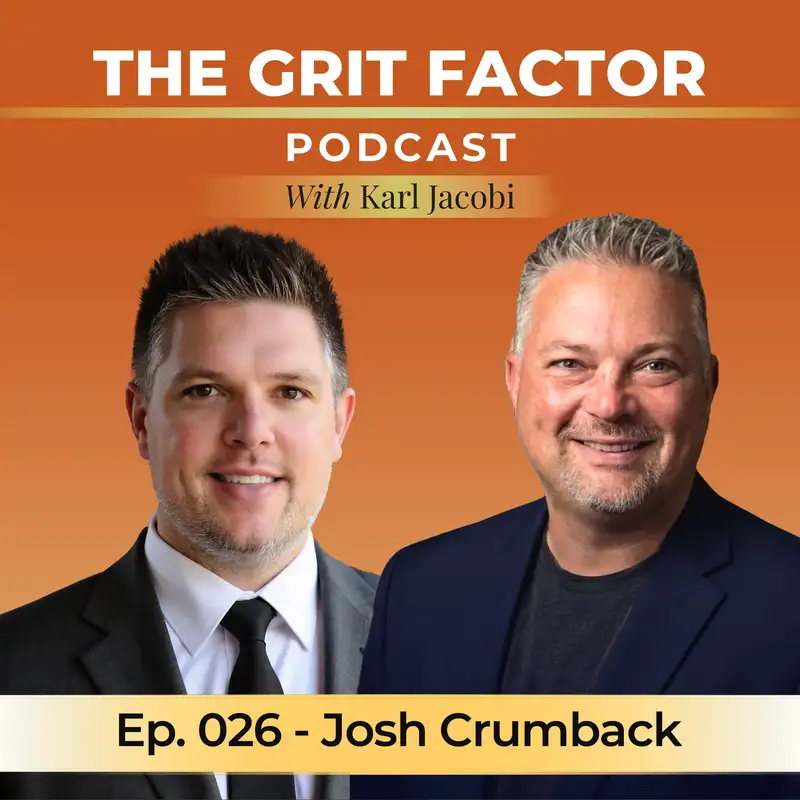
Episode 026: The Guy Who Was Best Man at His Wedding Emptied the Business Account, He Kept the Doors Open Anyway with Josh Crumback
TGFP_Audio_Ep26
00:00:00 Speaker: Average is the enemy of greatness. Comfort is the enemy of growth. Welcome to the Grit Factor podcast, where we strip away the highlight reel and get into the darkness beneath it. The real stories, the real battles, and the battle plans used to conquer them. I'm your host, Carl Jacobi, combat vet, entrepreneur, resilience and performance coach, keynote speaker, husband and father. I've built, scaled, and exited multiple companies totaling over forty million in revenue. But here's what that highlight reel doesn't show you. Life has been smacking me in the face with a two by four since I was just five years old. Broken home. Constant chaos. No playbook. No safety net. Just grit. And if you're anything like me. You know, you've got another level in you, in your business, your career, your faith, your leadership. You're just not sure how to get there. That's exactly why we're here. Be sure to follow me for more great content, and check out my website success with Karl dot com. Now that's Karl with a K. Now let's get to work. All right. Welcome back for another episode. Today I am joined by a good friend of mine and president and co-founder of Encore Business Group, a three PL based out of Grand Rapids, Michigan, specializing in e-commerce fulfillment for Amazon. All of that good stuff. Just if you have any Amazon needs or e-commerce needs, you need to hit these guys up. Fifteen years in business and logistics, uh, spent time at Blue Jay Solutions Transcore basically spent a good amount of time into in logistics before stepping off the corporate ladder and deciding to take the reins and to build his own life. And that seems to be the common theme with some entrepreneurs I've been talking to for the last couple of days. But he dropped out of college after one semester to do to, to pursue his own life, you know? So he learned everything he knows through books, podcasts, and just getting beat up in the arena. I love this. So he runs iOS inside his company. And ironically, if anybody's listening to my recent episodes, I had one of the top iOS implementers on, on the show, uh, based out of Australia down Under, but he's built an amazing operation up to nineteen employees, ISO certified nine thousand and one, uh, ISO nine thousand and one certified and he's really. And I've been following him on LinkedIn and social. He's been he's constantly providing value to the professional community. Right. He's always out there providing community, providing value. One of the top notch guys that I can just approach and talk to very people first, very approachable. Uh, he's a husband, a father, an absolute grinder. That is something I can resonate with. And his story starts with one person. He never thought he had to worry about betraying him. And that right there, that line hits me not just once, but twice. So my dude Josh, welcome to the show, my man. Thanks, Carl. Thanks for having me. I'm looking forward to great conversations with you and your audience. Yeah, man. Me too. Dude, I'm, I'm super stoked for this conversation because as we're talking about in the green room, like as I was reading your bio and I was like, oh man, we really got some stuff in common, right? Because, you know, we've both been on the Amazon platform. We're seasoned veterans, but you know, I used to own two, three plus. I didn't go through the misery once. I went through it twice. You know. Uh, but we've, we've got a common thread as well, which we're not going to dive into just yet. Um, but, uh, yeah, I'm super stoked for this conversation. So Josh, man, take me back before encore, right before any of this, before the three p m, before the, you know, before the jump, you know, paint me the picture of this young dude who that dropped out of college out of one semester, you know, working your way up logistics. What was driving you in those early days? And what did you think your career was going to look like at that point in time? Yeah. Yeah, man. I mean, I'll, uh, I'll have to go back pretty far here. And yeah, you're seasoned like I am. Yeah, you can see these gray hairs coming in, so it's going to have to go back pretty far. But guess I go back to high school. I always had a goal of playing football in college. And then, uh, unfortunately, uh, had a back injury in high school football and, uh, ended up having to quit. Uh, I probably could have stayed on the team and played. Um, but I was a starting offensive lineman. I played pretty much every, every spot on the line, but I was also the, the punter as well. Uh, so I could have stayed and punted, but it was kind of like a tease. Um, because that was my, my main motivation was to be on the line, you know, I was a pulling guard, um, on the line. So it was fun. I could pull and hit those, uh, small little corners down. So, uh, yeah, unfortunately, uh, going into my junior year, I had a back injury and decided it's probably best not to play. Um, so I had to, I had to quit there. And then it all started, started from there. But, uh, the, the work ethic kind of kind of started, Um, in high school I started playing football late as well. Um, I didn't play until my freshman year, um, a little before that. Um, but I had to get caught up in the weight room, so, um, I knew that. So, uh, we had some, some great, uh, PE teachers, weightlifting coaches at my high school, East Kentwood in Grand Rapids, pretty big high school. Um, so I got caught up just, just, uh, grinded all summer long, rode my bike to, to the school gym to, to work out during the summertime and started lifting weights, uh, heavy weights. Um, a little, a little too fast. My form was all good and everything, but, uh, I think it was just too, too quick of a time frame. So that's, that's kind of what put the, the back injury on there. But, um, so yeah, after, after quitting football, I was like, man, I need to figure out what I'm going to do now. You know, obviously just still a junior in high school. Like I had time to figure it out, but, sure, a school not necessarily wasn't for me. I didn't necessarily enjoy it. I can relate. Yeah, except except for my last year of high school. I could have graduated early in December, but I decided to stay on and I took a six gym classes. That was probably my most, most fun I had in school. Uh, so yeah. Um, but yeah, obviously I'm not for sure if it was all the questions at the high school graduation open house. Uh, are you going to college? Are you doing this? Are you doing that? The pressure of going to college? Um, I, like I said, I knew it wasn't for me. Um, but I knew I had to had to give it a shot. Um, so I decided to just enroll in a Grand Rapids community college here in town and, and see if it was for me. And, uh, unfortunately, I decided it wasn't. So I knew at that time, uh, it was, it was going to be hard, you know. I had to. I was going to have to work harder without a degree. I mean, back, uh, I know I look really young, right? But, uh. Yeah, you do. You're a stud, dude. Uh, but shoot, twenty years ago. I mean, they're still pushing college pretty hard where nowadays they're pushing, uh, trade school and thankfully. Right? Yeah, exactly. We need that. So, um, so, yeah, I, uh, decided to drop out after a semester, and I, uh, got a job working for my great uncle. He owned an office furniture manufacturer here in Grand Rapids. Oh, wow. Fun fact, uh, Grand Rapids or West Michigan is the office furniture capital of the world. Really? Um, yeah. So we got Hayworth, we got Steelcase, we got Herman Miller. Uh, they're all in West Michigan, so. Nice. That's okay. Yeah, yeah. So that's a pretty big industry, uh, here in West Michigan. So yeah, I worked with him, uh, started out in the factory. Um, stayed back there for like probably like six months or so and then got promoted up to the front office and did a variety of roles there. And then, uh, yeah, that was, that was going to be like a six month job. Um, and then it turned into like five years. So, uh, yeah, that's a, that's a good perspective, man, because it's, it's, it's funny how he's, uh, I'll just give it a little bit of time, right? We associate a timeline. Uh, and here you are five years later, I can, I can definitely resonate with that. My wife and I, when they had drawdowns overseas, you know, and this was back in two thousand and nine. And, uh, it was so bad that hardly anybody in my line of work, I was still W-2 employee at the time, uh, in the, uh, working for DoD. And, uh, the only place that was hiring at that point in time for my skill sets and for my what I was doing was in Fort Rucker, Alabama, and my wife's like, where the hell is that? You know, because, I mean, we spent most of our time overseas and or New England, like in Connecticut and so forth together. And, uh, and so I said, just give me a year. Give me a year. How long do you think we stayed there for? Thirteen years. Oh, wow. Yeah. One year out of three to that. You know, that was thirteen years, man. So. Well, dude, thanks for painting this this picture of the work ethic. And I knew there's another reason I liked you. You know, some, you know, we like to go to the gym and, and clank some iron. Um, you know, so I'm imagining this guy, this, this stud here that is, you know, had hopes, dreams, aspirations to be this football player, uh, tried out college and was like, yeah, nope, not for me. Right. But you still had that work ethic. You know, you still had that disciplined mindset that you, um, maybe was installed with into you from football. Because I know in football you've got to be disciplined. Um, you know, you really don't have a choice. But when you went to college, you quickly realized this isn't for me. Right. This isn't for me. This, this is, um, and this is probably going to rub, uh, hit some nerves, but you quickly learn that it's a scam, right? Um, because a lot of people go to school for the wrong reasons. They think they're going to go to school for basket weaving, thinking they're going to be able to get a, a job somewhere, a good paying job that's going to pay for their student loans and sustain them. Right. Um, so fast forward a little bit, man, you have a good day job, corporate logistics, you finally got into logistics, um, you know, paychecks coming in. Um, and you're. But you're also building this company that you have today, right? That you're all in on encore on the side for two years. I've actually remembered some stories you posted on LinkedIn. I'm sharing some stuff about this. Um, and you funded this whole thing out of your own salary, right? It wasn't like somebody had donated or, you know, a rich granddad or a rich uncle that gave you X amount, you know? So was that the vision, uh, that you had to be willing to bet two years of your, uh, well, let me ask this a different way. Was that the vision that you had? You willing to bet two years of your life? You know, that did not yet exist? Yeah. I mean, not necessarily. I mean, as a twenty six year old, um, you can be a little naive, right? And, uh, especially nowadays with social media, you see all these influencers. Uh oh, no kidding, man, that are so successful, right? And live the live the perfect. So easy. Yeah, yeah. Make it look so easy. So I mean, yeah, thinking at twenty six thinking you're going to start a business and it's going to be an overnight success. Right. And that was that was a, a wake up call right there, you know, so yeah, I mean, but go ahead. We could have, uh, we could have done it differently. We could have, we could have got some investors and done it faster and, and wouldn't have been as much of a struggle. But, uh, even in my personal life, I hate debt and I hate owing people. So, uh, I knew I wanted to bootstrap it. I knew I had the work ethic to bootstrap it. I knew it was going to be hard, but I was going to take grit. Right? So yeah. Uh, yeah. Uh, two years working my day job. Um, I even, we even got to a point. So we had to get ISO certified, um, in order to do business with this first big customer that we had lined up. Wow. And in order to do that, we had to have product in house in order to get certified on. So that was a struggle in itself. Um, so that kind of set us back, uh, a good six months to a year. Um, so I was funding. Funding the business, paying rent out of my own, out of my salary. So it kind of ran us dry to. A point. And I actually, uh, ended up, I had my, my Jeep paid off. So I ended up refinancing my Jeep just to. Keep us going longer. Um, so yeah, I had had a lot on the table. Um, as far as that goes. Yeah, man. Let's talk about that for a moment. Because a lot of people would have given up right there. Right. A lot of people would say, this ain't for me. This, you know, this, uh, this, this isn't for me. Right. Or it's not working. Or they're, they just don't see the path out. But you decided to, to. You know, grit it out, right? You decided to because you saw something. Uh, and by the way, what year was this? I want to make sure there was a good timeline associated with that was around twenty fifteen, twenty sixteen. Oh, so not too long ago. Really? Yeah, I say that, but I mean, it's not. Yeah. Seems like ages ago. Yeah. But, uh, so help me understand or the audience understand, like you were at that brink and instead of giving up and instead of saying, you know what, uh, my jeep's paid off. I don't have any payments. You could have literally walked away and everybody would have understood. Right. Oh, it's okay. Josh. It's okay. It happens. It happens and so forth. But you decided to not give in. Why? Yeah, I mean, I, I felt it was a calling, uh, in my life to start a business. I, I always wanted to, but I also thought it was a calling. Mhm. Um, and I took a lot of time to pray and think about it. And I never, never necessarily got the the word back that it was time for me to quit. So I took that as a sign to move forward, to push forward. So yeah. Real quick, before we keep rolling, maybe life hit you hard. Business fell apart. Career isn't working out. Relationship ended. Health took a dive. And now you're standing in the rubble. Trying to figure out what the next move even looks like. Or maybe nothing blew up at all. On paper, you're winning. Sure, but on the inside, something's off. If you're not in crisis, you're at a crossroads. And the playbook that built the life you have is not the playbook that builds the one you want. Either way, you're stuck. Not broken. Stuck between who you were and who you're becoming. Most self-help just piles more weight on the load you're already carrying. I do not want to do that. I put together a free video series called the Grit Code Exposed, and I want to invite you to check it out. Seven short videos. That's it. The five laws that change everything for me. In every client, I coach the same five that every person who's ever come back from the fire has walked through where they had a name for it or not. No fluff, no ninety minute webinar, no bait, just the free video series. You can start it tonight. Grab it at grit. Code exposed dot com one more time. Grit code exposed dot com. It's free. You don't need any more hustle. you need the next version and this is how you find it. Check it out. See if it speaks to you. And if it does, I'll see you inside. All right, let's get back to the conversation. That's a that's a great that's a great sign. You know, and those are listening and watching. I hope you hope you understand what he's saying. Now, mind you, it's not like he was listening for Gandalf to say you can quit. Right? It doesn't come like that. It comes through, uh, conversations or feelings. I know it's not feelings, it's intuition. And, um, you just know it in your gut, right? And so, um, and the other side of that coin too, is you got to be able to see yourself on the other side of it. Yeah. If you don't see yourself on the other side of that, the other side of the obstacle or adversity, then you know, you need to pivot or you do need to, fold the cards and that too is okay. But you need to make sure you're doing it for the right reasons, not just because it got hard. Not just because the two by four hit, right? So you quit your day job. You. You know, so you're starting to see some success. You went full time, you went, you're like, all right, it's time to go all in at encore. Uh, and right after you got married, if, if my, you know, notes are accurate, which, bless your heart. Yeah. So take me back to those first few months in that period, man. You're, you're walking into the building every morning now as a full time entrepreneur, full time founder, full time owner. When did you first notice that something was off? Uh, in that situation? What did you see? I think you know what, Tom, with that situation, right? Yeah. Yeah, definitely. Yeah. So just a timeline real quick. So we started the business back in fifteen. Yeah. Uh. Got married. I actually started that job with Blue Jay Solutions in fifteen as we decided to start this business as well. Um, so, uh, fast forward to seventeen, I and I actually met my then girlfriend at the time around that same time as well. So twenty fifteen was a lot I can imagine happened, uh, starting a new job, uh, started dating my, my now wife, um, and then started our business as well. So obviously, uh, uh, didn't want to quit my full time job. Um, as we were engaged in planning a wedding and completely rely on, uh, on my fiance's income. Um, because I didn't know if she was going to leave me at the altar. Uh, so you're a stud, man. She ain't gonna do that. You ain't. She ain't gonna do that. But I understand where you're coming from. Yeah, yeah. I mean, I had this nice, cushy salary job. I mean, it was it was good at that at that time, but I knew I wanted to start a business. So. Seventeen um, we got married and then fast forward to eighteen is when we felt comfortable that I could leave my job and unfortunately take quite a bit of a pay cut, um, and, and go full time with encore. So, um, I can't remember, I want to say January of eighteen, I quit my job. Um, and then probably going into the summer, um, I kind of saw, I mean, I saw stuff early on, uh, going on, uh, with the books and whatnot in the business. Um, I was kind of, uh, out of that part of the business. My partner was handling that. Uh, so I never really looked at it, but as I was there full time and seeing things and decide to get more involved in that side of the business, I saw things that weren't necessarily, uh, moral on ethical. So come October twenty eighteen, I made the proposal. Uh. Either I leave the company or he leaves the company and, uh, he decided to, um. And at that time, uh, I found a business partner. I actually approached this, uh, business partner about another, uh, I was, I was scrambling, I was like, I'm gonna, I'm planning on leaving the company. Um, so I need to find something else. So I had this other business idea in my head and I approached an old buddy. He was actually the quarterback of our football team in high school. So I knew him really well. We lifted weights together. We're, we're good friends. Um, and I knew he was a good business guy. He, he was in real estate, owned some apartment complexes at a very young age down at Western Michigan. Nice. So he had he had his stuff together. So I was like, I approached him about this other business opportunity. He was like, well, uh, what's going on with encore. So I told him the story and he was like, well, why don't I be your partner in encore? Because that's an established company. And obviously as an investor that looks better with revenue incoming instead of a brand new startup that has no revenue and no guarantee. So, so, uh, long story short, my partner ended up leaving. I brought on this new partner, Dom. Uh, he was pretty much a silent partner. He he, uh, like I said, he was in real estate and already had a business, so we used his accountant to handle all of our, our bookkeeping. Um, so that's never been my, my forte. I never cared for that side of the business. I hear you. Yeah. So it was a perfect fit. Um, he, he stayed out of it. And then when I needed him, uh, at the warehouse, he was there. So yeah, it worked great. And then, uh, shoot, then that thing, uh, in twenty twenty happened with Covid. Uh, when the world got stupid. Yeah, yeah. Um, and, uh, twenty twenty one, uh, my partner at the time, Dom, is his name. Dom decided, hey, I, I doubled my return on my investment and I think it's time for me to leave. And I was like, awesome, man. That's great. I, uh, I appreciate all that. He pretty much dug me out of a hole. I didn't know how I was going to get out of. So, um, definitely appreciated him. And then that's when I brought on, uh, my cousin and business partner, Ryan Walsh, who you've had on the show. So. Yep, yep. Amazing guy. Yeah. Amazing dude. Well, thanks for shedding some light on this. And again, this is an area that I, I can personally, I have personally experience with, um, you know, having some, um, partnership conflicts and we'll just leave it at that. Right. And, uh, not, not once, but twice. But, um, I, if you, if you can. If you can't, that's fine. Um, I'm not asking for any names. Of course I would never do that. Um, but, you know, uh, what was the specific things that you saw that, uh, that, you know, that sparked all of this, you know, walk us through for a moment because I want the audience to hear again, if you can't disclose, that's perfectly fine. But, you know, give some meat to the context of what was going on, man. Yeah. I mean, uh, pretty much just, uh, using, using, uh, company money to fund personal, uh, expenses and, and other business ventures. Um, so yeah, it was unfortunate. Uh, like I said, he was, he was my best friend. Uh, I was his best friend. We were, we were both best mans in each other's wedding. Uh, so yeah, it made, it made it really tough. And, uh, unfortunately, yeah, it came down to no longer friends either. So I mean, yeah, that was, uh, eight years ago and still haven't, haven't talked. So, um, yeah, I was, I was starting to think, uh, was it me? I had a lot of, uh, a lot of bad thoughts. Um, but everyone I talked to a lot of respected business men, uh, I confirmed that. Yeah, I made the right call, so. Oh, one hundred percent, dude. One hundred percent. Uh, that. I'm sorry. Yeah. I mean, I, I look back on it and I approach the situation a couple times. Um, I'm not one to, I as business partners, especially, uh, let alone, uh, grown adults, grown men, um, I expect you to know to do the right thing. And, uh, I probably could have been more stern and more, uh, set my foot down a little bit harder, but I didn't, I don't think I should had. I've had to. Uh, so yeah, that was the tough part. And, uh, the final straw was kind of just laying it out there like, hey, this is where, where I'm at. I'm either out or you're out. So, um. Man, I can, I can relate, dude, you know, I, I could feel, you know, the, the, the feeling or the emotion behind it because, you know, this is a dude that you trusted for so long. You guys were like brothers. Um, and I had a similar instance, you know, of course, you know, like you, I'm not going to name drop, but I imagine this person is listening and I don't give a flip, be honest with you. But yeah, um, you know, this was a guy, uh, in the first dispute, you know, this was a guy that I, I pretty much called a, a dear friend, a brother, you know, somebody that I would call at five a m or three because I literally have, I literally had called him, um, at that time. And, uh, long story short, man, we had several hundred thousand dollars of funds gone and it just led to serious disruption. And, um, and, you know, you hear the money aspect, but man, the money aspect, I mean, you can always replace money, right? It's the relationships, it's your health because it creates a crap ton of stress. Like you're at the brink, man. You're like, bro, you, you said it. I was going to walk, you know, you're going to shut it down. Um, and, uh, it wasn't until, you know, Don, when you approached Don was like, hey man, let's just resurrect this thing or let's just, you know, let's put this back on course and let's, let's go, you know, and so, uh, it's not just the money aspect, in my opinion. I think that's the yes, it hurts, but it's the identity aspect because even at that point, you're a question yourself, right? Your question yourself as a business owner, as a partner. Um, and that happens to everybody. You know, myself included, you know, then it takes a toll on your health. It takes a toll on relationships. You lost a relationship, not you, but you both lost a relationship. Yeah, yeah, yeah. I mean, I don't I don't wish that on anybody. I mean, that's one of the worst feelings is having to go through through that. Mhm. And, and if I, if I remember correctly too, wasn't that he just walked away too. Right. He walked he walked away with one of your best customers. Do I understand correctly? Yeah. Yeah. So yeah. Jesus. Yeah. One of our best, uh, profit generating customers. So yeah, if you look at it back in October of twenty eighteen, um, we were still young, very young at the time as a company. Um, and then then Covid hits in twenty twenty. So we had to start, start over in twenty eighteen and Covid hits in twenty twenty. It was like a double blow, um, to kind of start over twice. Um, yeah, because we, we, we did fulfillment. It was more B to B fulfillment than anything. We worked with, uh, quite a few manufacturers in the area to do B2B fulfillment. Um, so we weren't really too much into the e-commerce game at that point. Um, and then twenty twenty, uh, I always had the goal to get into e-commerce and, uh, my partner at that time, um, uh, just couldn't wrap his head around it for some reason. I remember quoting our first e-commerce, uh, job and, uh, he wanted to upcharge add this huge admin fee, monthly admin fee. Um, because he couldn't figure out how, uh, how we were going to make money off of it. And, uh, so yeah, that was, uh, that was kind of kind of one of the reasons that, uh, I wanted to stay in the business and keep it going, uh, because I saw the vision and then, uh, Covid twenty twenty hit and e-commerce just boomed, right? Yeah, it accelerated it by ten times. So yeah, it was, it was bad timing, but it was also great timing. Um, so yeah, that's when we, uh, transitioned pretty much one hundred percent to e-commerce. Uh, we, we used those, uh, B2B customers, those manufacturer companies to, uh, pretty much fund our transition into e-commerce. Um, and then, yeah, it's, uh, pretty much, uh, from there. Yeah. That's interesting. So that. Out of, uh, well, I'm glad you said that because honestly, I thought from the beginning you guys were in e-commerce. Yeah. No, uh, you know, we really haven't talked much about the, the, the depth of your business. I know we've, we've met at past conferences and talked a few times here and there throughout the last couple of years, but for some reason I just had the assumption. You've always been into e-commerce, so now your story is even more amazing because you're pivoting into an industry because, you know, typically the way the scenario works with, you know, three p l owners or restaurant owners in the e-commerce space, specifically for Amazon or Walmart, it's typically the, the stairway is, hey, you know, I'm already a business owner in this platform. I'm going to, um, you know, create a three PL or prep center because I already have the infrastructure, right? I already have warehouse, I already have resources, blah, blah, blah. So it's kind of like a natural next step if you want that death wish, right? Um, again, you and I could both talk about it because, you know, we've been there, done that. Um, but for you, man, you just, it was something that was totally new to you. Yeah, yeah. I mean, I knew to pivot. Yeah, yeah. I mean, I knew, knew logistics from, uh, working at Blue Jay working at Transcore. Um, but that was more the trucking side of logistics, not the not not the product moving e-commerce side of logistics. So yeah, I knew, I knew a little bit, but it was also new, new to me. Uh, I learned a lot since, uh, twenty twenty. So yeah, I can imagine. So man, it's almost like taking you. It's almost like going to school. You're taking four years of school and compress it down in like six months. Yeah. You know, because you're really. And at that point, that was probably the best time slash worst time to get into e-commerce space, right? Yeah. Uh, best time because of growth, best time because of growth. Because of course. What cash. Right. Yeah. Um, and people, um, and fortunately at that point when I owned the first three PL, um, we were in a state that, uh, wasn't, yeah, they, they tried to lock down, but the people in the state were like, yeah, screw you. Yeah, we're, we're gonna live, we're gonna, you know, we're gonna not just we're going to thrive. So. So take me to the day you realize that the customer was gone with him. I'd love to hear. I mean, how did you find out? Um, and what did that do to the business you have personally funded for two years? Was this at that pivot point or was this a different time? Yeah. I mean, it wasn't too much of a blow as far as him taking that customer, because that was actually part of the agreement. Oh, okay. Yeah, that was that was part of the sale. So, um, I don't know. We didn't even try to push back on it. Um, we just let it go. We just wanted to move forward and get on with it. Um, so rip the band aid off and go. Yeah, exactly. So yeah, I mean, it hurt. Um, but it also wasn't in my long that that type of, uh, customer wasn't in my long term vision. So it wasn't hard to let go of it. Well, I mean, so it sounds like in the long game it worked out for you, right? Oh yeah. And God was like, hey, don't worry about this. Don't worry about this little fish. I've got some whales coming. So yeah, make room for it. Yeah, yeah. Um. Speaking of whales, not that I'm calling that bad choice words here, but, you know. And then in the middle of all this, right, if I if my notes are correct, your wife tells you. Hey, babe, there's a new addition coming to the family, right? You know, so, you know, business in crisis. Partner gone. Best customer gone, uh, baby on the way. And, you know, so you, you told me on or you put on the intake that you got on your knees and you prayed. And when I read this, and I want to hear this story, when you read this, this, like, I can almost know the exact time, day and moment when I had to do this on a recent, uh, fallout on acquisition that, uh, of, of my last company. So I want to hear this story, but take me that moment when you're on your knees and you're praying, you're asking for a sign. You know, of what you were doing wrong or what the wrong thing you were doing, and you never got one. So take me to that moment, man. Yeah, definitely. Yeah. I mean, it's definitely a blessing, uh, to, to bring a child into the world. Right? And I was definitely excited, but I was like, man, can we, can we have a little bit more time, you know? Uh, yeah. Yeah. Hey! God. Come on. Please. Yeah. Yeah. But, uh, trust God's plan, right? I mean, everything happens for a reason at the at the right time. So, um. Yeah, I mean, thankfully, my wife had a, had a really good job with a, with a nice salary, so I wasn't, uh, extremely worried about it, but also as a, as a man, uh, I wanted to be able to provide for the family. So the goal was always to, uh, my, my wife always wanted to work part time or be a stay at home mom. Um, and unfortunately, she didn't get that that chance. Um, but, um, yeah, it, uh, starting a business has definitely drawn me closer to God than any other. Any other thing out there. Ooh. Yeah. I mean, the, the trenches he puts you in, uh, will definitely test your faith, that's for sure. You got that right? Yeah. You're you're one hundred percent correct on that because that's a man. I need to think about it this way. Until you just said that, man, I seriously, because in the W-2 world, you're just punching a clock, right? I mean, the yeah, that's a great perspective, man. I really, honestly think about that until you until you mentioned that because, um, you know, even in an entrepreneurial world, man, when I first got into entrepreneurship, um, you know, I still had a lot of it figured out, man, But fast forward, you know, several years into this recent season, man, it has been all him. You know, I literally have like, show me one step, you know, in the next step and next step up, you know, but let's get down into the nitty gritty for a little bit because, you know, um, when you, when you were asking for this prayer, right, you're, you're asking for this sign you, but you were hearing nothing. What was going through your mind, man? Like the average person, uh, paint this picture because there, there's a lot of people out there that are in this space. They're in this place right now. They're, they're like, they don't know what to do, whether they're in their jobs or they're in their businesses, they're in their whatever season they may be just in. They're in the season of parenting. Right? So you were on your knees. You're, you're, you're, you're praying. but you felt like you weren't getting anything. And to the average person, especially those who are weak in their faith, they're like, ah, screw this. Faith isn't for me. You know, God's not for me. God, God's out for me. God's you know, whatever. You've heard these. Yeah. So to that person that's thinking this or to that person that's in that position you're in. What made you say, you know what? I'm still going to lean in. I'm still going to go in that direction because you had every excuse in the world to do something completely different. Everybody would have understood and justified it. Yeah. I mean, I came across this verse during those times. It's Jeremiah twenty nine eleven, for I know the plans I have for you, declares the Lord, plans to prosper you and not harm you, plans to give you hope and a future. And I read that. I still read that verse almost every morning. Wow. Um. That's powerful man. I just have always felt that, uh, that he has a plan to make this work. And this is where this is where I need to be at right now. Yeah, man. That's so good, man. And just like you said, it's not this. Not this little voice on your shoulder whispering into your ear. You don't, you don't always get that straight answer. Kind of. I mean, I feel like that the devil is that little guy on your shoulder whispering in your ear, but God's bigger and he's you're not going to hear that voice all the time. Um, but yeah, you just have to trust. Yeah. And it's hard for a lot of people to do that. Yeah, it really is. And I'm not going to sit here and say I'm an expert at it. There are times where I'm like, I don't know, bro. Like this, this path that you're trying to like that I'm seeing right here. Are you sure, man? Like, yeah, yeah. Are you sure? Sure. Yeah. I question that many times. I'm like, yeah, is this is this really how how it's going to go. Is this really your plans you have for me? It should. AM I am I not supposed to be providing for the family right now so I can in the future? And what? It was very hard to see. I mean, it still is, right? Yeah. But yeah, yeah, that's a great point. I'd love to hear your perspective on this because I, I heard this numerous times, but it's not in looking forward where all the dots connect, it's actually looking backwards where all the dots connect. Yeah. Right. And here we are. We're looking forward as though we expect all of those dots to connect, you know, and it's counterintuitive. I know, I get it, but but if you look back, it's like, ah, I get it, I get it. Yeah, I get it. Yeah. It's like, it's kind of like an epiphany. Like you. Yeah. Obviously don't know the plans that God has for you. Um, but you're, you're walking blindly, right? But yeah, then you, like you said, you look back on and you're like, aha, that's why you did that. You know, just connecting the dots. So. Yeah, absolutely. Yeah. It's fun to look back and see those right. Yeah. Yeah it is. It's it's fun. It's enlightening. It's um it's enlightening. I will say that encouraging that was the right choice. Yeah. That's a good word. Yeah. Encouraging because it, it's affirmation, right. It's like, oh, and still sometimes we get sweaty palms and, you know, heart rate's racing and all the noises come in our mind, start questioning our judgment and this, that and the other. And then we allow other people that we shouldn't be right. You know, the peanut gallery vomiting their, their negativity. And it's yeah, that goes nowhere. Yeah. Um, man. So, you know, when you decided to stay, you know, as I said, most people in that seat would have just pulled the ripcord right again. um, giving you a excuse in the world been okay so forth. Right. Close the doors, got back to salary, um, with a baby on the way, that would have been, of course, right. The responsible move on paper. Um, and however, man, you did not do that, you know, and, but what was the actual decision point at that, at that time? What made you keep the doors open when everything was pointing to shut them down? Yeah. I mean, again, it's, uh, it all came down to faith and, and vision for my future. Like I said, I always wanted to start a business, but I didn't, I didn't necessarily want to start another business just because of this, because of this, uh, uh, falling out, um, whatever you want to call it. Um, so I, I felt like I felt like this was the business, uh, for, for me. Um, and yeah, it just felt like I needed to stay with it and yeah. And trust, trust God that this was the plan. That's amazing. So you had to pretty much start all over, right? You had to resurrect the Phoenix from the ashes, new customers, new systems, essentially, uh, a new company wearing the same name, same new uniform. Right? Yeah. Uh, you know, the old uniform. Um, so where did the first win come? Uh, or where did it first come from? The win after the split? Yeah. I mean, uh, not shortly after. Um, it was, it was sometime in nineteen early twenty. I want to say, I think it was nineteen, um, that we brought on our first like true e-commerce, uh, customer, uh, pickleball brand. Uh, they had their own line of pickleball paddles. Uh, and, uh, yeah, that was exciting. Uh, because that was the direction I wanted to take the company. Yeah. Um, And. Yeah. Smart move. Yeah, that was, uh, that was, uh, definitely the right move to, to take that and, uh, and take on that customer. Mhm. So from there on, it's pretty much just build, right? You're, you're on that trajectory of building. And at that point, you know, you're starting to see, okay, this is the way, right? Like that was, excuse me, that was the sign that we're going to make it. We're going to be okay. We're going to make it right. Um, you, you said something. I, I want to see if I can pull it out of you. But you said this season taught you one word. What was that? Um, perseverance. Okay. That. Okay. That was another word that what I put down I can't I can't remember unfortunately. I t I wrote these these answers about, two months ago. So I know it's like twisting your arm, trying to get you on here, man. Yeah. Yeah. I had to push it out a little bit. So, uh, trust. Trust? Yes. Trust. Trust in him, right? Yeah. Yep. Yeah. So, uh, in that shifted after this, right? Because, you know, what does trust look like for you right now in business? You know, walk us through what does trust look like for now for a business? Because for a lot of people that's listening to this and or they're experiencing their own version of what you experience, that's hard, right? To trust people. Um, so, you know, how did you, you vet your next partner, the next hire, the next big customer? Like how do you establish that trust? Um, when that event happened to you because so many people are like, screw this, I'm gonna do this my own or just shut down or whatever. Yeah, yeah. I mean, uh, prior to the falling out, I mean, I was I could trust people pretty easily. Uh, I don't know if that was, uh, being naive or what. Um, but it always worked out for me, uh, trusting people. Uh, but now trust looks a little bit different for me after that. Um, I can imagine. Yeah. Having a best friend. I'm sure you felt the same way after one hundred percent, right? Yeah. Yep. So, yeah, it looks a little bit different. Um, obviously bringing on a new customer to handle the side of the business that we had issues on, uh, completely trusting him to do that, uh, was, was a hard thing. Um, but, uh, with his background in business and I knew him, um, uh, it was, it made it a little bit easier to trust him to do that. Um, and then same with bringing on Ryan, my current business partner, uh, and he's family, so it's a little bit easier to trust. Um, but he's, he's a moral and ethical guy. Yes. Very stand up guy. Yes. So I had no concerns about that. But yeah, I definitely look at trust differently now. Um, especially in a professional way. Um, you can't always just trust people, uh, even even customers, you know. That's true. Uh, someone might want to negotiate pricing with you and they promise you the world that they're shipping a thousand, five thousand, ten thousand packages a month. Uh, just trust me. You will. Uh, that doesn't work. No. Yeah. Yeah. I've heard those before. Yeah. Yeah. I hear you. Real quick, before you go, if you're still with me this deep into the episode, something in it hits you. Maybe it was the guest. Maybe it was one line. Either way, you're still here. and that feeling in your chest right now, that's the signal. Most people get a signal like that and do absolutely nothing with it. They close the app. Life rushes back in. The moment's gone. Six months later, there are the exact same spot. I don't want that for you. So I put something together. I want to invite you to check out a free video series called the Grit Code Exposed. Seven short videos. The five laws. I walk every client through. The same ones that rebuilt me when everything else fell apart. And if you listen closely today, you heard them running underneath the entire conversation because everyone who's come back from the fire walks through these five laws. Some find them on their own, some get help, but the laws don't change. Free video series. You can start it tonight. No fluff. No ninety minute webinar. just the series. If you're going to do something with what you heard today, do this before life talks you out of it. Go to grit Code Exposed dot com one more time, grit Code exposed dot com. And hey, before I let you go, thank you for riding with me this long. It means a lot more than you know. Thank you. I hear you. Well, let's get back to some lessons learned here because again, going back, it's not looking forward that everything makes sense. It's looking back. Right. That last season prepared you for this next season, right. It helped you appreciate a different version of a partnership, right? Yeah. But you couldn't have that new level of appreciation if you didn't go that through that experience. Right? Yeah. And at that point, and this was again, you know, referring back to my experience, I, uh, I actually, ironically, it's the same, uh, podcast episode for the where the guest starts asking you her passport question. Um, uh, she's a behavioral specialist and dives into trauma and stuff of that nature. And anyways, so you just have to listen to the episode. But I, I actually announced something, um, because I didn't really realize this, but I was, I, I needed to be thankful for those events to occur because yes, it taught me something, but it made me realize where all our gaps were, where we are exposed, right where I was exposed, you know, so that in the future, when I, you know, ever, you know, have partnerships again, or I consider partners, I know what to not do next time. Yeah. Right. And for those that are listening, if you're if you're not like getting a point already, you should not do something just because you made a mistake that whole season, that chapter, that little paragraph is meant to teach you a lesson, right? And so take the lesson learned, drop the rest, and move on, just like Josh did. Josh realized that. Okay, uh, I need to be a little bit smarter of how I vet people, how I vet partners, how I vet customers and make sure they're not the exact same person I am. Right? They gotta be different skill sets, different people. Um, so fast forward to today, man. Um, you know, you said one of the, you know, you said the one system that you attribute your success to today is iOS. And I, it's ironic, man. It's kind of scary actually, because I'm wondering like, okay, God, are you trying to tell me something? But yeah, uh, I, I had a guest last week. Uh, he's one of the top EOS implementers out of Australia. Um, and, uh, but so for you, the, the entrepreneurial operating system, see that ten times fast, you know, for the founder or the entrepreneur or the business owner that's listening right now who runs their business out of a notebook and a prayer, give them the real answer. What did EOS actually fix for you that nothing else had? Yeah, we're getting a little tactical here. Yeah. So we we implemented EOS back in twenty twenty. I was introduced to it actually by a customer. Um, he actually ended up leaving that company and, and starting a few businesses actually. Um. Oh, wow. And he introduced me to a guy named Gary, um, here in town and he, uh, introduced EOS to us and said it was life changing, business changing. Nice. and I agree. I mean, to have everybody on board in the company. Uh, all, all pushing the car that ran out of gas. They're all pushing the car in the same direction. Nobody has their foot on the brake has been has been refreshing. Yeah. Yeah. So, I mean, you have, you have one person. I mean, obviously we're a small company, so it's a little bit easier to manage. But, uh, when you get into larger companies with more employees, uh, it's a little bit more difficult. But yeah, when you have people with their foot on the brake and, and not, not on the same train. Uh, yeah, it's not going to, not going to work out or it's going to slow you down. Yeah, that's a great point, man. And at the end of the day, that's where it's going to break and make or break a company. And, and this is only because I have industry knowledge, man. Uh, I don't think it's an exception to any industry or any type of business, but especially in a three PL space, it is all about efficiencies, man. Oh yeah. Definitely. Right. It's throughput. Like you've got to measure in and squeeze every drop out of every bottleneck you can possibly find. So yeah, I mean, in our business, time is money. So yeah, you got to be efficient in order to make money. So yeah, absolutely, man. Especially in today's age with AI and you know, way that's rapidly evolving. And of course, everybody's, you know, panicking about taking jobs and so forth, which I get to some degree. But, um, it's not the first time where, you know, we've been through an evolution, right? You just look back in history, just roles change, things change, you know? All right. So moving on, man, you know, nine years in, right? I think if my math is math incorrectly, you move into a new building. I remember, I remember this conversation specifically and you even talked about on LinkedIn, uh, onboarded the, the largest customer company history, right? Um, and you've implemented a new w m s bless your heart. Yeah. Yeah. Those things are not fun, dude. Yeah. Um, and you're shipping more to Amazon than ever, right? Nineteen employees. ISO nine thousand certified. Um, you know, looking back, man versus today, how do you feel? Like how does this make you feel, dude? Like. Give us the picture. Help us experience the feeling you're feeling right now. Looking back of what you've been through to now, fast forward like where you are today, right? You're, you're ramping up, you're progressing, you've got all of these accolades. Like you're seeing progress, you're winning, you're seeing the wins. Like, how does that make you feel, man? Yeah, yeah. I mean, it feels great to be in the right spot. We've never been in a better spot right now. We've never had so much momentum going. Um, I'm an optimist, but I am also a realist. Uh, especially with, with my past, um, with what I've gone through. Um, I kind of, I don't know if that's, uh, like doubt creeping into my mind of being I'm optimist, like, hey, we're going to bring on all these customers we have in the pipeline. But then I'm like, oh, let's, let's, let's calm down a little bit. Josh. Let's, let's, let's be real. Right? Um, so yeah, yeah, it's, uh, I've never been in a better spot. Um, I love what we're doing. I love, love the customers we work with. Uh, I love seeing them grow and helping them grow. We're, we treat our customers, uh, as, as partner, true partners. We're, we're an extension of their business operations. Um, if we, uh, our, our successes all on our reputation. So if we can, uh, do a good job and help our customers succeed, we're going to succeed in the long run. But it, it, uh, it first comes with helping our customers succeed. Man, I don't know if anybody paid attention to that. Succession is dependent on reputation or reputation. Right. And man, especially in today's time, especially with the evolution of AI man being reliable, being that true partner, that actually gives a damn. Right. Yeah. Um, and I again, you know, going back to LinkedIn, just because, you know, you and I interface LinkedIn quite a bit. I see all the stuff you post on there, man. It is a true testament. I can personally vouch that you truly care. You guys truly care about your customers and the people you partner and you do. You are selective, right? And I know that root, uh, you. Yeah. You're not going to serve everybody. Not everybody you need to be serving. And yeah, you have to be good with that. Um. Help me. What are you most fired up about right now, man? You know, you're you're in this, you know, this phase in your business. What are you most fired up about right now? You know, I just I pretty much just. I'm kind of a cool, calm and collected guy. Um, I don't get too excited about things. You could probably ask my wife about that. I'm not too emotional. Uh, so I just kind of take it day by day, but I'm excited for the stuff that we just have in the works, just the customers that we have in the pipeline. And, and we have stuff, uh, pretty, pretty long ways out like that. You were telling, uh, talking about that customer, uh, the biggest customer we signed on board that that deal took took us two years to sign on. Wow. Not so much on our end. It was on their end. They, uh, they kind of delayed it a little bit, a little bit. But yeah, yeah, a little bit. So we, we needed to move into a bigger space and we knew that, but this customer was going to help us move into a bigger space than what we actually needed. Um, so we were patient with it and just trusted the process. Um, but yeah, it, uh, it took two years. So there's some stuff in the pipeline that you're like, man, I wish we could, we could use this business right now, but you just have to trust the process and when, when the time is ready, um, they'll, they'll come on board. Trust the process. That's so good, man. I think that a lot of people miss that. Trust the process. That explains why you've got a little more gray hairs. The last time I saw you. Yeah. That is accurate. Man. This has been such a great conversation, man. I know time has been has flown. I know we could probably talk a lot longer. Um, you know, early on when I, when I did the intro or maybe somewhere throughout the conversation, you told me self-help and leadership books and podcasts shaped you, um, as a young adult to who you are today, right? You know, that is exactly, uh, what you are, uh, you know what you're on right now, right? Uh, or why you're on right now. So look back at that. You know, that old twenty two year old version of you. You know, that one that's listening to the gym or in a car? Um, you know, what do you have to that say to that person that they could take away from this conversation? Like, what would be the one thing that you would want them to take away to that twenty two year old version of Josh that isn't a thick of it or in that transition? Yeah. Um, I think I would just say it's all going to work out. It's all going to be okay. Um, trust the process, trust the plans. Um, and yeah, it's, uh, there's a lot, a lot of more and more anxiety out there than ever before nowadays. Oh, you got that right. And, uh, a lot of worry and a lot of people not wanting to take risks. And the biggest thing, one of the books that helped me out the most through this whole process was called Peaks and Valleys. And just not making, uh, making decisions in the peaks and not necessarily making them in the valleys either. Um, agree. Making them in the, in the plateaus. Um, so, you know, when, when you're so up high on, on the valleys, um, you kind of have a big ego and don't, don't make decisions then, you know, and then when you're down in the slumps in the valleys, uh, you're thinking about giving up, you're thinking about quitting. Uh, and yeah, don't, don't make a decision there either. You're gonna, you'll, you'll get out of that valley. You'll make it up to the plateau. You need to make a decision. Well, that's the other side of resilience, right? I mean, a lot of people, when you when you hear resilience, it's, uh, I think one of the perfect go to scenes is when Rocky is talking to his son. You know, that iconic line. He says, it's not a line. It's actually like a, a phrase that he says, I'm going to butcher all hell if I try to say it now. But basically, you know, it's not, you know, about just how hard you can get hit, right? It's about how hard you get hit and keep moving forward. And that's how winning is done, right? But what he says is so like, I get goosebumps just thinking about it. Yeah. Uh, I love Sly. He's such a good dude. Um, but it's not just that. That's not just. That's not the only form of resilience. The other form of resilience is what you just talked about, right? It is how fast you can get from the peak. Steak. Steak. Hello. Yes. I'm hungry for steak right now. Get from that peak steak. My gosh, you I just said it again. Peak state. Down to, you know, to the equal state. Right. The same concept down here. You know, how fast can you get back into that equal state? Oh my gosh. You know, and that's where resilience is truly at. Because when you're outside that equal state, man, you are making some not good decisions, right? When you're not making good decisions, guess what? It just, it's a landslide from there or just it's, it's a tailspin, right? Because we have never correct me if I'm wrong. I love to hear your feedback on this. We've never made a good decision from here, especially here. Right. I know I haven't um, on anything, you know. All right, my dude. So for the person that's listening out there, man, they're they're hearing your story, they're hearing about your business. They're like, man, I want to support Josh, I want to support encore. I think they'd be an amazing partner because we're drowning in our own freaking infrastructure. Where do they find you, man? What? How? How do they find out where they can sign up for you? Yeah, definitely. Yeah. You can check us out on our website at w w w dot business dot com. Uh, you can find myself on LinkedIn. Uh, pretty simple, just search. Josh Krumbeck. I think I'm probably the only Josh Krumbeck out there. Uh, probably shouldn't be too hard to find, but yeah, connect with me. Uh, and we'll, we'll talk. Awesome, man, I love it. We'll definitely be dropping all of this stuff in the show notes. You know, the website, he just dropped his socials and yes, connect with him on LinkedIn. He's very active on LinkedIn providing tons of value. Um, so all right, man, so last handful of questions, rapid fire questions in this season that you're in, what does grit mean for you? And what does grit mean for me? Um, I always remember this quote. Uh, I can't remember if it was a speech I heard or a book I read. Um, but when the going gets tough, the tough get going. Ooh. So when, when hard times hit, uh, are you going to give up or are you going to keep going? So, um, yeah, that's always stuck in my head. Uh, and so good. And the answer is for me, uh, that that means get to work and get going. So. Yeah. Mhm. That was good, man. I love to hear your thoughts on this because especially in this season, of course, you know, as you said earlier, um, you know, talking about social media or maybe it was a different conversation, but, um, oh, that was about anxiety. But there's been so much hype around adding, right, adding strategy, adding, adding, adding, adding vision, adding whatever. right? But also subtraction is necessary for growth, right? Addition by subtraction. So what is something that you're actively working on? It could be something you believe you've had to unbelief or something you've had to learn. Or where is there another point in your life where you had to reduce some friction so that you can level up? Yeah. I mean, we live in some crazy times, man. I work with technology and everything. I always I like to ask people this question. Would you rather go into the future one hundred years or go back one hundred years? And I always say I'd love to go back one hundred years. Um, even without knowing what what the future today looks like, I just think it's more simpler times. Um, and that's what we kind of do at encore. We just kind of keep it simple. Yeah. We want to, we want to stay up to date and keep up with the times, especially in the e-commerce world. You have to. But we also just want to keep it simple. Just the the kiss method. Keep it simple, stupid. Uh, so as you get those backwards. Yeah. Yeah. Phrase works. Yeah. That's good stuff, man. Good stuff. All right. Last two questions. Last question. Being a two part, which both of these I've prepared you for in the green room. Um, and you've already said it, but I'm going to ask it again. Um what is a quote like when the lights are out in the trenches and man, you're in the thick of it could be for a moment, could be for a day, week, month, year. What is a quote or directive or even scripture for that matter that pulls you out of those trenches? It helps you stay encouraged. Stay. Yeah. Just help you stay encouraged. Yeah. I, uh, I think I go back to that, that verse I talked about earlier on, uh, Jeremiah twenty nine eleven for I know the plans I have for you, declares the Lord. Plans for prosper and hope. I always fall back on that when I have that doubt. Kick in. Uh, have a have a bad week. And you know, you might, uh, might lose a customer due to them not wanting to push on. Um, thankfully, we've never lost a customer, uh, because of us. Um, we've lost a few, uh, knock on wood. Yeah, knock on wood for sure. Where's the biggest piece of wood you can find? Um, but yeah, uh, but we, we had this, uh, this week actually, uh, customer came to us and told us that they were losing a part of their business that was heavy in Q4. Um, so we're obviously relying on that revenue for Q4. So now we're going to scramble and, and replace that. It's going to, it's going to be all, all, all, all right. But, uh, yeah, it's, you just kind of have that doubt kick in and like, what am I doing? You know, is this really worth it? And yeah, and I go back to that, that verse and I always get reassurance that, yeah, you're in the right spot. So yep, one hundred percent dude. Yeah, man. Love it. All right. This last question is a two part that I prepared you for in the groom. Those that are listening, especially if you're listening for the first time, I love to give my guests an opportunity to challenge my next guest with a question. Now, mind you, the lineup is completely anonymous. They have no idea who's coming up. And so far this question has landed perfectly and I'm actually getting goosebumps right now. Here's why. This question was from Karlie Pippen, an amazing guest. She's actually behavioral. Um, and. She analyzes people's behavior. I forget the term off the top of my head mind is glitched. So sorry, Karlie, if you're listening, but she had this question for you. And again, I'm getting kind of goosebumps here. What is the hardest thing you've been through and what are you grateful for about it? Not the forgiveness piece, the gratitude. What did it give or what was the gift in it for your life? Yeah, that's a great question, Carly. Um. Appreciate it. Yeah. There's, uh, like I said, nowadays, a lot, a lot of things are hard, you know, um, especially with, uh, social media and people trying to keep up with the Joneses essentially on social media. Um, but for me, um, I think the hardest thing. I mean, for one, starting a business, I knew that was going to be hard quitting school. I knew it was going to be hard. And then starting a business I knew was going to be hard. Um, and then obviously getting married marriage is hard, right? And then you throw in parenting. That's hard. Right? So Yeah. Um, I always thought, uh, starting a business would be the hardest thing, but I think parenting has been the hardest. Um, and especially parenting, uh, while starting a business or, or keeping a business going, uh, as scaling. So yeah, I mean, um, it's been tough. Uh, we have a daughter that has some behavioral issues, so that's maybe why you're getting goosebumps. Um, so that's been, uh, a test for sure. Uh, she's, she's six years old now. We had her, uh, we literally had her the week, uh, that Covid shut down in Michigan. Uh, we, we weren't even for sure. I actually just put a LinkedIn post out on this. We weren't even sure that I was going to be able to go to the hospital and see my daughter born, uh, because of Covid. That's how strict they were being here in Michigan. So oh my God, luckily I was, I was able to go, um, but if I wanted to, my, my wife tried to have a natural birth, but it wasn't working out, so we had to have a C-section. So we had to stay there, uh, a couple extra days longer. Um, but if they said if, if I wanted to leave the hospital, then I wasn't going to be welcomed back because of Covid. So, uh, that was brutal. Uh, to stay in a hospital room for three straight days. And, uh, yeah, I didn't get to eat steak like you were talking about. Um, I got. I got, I got to eat hospital food. So. Oh, which, which I'll, I'll sacrifice that for my children. Right. That for sure. Man. Our children have been a blessing. Um, so yeah, it's it's, uh, it's been awesome. Uh, but definitely challenging, man. Dude, thanks for sharing that. That was, uh, yeah, I do have goosebumps. And it's funny how state came up because I'm coming off of another five day water fast and yeah, yeah. So and I've been on strict carnivore for well over a year now at this point dropped over one hundred and thirty pounds. And um, and thanks man. Appreciate it. It's, it's been a massive transformation and, uh, but you know, all I've been eating it, you know, for the last, you know, almost a year now is steak, eggs, bacon and butter and, and so forth. So what, guess what I'm eating right after hitting the record button steak, eggs and bacon off the water fast. Yeah. I remember meeting you down, uh, down in Orlando last year. Um, yeah, at the proving conference. And you're talking about you're doing a fast and you're getting ready to break that fast. And I could see the excitement on your face. Oh, yeah. Buddy, like Homer Simpson. Sarah. A box of donuts. Yeah. Oh, man, this has been such a keep it going. Thanks, man. Appreciate it man. Thank you, I appreciate it. Yeah. Appreciate it man. All right dude. So what is the question that you would love to ask my next guest? Yeah. I mean, mine's like I said, I like to keep it simple. Um, so mine's going to be pretty simple, but do you. My question would be do you have what it takes to keep going. Ooh. I like that. Look at my guest line up, bro. This is again. Guest line up is perfect. So yeah, man, I can't tell you who it is. Sorry. You're just gonna have to listen. But it is perfect. It is perfect. So, guys, you know, those are listener or and or watching connect with us guy, please connect with this amazing young man that, uh, uh, that's been pouring into us for the last hour because, man, there's been a lot of wisdom here, a lot of grit displayed. And he do, he does truly care about people. And I personally have been seeing his content on LinkedIn. And so I can personally attest, you know, just how much, you know, stuff he posts, how much value he provides. And he's just that kind of dude. You just want to be around, you know? So, uh, again, man, I appreciate you spending this last hour, man. I appreciate you, Carl. Thanks for having me. Yeah, man, it's been an absolute honor. And, uh, I honor you for coming in here and allowing us to peek under the umbrella, so to speak, to share your story and things you've been through and not just sharing a highlight reel because that's easy, right? Um, and that's part of the problem why we have anxiety is because of the Joneses, right? That you talked about and, uh, always comparing ourselves, we're creating problems for a situation for, or for a time period. It's not even here yet. That's why we have one of the biggest reasons why we have anxiety is because of social media. Um, anyways, man, I appreciate you, dude. I, I honor you and respect you for coming in here. Um, all right, for those that are listening and watching or watching whichever, uh, you know, by now, this is the, you know, the second time or third time you went, I'm about to say here, the gap between average and excellence is just action. You heard Josh today, it was all just action, action and fate. So please don't just sit here and listen to Josh. Please just take one thing he's talked about today. Share or yes, share it too. But implement it in your life within the next twenty four hours. Don't wait till Monday or Friday or next week. Do it today. Also be the reason that someone doesn't quit today. Don't just keep this episode to yourself. Be that person in your circle that your circle needs. Share this episode. Send it to him again. Josh, thank you so much, my dude, for stepping in today, man. Thank you Carl. Appreciate it. Absolutely.
Creators and Guests