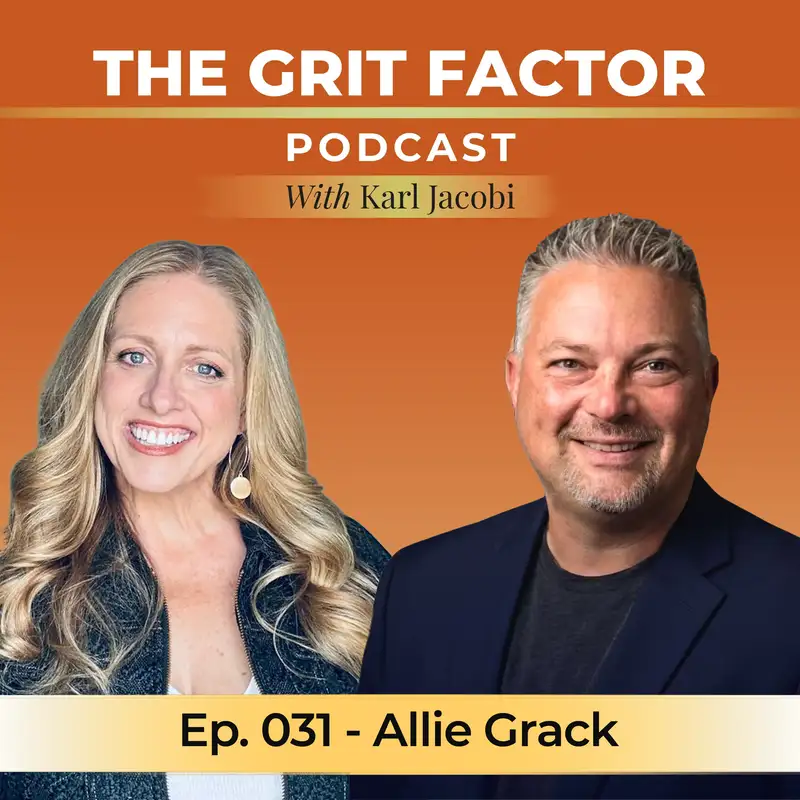
Episode 031: Grit Is Glitter. She Left It Everywhere with Allie Grack
TGFP Ep 31 Audio
00:00:00 Speaker: Average is the enemy of greatness. Comfort is the enemy of growth. Welcome to the Grit Factor podcast, where we strip away the highlight reel and get into the darkness beneath it. The real stories, the real battles, and the battle plans used to conquer them. I'm your host, Carl Jacobi, combat vet, entrepreneur, resilience and performance coach, keynote speaker, husband and father. I've built, scaled, and exited multiple companies totaling over forty million in revenue. But here's what that highlight reel doesn't show you. Life has been smacking me in the face with a two by four since I was just five years old. Broken home. Constant chaos. No playbook. No safety net. Just grit. And if you're anything like me. You know, you've got another level in you, in your business, your career, your faith, your leadership. You're just not sure how to get there. That's exactly why we're here. Be sure to follow me for more great content, and check out my website success with Carl dot com. Now that's Carl with a K. Now let's get to work. All right. Welcome back for another episode. Today I am joined by a guest whose entire life is to answer one question. Can you build an incredible life from a path that started with nothing? Foster care, abuse a baby before she was old enough to fully understand what Karen one meant. No stability, no safety net. Nobody's job. Who as it was to make sure she was okay. So she built her own life from there. Today she's a president and owner of Workhorse Marketing, a female owned, mission driven agency running for over two decades out of good old cold Minnesota. We're just talking about this before we hit record about how cold it is there versus here in good old sunny Sarasota, Florida. She's serving on the YMCAs, nonprofits, local governments, mission driven brands across the country, thirty plus years in this industry. Guys, a team in office in Brooklyn Park, a daughter she raised before she was old enough to drink, the kind of life most people would call. Absolutely incredible. And I would agree with that. The kind of life she had to build entirely without a roadmap. And many of you could probably resonate with this. She's also the woman who refuses to make her own bed, because every motivational book told her it was the key to success. I. I just laughed when I read this and I had to learn more about this and decide to be successful anyways. Decided to be successful anyways. Calls her grit glitter. Messy. Fun. Beautiful. Hard to clean up. I'm already falling in love with this person. And when I invited her on the show, she sent me one sentence back that became the spine of this whole conversation. Not having an ideal life path doesn't mean you can't make an incredible life for yourself. So, Ali, grok, welcome to the show. I'm excited to have you. Thank you. What an intro. You did your homework. Or I hope you can't see my bed from here because it is not made. It's not. That should have been part of the background. Ali. I know, I know, I really should do that. I should just have a messy bed in my background. It is definitely a pillar of of who I am. And when I write my memoir, it will be part of it. So that's that's, that's perfect. When I read that, I'm like, I've got to include that because it was just after I heard an admiral talk on how important it is to make your bed. Yeah. Hey, you know what I am a big fan of? If it works for you, if this is what inspires you to get out of bed every morning, is the idea of making it so that you can get back in it again. If that to you is an indicator of success, then you know what? Have at it. Have at it. You know, work your same job for thirty years. Get up and live that patterned life that's for you. That is not for me. I, uh, no thanks. No thanks. No, I love it this way. You know, it's like a little, little cave when you get in at night. I think that's going to be the title of this episode. You can still have a messy bed and be successful or something. Exactly. And, you know, I really do think part of it was, is I felt so misaligned with a lot of the motivational stuff that came out, you know, during kind of my coming up through trying to develop who I was and what I was going to do with my life. And, and my life never felt structured and, you know, simple. And so when I heard like, you can't be successful, you can't be a good person, you can't develop skills, you can't do anything if you don't follow X, Y, and z path. And I would see, and, you know, I went into college right away after my daughter was born. Um, and I got very involved in like Deca and, you know, marketing and business and development. And we would go see all these motivational speakers and things. And it was like they've had, they had it all figured out. The mysteries of life have been solved. I am successful and you are not. And I am here to tell you what to do to be successful. And I just thought the audacity of someone to feel like they've found an answer to a solution when every question is so different for every person. And so it really inspired me to say, you know what? I can use that as a piece. I can take little chunks of motivation from people and use it in a way that works. And this was before I found out I had ADHD, which explains so much about my personality, by the way. Like. Definitely helps when you start to understand that you're not a lunatic and that this is how you're wired. Um, and, you know, just kind of going from there and then, and then finding a path that works for you. And the good news is I still don't have it figured out. I'm fifty three. I love growth and development. I love finding out who the next version of Alli is going to be. Um, it's like reading a book that you've never read before. It's like you get to know what you had behind you. You know, the story that you've read, but every page you're like. And sometimes it's a jump scare, okay? Sometimes I turn the page and I'm like, oh, hey, close the book. Didn't see next, let's start over. Do over. But you know, that's what makes it interesting. I agree, I agree. We're see, we're already diving into some, some gold right here. And we really started the episode yet. But this is this is great. You know, and those that are watching right now, you're probably calling her bluff too. She's not fifty three guys. She told me she told me to agree and she's only thirty three. Don't let her fool you. Oh, I wish I would love to be back. And and actually, I wish I was, but then my daughter wouldn't be thirty six, so I can't. It's hard to hard to lie about your age when your daughter is. Keeps keeps getting older too, so I can relate. I can certainly relate for that one. So yeah, so Ali, take me, you know, take me back to, you know, before all of this, right? Take me back to the incredible life of, you know, back when everything was but ideal, right? Um, what does your story actually start? I mean, I, I could kind of take it all the way back to, um, you know, being born and having a mother that decided she wasn't ready for this. And so back at the time, you know, when you gave a child up for adoption, that was it. And, you know, hands, you're clean of this problem forever and ever. And, um, I was adopted into a very, uh, dysregulated, dysfunctional marriage. Um, and it was near its end at that point and it was abusive and volatile and, um, just very, very kind of always on chaos mode. You're always looking for the next path out of a situation. And so that heightened sense of, um, really thinking about how to look at a situation happened for me really early. Um, the benefit and I always try and say, you know, hey, this happened, but it taught me A, B, C, and D is I can judge a situation so quickly based on my gut instinct, based on people's body language, based on their behavior, that is really provided a lot of benefit for me as an adult to be able to come into a room and, and read it quickly. Um, it may not always change how I react to it, but I always know when I'm walking into, um, and chaos I love, I mean, chaos, the wilder it gets, the more calm I get. I always say it's like everything just gets quiet and I see exactly what needs to be done, you know? And I was in events marketing for years with festivals and I worked with Harley. And you know, if somebody, you know, we actually had an artist take an Ambien fifteen minutes before he was supposed to be on stage. What are you going to do? Right. You got, you know, at that couple thousand people standing out there waiting for he not to be named country music artist. And, you know, everyone was like, we had it. And I was like, nope, I got it. I knew exactly what to do. I knew which stage to shift to. I knew what artists to pull out that I could get to finish up. And it was a whole thing. And I thought, you know, I'm so glad I was dysfunctional. Well, that that's a good point, right? Like that that story has has prepared you for the life that you live. Absolutely. And if you can't look back on it and find meaning in it, even tragedy, even things that should happen to no person, and I wouldn't wish them on any person. But the whole purpose for me is to be able to look back at those situations and find one thing that I am grateful for in it. No matter how traumatic, no matter how bad, no matter how chaotic. Just, you know, like, what did I learn? What did I get out of it? So I agree. I think the very questions that you ask flips your perspective and it changes your life for the most part, for the most of my life, you know, I was always asking, why? Why is this happening? Like, you know, why, why, why, why, which is the victim mindset, right? Until I was, in a lovely way, probed to start asking the other question, what, how, you know, what can I learn from this? What was I trying to teach me in this moment? What you know, how can I overcome this? You know, when I start to look from that perspective, things start to get revealed. The real answers, right? Um, it's a great perspective. You said on your intake, I love to hear more insight on this because not that I completely relate to your upbringing, but for me, you know, I come from a broken home, you know, and I don't fault my parents one bit at all. They did the best they could. Um, but I come from a broken home at five and live the chaos life of chaos ever since. And, uh, so for me, I had no stability, no coach, no guidance, no nothing, no word. Map is what you said. Right? So I could completely resonate, although for me, I raised my right hand and said, okay, I do to Uncle Sam and gave eight years of my life, which don't get me wrong, I'm grateful that I did because I got the discipline whether I wanted it or not. I got it right. But you know, early on, uh, you said your intake, you learned early on that no one was coming to save you. He was, you know, no one's coming to save you, that if you wanted a different life, you had to build it yourself. How young were you when you actually figure that out, honestly. Um, I think I was about eight, I think I was about eight. Yeah, it was pretty clear at that point. I had gone to my first. Well, I had been through several like emergency placements by then where it was like, you know, what do we do with an eight year old who's not the problem, whose parents just can't function? And so I got placed in all sorts of weird places, like a runaway home for teenage, you know, youth and then a psychiatric hold for twenty four hours. But like, for people who were mentally unstable. And then finally, the foster care system kicked in and I ended up in a placement, um, and I was there for almost two years. And the day I walked in, uh, to their home, uh, the foster mother, her name was Bev. She sat me down, we were coloring and she said, I have a lot of rules and you're going to follow them, and you're going to do what I tell you to do when I tell you to do it? And if you don't, if you go out the door and you walk down that gravel road about a mile and a half and turn left, you'll eventually hit town. End of story. And I really knew at that moment it was no one literally was going to come save me. I was either going to follow her rules or I was going to walk down that road. And there was a big part of eight year old Ali, who, you know, had been through enough already who was like, I'll take the gravel. Like, I don't know what I'm in for here. I can actually picture that, to be honest with you, based on our previous conversations. But yeah, it's scary for an eight year old. It was scary, but I know I look back and I had such a hard time with this through therapy of looking at that girl, like being able to get into her body and looking at her girl, at that little girl and thinking of her as an eight year old. I have felt like a grown up in this body since I was six, seven, eight. I didn't have adults around me. And so you know what? I used to get very mad at little Ali for choices she made, right? And it almost makes me tear up a little bit because like, now I can look at her and go, like, I can see an eight year old instead of the adult version perspective. So at that time, I didn't think of it as poor little Ali. It was like, we have to do this. Like, we don't have a choice. Yeah, we're going to do something. Thankfully, um, that first placement was pivotal. She was not a hugger. She wasn't a player. But man, she had me like dialed in and my foster dad, uh, Butch, who, uh, was the opposite. He was fun guy, right? So I followed him around like a little puppy. We did. We had go carts. We had snowmobiles. He had a camper. Definitely sounds fun. It was so fun. And, you know, I mean, it was it was a really nice mix of like, you have to do the stuff that you have to do, but you can also have fun at it. Um, and so that was nice. It was a beautiful, it wasn't easy. I wouldn't say it was like, I think everybody wants to make that like, oh, it was perfect. It wasn't perfect. I still had to deal with my family. The point of foster care is typically reunification with your family. And so I had visits and I had a lot of disruption and upheaval. They had other foster kids who had disruption and upheaval. And so there was always a sense of like, you didn't know what was around the corner. So you took advantage of the moments like a snowmobile ride. And, you know, that suddenly becomes the highlight of your of your moment or your youth, even because you didn't know, you didn't know what was coming down the road. So about, you know, almost two years, maybe just short of two years, I got replaced back with my family. It lasted less than six weeks and I was back in the system, and they actually actually went to court and asked for me to be replaced. And my adopted family said that was a no no starter non-starter. They felt I had gotten too attached. And so yeah, so then it was, um, I mean, in total, we're talking about eleven moves from eight to junior year. So no consistency in education, no structure, no family dynamic. Um, my final placement before I actually ended up moving back in with my abusive father when I was fourteen and a half, fifteen, almost fifteen, because I didn't want to go back with my mom and, um, he, he, he was fifty when I was born. So by the time I was fifteen, you know, he was sixty. He was done. He was over it. Yeah. You know, and so I kind of just got free rein to do what I wanted at that point. And by then I had been on my own since, you know, eight. So I was like, well, okay, let's just go do this, which also kind of summarizes in a really short, brief way how you end up with a daughter at seventeen. Um, makes sense. Yeah. When you've been kind of captive your whole life, other people's needs and wants, you do find, um, you know, a way to kind of break out of that pretty quickly when you have some freedom. But, um, but, you know, honestly, Bev and Butch gave me a lot of really good direction. Um, you know, I think she gave me the skills that I needed when I needed them at the time, you know, some structure, but, um, like a sense of responsibility even. And that really helped, um, kind of mold who I became as a parent, which is double edged sword. I was not the get on the floor and play mom because I was so worried about, you know, making sure they were okay and structure, structure do this. We have to do this, you know, very survival mode parenting. Um, so, you know, it has its good and its bad, but, uh, you know, it was, it was an adventure. I was really fortunate. I will say one of the key things that happened in that was as being one of the throw away kids for the state. You get a lot of benefits, like free summer camp, right? Because they don't first of all, they don't know where to put you anyway. And, you know, things like the YMCA, which, you know, ironically, I now work for a lot of YMCAs around the country, but the YMCA would give us a couple weeks each summer at summer camp. And the Des Moines area YMCA in Boone, Iowa, had the most incredible summer camp. And there was an executive director there named doctor Ray Pugh. And he dedicated his whole life to kids like it was. He was just the most dynamic individual I ever met. And he actually had a really transformational series of camps about the time I was like twelve, thirteen, and it was called leadership Of two thousand, which means I'm very old, because it was in the late eighties that we were talking about two thousand. And, um, but it was, it was teaching us to be the leaders of our generation. And so, um, how to shake hands like a firm handshake. I still judge you by your handshake. No one knows I'm with you. I will still judge you, um, by your handshakes, especially women. So girls shake some hand like shake it. Well, none of this. Don't, don't flop your dead fish in my hand. Um, you know how to make eye contact, how to speak with authority, how to, um, publicly, publicly speak, which he said was the key to the universe is if you can get up in front of a crowd and feel confident around thousands of people while you're speaking, that's power. And I hung on to that. I was like, tell me more. That's true. Yeah. And that's how I got into debate. That's how I got into speech. That's how I you know, I actually helped pay for college through some of those skills. So yeah, kind of wild how those one little things, you know, that and I, I hope he knows he did pass before I ever really got to have a conversation with him about it. But I hope he knows how much impact he had on so many lives. But specifically, um, mine, you know, I think about it a lot about how fortunate I was to have someone like that see potential in someone who everyone else looked at as trash. You know, that's a, that's a great point. And I want to highlight that for a moment because we do things like for the example you gave with, uh, um, last name of Pugh. I don't remember the first name you say. Doctor Pugh. Yeah. Doctor Pew. Yeah. Um, it is, It's very memorable. Sure. But, you know, in those situations, they don't really realize the impact they have and they never will. No, no. Um, and oftentimes I would say I would be inclined to say it's upwards of eighty to ninety percent of the time that you impact people. It's not through a direct conversation, it's through your audience or, you know, to your point, you, that person's an audience, you're sitting there, you know, listening to this person, uh, speak to a group and you took action on that and it changed your life. Well, that person's, you know, never going to know real quick before we keep rolling. Maybe life hit you hard. Business fell apart. Career isn't working out. Relationship ended. Health took a dive. And now you're standing in the rubble trying to figure out what the next move even looks like. Or maybe nothing blew up at all. On paper, you're winning. Sure. But on the inside, something's off. If you're not in crisis, you're at a crossroads. And the playbook that built the life you have is not the playbook that builds the one you want. Either way, you're stuck. Not broken. Stuck between who you were and who you're becoming. Most self-help just piles more weight on load you're already carrying. I do not want to do that. I put together a free video series called the Grit Code Exposed, and I want to invite you to check it out. Seven short videos. That's it. The five laws that change everything for me. In every client, I coach the same five that every person who's ever come back from the fire has walked through where they had a name for it or not. No fluff, no ninety minute webinar. No bait, just the free video series. You can start it tonight. Grab it at grit. Code exposed dot com one more time. Grit code exposed dot com. It's free. You don't need any more hustle. You need the next version and this is how you find it. Check it out. See if it speaks to you. And if it does, I'll see you inside. All right, let's get back to the conversation. Now. No, I'm even having the foresight to see that there was not going to be a lot of opportunity for kids in that era. I mean, this is all pre computer. We didn't couldn't learn everything on TikTok, right. Like we were doing the best we could. I mean, the children now you're really dating us. I know. I mean, the children's encyclopedias were nice, but come on. So, you know, I think for that to even have the insight to say there's a gap, there needs to be more than reading, writing, arithmetic. And that I mean, that was back when the schools were really doing education. Like we were learning, um, things. And, you know, now I almost wish we would refocus on things like leadership and life skills, life skills. Like, I mean, I don't usually try and my, my youngest, uh, stepson is turned eighteen this week and I love him so much. He cannot sign his name. They don't write cursive. They didn't, they can't read cursive. I used to have to read his grandma's cards to him. Um, so I just kind of, you know, I don't want to be the old lady in the room. Like, we need to learn cursive and do these things. But you know what? Like shake a hand. Go, go learn how to shake a hand. Go learn how to have a conversation and make that eye contact and be engaged and ask the questions and show interest. And it's astonishing to me how few, um, teens will make eye contact. Agree. Wholeheartedly agree. Yeah. Agree. I've, I've even had to have that conversation with our kids and even people they, you know, brought in and was like, you know, as I look at their, you know, uh, their influence, they don't have that influence. No, no, no. And, and that's the thing. Like, I don't feel like there's those generational leaders developing in the way that we used to kind of see. But, you know, I think there's a lot I do think there's a lot of positive things about, um, some of the generational stuff, right? They don't apologize for anything. Okay. They, I love the empowerment side of it. Um, especially from our female, uh, you know, younger generation, they are not here for taking your crap. If you know, somebody wants to lip off to them, they will put them right in their place. I love it, they ask for what they want. They are very clear about their directives. Um, I think it just needs some tweaking. I think we just need to rebuild some of those core communication skills. Yeah. Um, and I think we've gone so fully remote that I can actually hear my daughter right now saying, you don't need cursive. What are you going to do with it? I can hear her saying things like, um, who's shaking hands? You're not even supposed to touch people, you know, like Covid. And so yeah, maybe I am stupid in the old days here, but, um, what's the equivalent then? How do you make a connection with another person through conversation and through communication then, because if we've lost the physical, you know, attributes and we're not going to be in the same room together and we're not going to shake hands, how do we still how do we still build leaders then? I don't know. Can't. Yeah. It's tough. It's a tough one. It is one hundred percent especially in the last five actually now six years when the world got stupid. Um, yeah. Yeah. It's gotten extremely challenging. You know, and I see it my kids and, and the kids, you know, after them, you know, and how especially with, with rapid evolvement of AI, in a way, it's gone with AI and wild how fast that's happening. Yeah. Yes. Oh, yes. For sure. I think that's one of the things that I'm most proud of is I really, as much as I do, relish not growing up with some of the technology, I think there's a lot to be said for our disadvantaged youth. Um, I adapt the minute I see technology, I'm like, okay, giddy up. Let's get this. Check this out. Let's do it. Um, you know, I saw the potential when Myspace was the thing. I was like, why aren't we running ads on this? You know, and, uh, you know, so I love the advent of it, but I just AI is a very different thing. And I think eventually we're going to have to put some sort of like, I don't think you can put regulation on it as much as you can, just like a mutual understanding that these are the guidelines we will use, um, for the best interest of the world. Agree. Yeah. I, yeah, it's going to be, it's going to be interesting to see how that's going to evolve in the next five years. You know, uh, the workforce just in life in general. Yeah, yeah. It's kind of fascinating though. I love for it all. Like when you really think about how much we've seen evolve, um, I kind of figure we're like, you know, the generation a couple before us where like lights came on in the house at night. And, you know, it's like, whoa, those are some big changes. But yeah, yeah, yeah, one hundred percent for sure. Well, getting back to your story, because man, I know I'm pretty sure we can dive into a lot of different areas, but yeah, you know, you told me that you do not see your life in rock bottom moments and I want to hear why. Because you called it the you called the hard parts the quiet. Wait. Yes. Explain that. I think for me, when you get into a scenario where it's as just abysmal as it can be, right? And I've been there. I've been, you know, in tears on a bathroom floor that gut wrenching, you know, ugly cry. Like I've been there. And I have always found that you just have to let that happen. That is the one moment where my brain has to stop for a minute and allow that wave. Because I know in my heart that if I let that happen, the next step for me is, all right, now what? Now solve it. But when you're at that low moment, I think for me, a lot of it is perspective. Like one, you know, and I, I do say this, my trauma has allowed me a sense of perspective that most people don't have. My husband, for example, grew up in a literal Norman Rockwell life. His parents were in love until the day his father died. He was in a small town. He went to the same school his whole twelve years, like he knew his extended family. They're still adorable, you know, as a like all perfection. So when his father, who was his best friend, passed, he had nothing that had ever happened in his life to prepare him for trauma. Makes sense. I, on the other hand, you know, can think of twenty things that would have prepared me for that moment, including losing my foster mother to cancer in ninety four. Um, you know, and because I did stay connected to them as much as I could. And, um, I think for me, I just knew whatever was about to happen, we needed to just stop a minute and then plan. And then I did go into hyper survival mode. Sure. But perspective. Huge. It will you will get up tomorrow. You will move forward. You will, um, you know, kind of have to continue to take a breath. And that was not negotiable for me. Um, because I am too curious. And so I wanted to know how the story ended, even if like, there's no way I wanted my story to end at sixteen, twenty two, forty one, you know? And there were points in all of those ages where, you know, maybe someone a little more sane would have said, this is too much, I don't know. I mean, maybe I have to just lean into the fact that some of it is not logical to continue on, but makes sense. And this the perspective of I'm a big traveler. So once I got the freedom, once my kids got a little older, once I could get out on the road. That's what my passion. I love to travel. And I just think when you go out and you look at coliseums or cathedrals that were built in, you know, twelve A.D. and you're standing there and you're like, the bricklayers issues do not matter. Whatever his life crisis was in twelve A.D., no one's talking about it means nothing. That's so good. I agree. You know, so you just kind of go like this is all we get. If I get fifty three point seven five years on this planet, at least it's going to be a good story. At least it's going to be mine. So if you give up or if you try to follow someone else's path, or if you're holding yourself to standards that someone else set for you, it's not yours. Yeah, I agree. It's not yours. And so dust in the wind, we're all dust in the wind. Literally nothing matters. In fifty years, no one will talk about you or your issues. And that's even if you're a great person and people love you and you know, you're iconic. Unless you're Oprah by. Yeah, it means nothing. So perspective. Agree. When you say perspective, it reminds me of when I was told, I don't remember who told me this. It might have been another guest, but we were just talking about this with another guest, actually. Uh, actually, the episode's coming out tomorrow. Oh, nice. Um, yeah. So, Ryan Otwell, uh, is coming. We talked about this perspective shift. It's it's not looking forward where all the dots connect, right? It's looking backwards where all the dots are connecting the trials and tribulations and things that we've been through so that the person behind us. Yeah. That we can pour into to guide them in their own fires. That's what we're prepared for, right? Right. We're we're not, we're not prepared to, you know, to enjoy our own wisdom. No, it's so that we can impact other people who are currently going through this similar flavor of fires. Yeah. Um, you know, to, to walk them through, you know, and I think to me, the key to is to show that there's not one path. Mhm. That's my number one thing, especially look, as a woman, you know, And of course, I had to go into a male dominated field where you have to be outgoing and, you know, all of these things. Like that was not a fun journey in ninety one, ninety two, ninety three. I imagine it wasn't. And you know, now it's gotten better. But let's be honest, my granddaughter has fewer reproductive rights than my birth mother who made the choice to give me up for adoption does. So we haven't completed this journey, and sometimes it feels like I owe it to not only little Allie who survived, because, you know, we did have reproductive rights and choices, but to the two generations ahead of me, that may not like we have to have these conversations, hard conversations and that there's no right answer to a solution. You know, I chose to have my daughter and keep her. That was a very personal choice. Um, I don't think I have the right to tell anyone else what their choice should be, you know? And so saying to someone else like, yes, this is how I did it. I ten out of ten do not recommend doing exactly what I did. But here are some ways to. Here's a tool. Here's a tool that you can use. Um, you know, God, that's all we can hope for. Because really, you know, I mean, if you can't bring a sense of, of some level of inspiration, even if people don't like you, um, which I have a stable of, let's be fair. I mean, I am, I am not everyone's cup of whiskey and that's fine and that's okay, but it's, it is only because I have very strong opinions about the people that I love and the things that I care about and the things I'm passionate about. And I am trying in my my older years to like, find that peace and that calm when people do hard, isn't it? And you just want to, you know, like fix. I want to fix their problem. I want to make them less bad decisions. Uh, inclined. I'm still going to offend people. I'm still going to tell you how I feel. And I'm really sorry. I probably should send out a hallmark card to all of the children and probably past relationships, I don't know. Um, but you know what? That's how you learn, right? And I agree, yeah, I wouldn't, I wouldn't trade it for the world. I really wouldn't, I mean, some of it maybe, but you know, I have to laugh like I've been writing down, um, not journaling because I think that's icky. If journaling works for you journal, you should journal. I think it's icky. So I just write notes like little one off things. And I was thinking about this, um, about a couple of years ago, we were in Mexico, um, a girlfriend and I go down for a month and work remote and she out of the blue, we found a box of brownie mix in the house that we were staying in, and I had not eaten brownies for one hundred years. Right. I know you think you know where this is going, but it's not. It's not fun. So I was like, oh my gosh, I haven't had brownies for years. Like, oh my gosh, we should make this. I remembered my placement in when I was twelve to fifteen, was in a group home in Sioux City, Iowa, hosted, I guess, hosted by Catholic Charities. Do you host a group home for girls? I don't know. Anyway, they're the main. The primary caregiver for us was a older, very tiny, limited English nun from China. And oh my gosh, all the stories I can tell. But when she made brownies, she used espresso instead of water. Oh. First of all, don't give teenage girls espresso brownies. I see noises, Literally. It was wild, but they were delicious. They were so good. And so fast forward thirty years and I'm in Mexico making brownies that were amazing because of that moment from thirty years ago. Like, doesn't that kind of blow your mind when you think about it has no relevance to life. It means nothing but those little pieces that come up and, and change who you are as a person. Yeah, that's a good point. It's kind of iconic. Guess what? Now my son that's graduating or stepson that's graduating, he wants my brownies for his graduation party. I have twenty six boxes of brownie mix down on the you know, that's that's a lot that's a lot of brownie mix. And I think the, the whole circle for me is like, that could have been a very traumatic time in my life and I could choose to focus on on those things. And to be fair, most of the girls that I lived with in that scenario, even at my age, more than fifty percent are deceased. Um, the other fifty percent, I don't feel like got the opportunity or fought for the opportunity. And that breaks my heart. So I could focus on that. I could focus on how it wasn't fair that I had to grow up this way. But I'm going to focus on the brownies. Great brownies. Focus on the brownies. That's going to be the title of this episode. Focus on the brownies. Yeah. Like why not? Like if you have to pull something from the abyss and remember it. Um, I think you honor the pain, but you have to focus on the positive. Mhm. Agree. Agree. Yeah. As soon as you started talking about brownie mix and so forth, my head was definitely going a different direction. I'm like, I know where this is going because I've had those brownies. I'll be honest. I'll tell you, growing up in the system, I was exposed to a lot of illegal illicit drug use. And I will tell you, the one thing it did for me was I did not do drugs. I saw people doing things that made them talk to house plants. I did not. Whatever that was, I didn't want it. Um, I did see people using marijuana pretty aggressively. They acted like morons. I did not want that. Um, part of my survival was control. And so anything that took me off that path, I was not really into. I didn't even drink till I was fifteen. That's my one liner. I'm literally serious. I wouldn't even drink a beer until I was fifteen. The fact was, I could have much younger. Um, but you know, fifteen is ridiculous. Don't drink at fifteen. That's stupid. But yeah, but, you know, considering the the places that I lived, fifteen was like an accomplishment that was like. And even then it was Bartles and James. I don't think it actually counts. So. We might have to put a little picture of what Bartles and James is up for. Anyone under fifty. Yep. Yeah, I'll put that in like in, you know, probably in one of the corners here, what that is. Well, of course those are listening are not going to be able to, you know, see that. So you have to watch it on YouTube, Google it, Google. There you go. What Bartles and James was. Yeah. Wow. Yeah. No. Now you're really making us feel more seasoned and seasoned. I like that, I like that I just, I run to old like, I'm just, I'm an old timer. Real quick before you go, if you're still with me this deep into the episode, something in it hits you. Maybe it was the guest. Maybe it was one line. Either way, you're still here. And that feeling in your chest right now, That's the signal. Most people get a signal like that and do absolutely nothing with it. They close the app, life rushes back in. The moment's gone. Six months later, there are the exact same spot. I don't want that for you. So I put something together. I want to invite you to check out a free video series called the Grit Code Exposed. Seven short videos. The five laws. I walk every client through. The same ones that rebuilt me when everything else fell apart. And if you listen closely today, you heard them running underneath the entire conversation because everyone who's come back from the fire walks through these five laws. Some find them on their own, some get help, but the laws don't change. Free video series. You can start it tonight. No fluff. No ninety minute webinar. Just the series. And if you're going to do something with what you heard today, do this before life talks you out of it. Go to grit Code exposed dot com one more time. Grit Code exposed dot com. And hey, before I let you go, thank you for riding with me this long. It means a lot more than you know. Thank you. Well, it's funny you say that your your you talk about control because one of the things that, uh, you know, that kind of made me chuckle was the anti routines, right? You said routines are the death of you. Absolutely. Explain that. I want to hear more of that. I get bored. Um you know, I think it's, I think it's just now getting to honor my brain, right? My brain is literally why I have an agency. I didn't honor that for a long time. I would come up with crazy ideas and people would be like, you're annoying. Why do you have so many ideas? Now I honor that. I, you know, I literally do come up with weird ideas and now I get paid for it. Like that's my job. Um, and so anything that's got to be so fun. It's so my job is so I have the absolute best team. Shout out to my amazing team. They let me, um, be a little weird and crazy and kind of off there. But we balance you know we have a good balance on the team. You have to you cannot all be Ali's. No one wants that. I agree you cannot be an Ali. Uh, I don't I again, I don't ten out of ten recommend, uh, this lifestyle, but I honor who I am now. But, um, it's so fun to get to just like, oh, we have a brand. Well, what do you want the brand to be about? Oh, here's ten ideas. Here's an image, here's a tagline, here's a jingle. You know, I, my greatest joy as a child was the escape to the TV of all four channels. And my favorite part, forget the really cool cartoons and stuff was the commercials. And you know, I would sing the jingles and I would remember every product that was associated with every ad and you know, it, it really was inspiring to see some of the creativity back then. And so now that's, I get to do that. That's crazy to me. So yeah, I get to pay to do this, right? Right. It's paying the bills. Who knew? So, um, you know, but I think that's part of the story too is like, and it's so much better than it was before because people do understand, especially for little girls. Little girls were not diagnosed with ADHD appropriately until very recently. And so I was just disruptive. I was loud, um, I was disobedient, I was, it wasn't creative and interesting and unique. All of it was very negative. Um, actually, my adopted mother recently told me that I was the demise of her preschool during the divorce, because I had to be a part of everything I had to be in, you know, running. I was six. Okay. So it probably was bigger than me. Yeah. Ruining her preschool. But like, that's how people saw it was disruptive and I didn't I was six, first of all. But if had I been a little boy, would it have been more acceptable to be running around and, and being creative and unique at the time? Absolutely. Absolutely. And I'm glad it's changing. I love dynamic little powerhouses. My own granddaughter, um, to actually both of them, the two little girls are only like five months apart and they're literally like cousin twins. And, um, but they're, they have opinions and they will tell you them and they are non-negotiable. That's awesome. Yeah. I love that. Me too. Me too. Very, very cool to see. So I imagine so. I imagine so. Well, thanks for, you know, sharing all this has been such a great, you know, time walking through this story with you. It's, you know, listening to your story here. It's been such a privilege. I thank you for that. Um, you fast forward to today, you know, with, uh, workhorse, you know, workhorse marketing, if I remember correctly. Yeah. Um, you know, with all the work that you're doing, right? You work with YMCA, the nonprofits, local governments, you know, mission aligned brands, which now all makes sense. Yeah. Right. What are you most fired up about right now? What chapter of your life that the world has not yet met? Oh, man. I've been on a roll lately about, um, one of my favorite phrases for years has been you can't out market bad customer experience. So amen to that. Right. And it's not talked about enough. And I am passionately obsessed with Burger King right now. If you're not watching, uh, Tom Curtis new CEO gave out his cell phone number, people called with issues and he is taking it to the bank, fixing signs, cleaning stuff up the, you know, they are restructuring. And I have been trying to preach this for decades now. I'm hungry for a whopper, honestly, like the Whopper was always, listen, I'm going to date myself again. This is the. Let's see how old Ali is. In nineteen eighty four, McDonald's quit using lard to fry the French fries. I do not care for McDonald's anymore. It's never been the same. If you could time travel to nineteen eighty four, I would go to McDonald's and I would immediately order one zero zero zero pounds of French fries and I would eat all of them immediately. But I feel like Homer Simpson salivating over donuts. Like really? Like you cannot tell the younger generation that McDonald's fries were once better because they still think they're good and they're not. So Burger King, for me was always the better burger by far. But now to put your money where your mouth is, and this is what I tell all our clients, we got to stop marketing and we got to look at the base. Are you selling the right products? Are they priced well? Remember the five P's back in marketing school? Like how is your website? Or if I come to your website, is it going to take me four clicks to complete a conversion? Let's fix that first. We just did a recruitment campaign restructure for a bunch of the YMCAs out on the East Coast. They were having the ADP seven page form as the conversion. Oh wow. No one's going to do that. So we put a I'm interested in employment at the Y form fill. Boom Boom. People came out of the woodwork because we changed the friction. We changed the funnel. So, you know, fix the stuff first. Then let me spend the money to tell people to come here. But if you aren't looking at everything in a holistic manner, and I guarantee you you're one of the few agencies doing that because I've worked with the agencies. This is what inspired workhorse. And the first question is how much do you have to spend? And can I put it on radio so I can get concert tickets? Can I put it on big TV so I can get, you know, some sort of financial kickback where course is built around the idea that we work for our clients. Which is why the nonprofit sector loves us. And I don't spend the money unless I would write the check. So if I'm going to put a million dollars of ads on TV, I would write that. Check personal account accountability. Mhm. That's so good. Yeah, it's kind of fun. I can imagine. Now, now that makes sense. You know, listening to you talk and I can feel it. I can feel your your passion and, and, uh, even though this is virtual, I can still feel your passion and enthusiasm for what you do. And I love it. You know, I could tell, I could tell, and, uh, I could tell you're really good at it just by the way you're talking about it and just the way you walk through that. So now as soon as I get done with this recording, I have to hop over to Burger King and get a double. I know. Thanks, Tom. You know, it takes leadership. This is what it all circles back like without him taking the initiative to make that change. Who's talking about Burger King? Sure. No one, no matter how much they spend in marketing. That's true, that's true. I do want a whopper now. Me, too. Maybe a brownie. Ooh, that also sounds good. Just swap the water for the espresso. Yeah. Yep. Yep, one hundred percent. My. You know, there's a part. Because I love espresso first thing in the morning after, you know, I get my routines done. See, I'm very opposite of you, but I. One of the first things I get is a couple of shots of espresso. So nice. I only do that if I'm in Europe. Oh, yes, I agree with you. I'm right there with you. You can't. You can't do it better than they do. I agree. I agree. I agree. I love to give every guest sixty to 90s to talk to this. You know, this past Ali, right? Maybe. Ali that's probably twenty years behind you that's walking through this similar fire, you know, that's been in this journey with, you know, that is needing some hope that's needing some aspiration. So talk to the Ali twenty years ago, thirty years ago that you wish you knew. Now, what would you say to her? What would you encourage her with? What would you empower her with? Whether it's a tool or a tactic or maybe it's just inspiration. What would you say to her? I think a lot of it would be validation. You know, twenty years ago, there was still a lot of questions. And I think I would just go back. Um, one of my girlfriends and I always say, bitch, you're doing a good job. And, um, I think I would honestly just tell her no one, no one really ever did that. Um, and you realize that's maybe part of the reason you kept working so hard, and that's even sadder. So you're not only doing a good job, but you are a good person and you are going to love where you get, you are going to be in that safe space. You're going to let all of this other junk go, and you're going to realize nobody else matters but you and the people you love. That's it. All the rest of them can pound sand. Love it. Pound sand. Yeah. like kick rocks. Isn't that what they say in the south? Kick rocks. Rocks. Bless your heart. Bless your heart. Oh, I would tell so many people to bless your heart. Oh, back in time. Yeah. I, I, I would say that I still say it sometimes, but it just doesn't come out the same way here in South Florida. Sorry. But yeah, right. When I lived in Alabama that that was commonly said, it took me. I mean, I grew up, I say I grew up, I spent a lot of my young, my young childhood with my grandmother and in North Carolina. And that was pretty much my mother role and oh yeah. So, uh, man, oh yeah, that's the grandma. I, you know, I want to be the cool grandma, but I also want my grandkids to be like, yeah, she taught us some stuff. She loved us big, you know? Yeah, and I do. I love them big. Real big. Yep. Yeah. So I would constantly hear her say, bless your heart. And it took me a while. Like, what, what does she mean by that? It's whatever she wants. Yeah, right. If you say something that's going to piss her off. Bless your heart. And you knew exactly what's coming after that. I love that. I love that. Yeah. That's great. Well, awesome. Well Ali we towards the end as we're coming to a close. I've got some rapid fire questions for you. Yeah. I'd like to ask every guest, two of which have already kind of prepared you for. Yeah. So in this season that you're in building workhorse, you know, marketing and some other initiatives you're working on, what is your definition of grit? Because looking back, that's all it's been. Right. So for you in this season, what does that mean for you? I mean, I think we talked about it a little bit. Like I don't want to look at it in a negative anymore. You know I think a lot of my grit got redefined as like I said, you know, you're just too big, you're too much, you're too this. So that's why I say like, my grit is glitter and I dare you to get rid of it. It'll be in your vacuum. I want to leave. Like I want to leave. Good stuff, you know? Um, and so having that grit, it's exhausting. And anybody who knows anybody who's fought the battle, who's, who's run on survival mode for thirty years, it gets tiring. And so repositioning it and saying, you know what? No, I'm doing this because I want to do it. I'm doing this because I love it. And I promise you, the first day I wake up and the passion for marketing is gone. I'm done. I'm done. Uh, that's the key. You do not have to fight this battle. You can change directions at any time. You will be okay. The universe will provide for you in some way or another. If I had to go work. I always say Coles. I don't know why. I don't really shop at Coles, but if I had to go work at Coles for a year to get my life figured out, I'd do it tomorrow. Yeah. So the. No fear of failure. I have none Because, listen, I've come from a gravel road with nothing and, um. And. True. And leaving your grit as glitter. It doesn't have to be ugly and painful. Like it can be fun. That's a good point. We should actually, you know, use it as glitter, right? Yeah, that's a great point. You know that shit everywhere. Like get out there, inspire people with it, you know? There you go. Yeah, I'm gonna say just inspire for some cover art for this episode. I'm gonna have some glitter, you know, sprinkled throughout the cover art. I will not be mad. I did have a friend who used to get mad if you sent cards with glitter on them. Because some people don't love glitter. That's the point. Oh my gosh. Yeah. It's okay. Oh my gosh, this has been such a good time. Yeah. Fun to chat with you. Yeah. Likewise. Likewise. All right. Last two questions, I promise. Uh, the last question comes a two part. But, uh, before I ask you that one, when you're in the thick of it and you're in the trenches, whether it's for a moment, a day, a week, whatever, is there a quote or a directive or even a scripture that you that you tell yourself to pull you through that moment? You know, it actually came from why camp? And it's probably, you know, I, I don't really lean any way through faith. I've been through a lot of journeys with faith. Um, you know, I, like I said, I lived in a Catholic Charities. We went to mass with a Chinese nun. If you can say that, come call me. I would love to meet other people who had that experience. But I also went to a Southern Baptist church at one point with one of the caregivers. I was born in Missouri Senate Lutheran. I was, you know, I have seen it all. So I respect all of it. I have just chosen to use universal energy as more of my guidance. But, um, boy, the darkest moments, it's this too will pass. Mhm. End of story. And that goes back to my view on resilience. Um, now it's more dust in the wind. Like I'm getting to an age where like I literally, um, am ready. Uh. I'm good. Like, I think that's the other thing too, is I'm living now out of, out of joy, out of sheer, like, what is the next, you know, story that we can talk about travel, adventure things, but I'm also good if this is it, if today is my last podcast, if this was how I spent my last, you know, hour, I'm good with it. And I'm glad you were a part of it, but I we're not leaving anything on the table. So the bad stuff will pass. It will be okay if people are, you know, doing things to try and hurt you, or if you're feeling hurt by someone else. That's their journey. You gotta, you know, you gotta allow people their journey. But this will pass. We will all be gone. and none of it will matter. So enjoy the time. Enjoy it, relish it. So good man. It was so good. Yeah, I, yeah, I think the whole episode just pretty much encapsulates just on that. Right. It really does. And I hope that's the takeaway is, is, you know, don't make your freaking bed if you don't want to. No one is going to come to your house. I do always laugh about like, if I'm on a Dateline episode and my bed isn't made, I will get shade. Uh, I know I will just, you know, let's just get it out in the ether. If my Dateline episode shows my bed unmade, I made that choice. That was not a I'm not a slob. I made that choice. I could tell, I can actually tell. Oh my gosh. All right. Last question comes in two parts, those for listener watching, if you're if you're listening, are watching for the first time. Just so you guys know, I love asking or challenging this is my current guess with the question of my future. Guess the lineup is completely anonymous and so far the questions have been perfect. Landed perfectly every single time. So no exception for you. Okay, so what would you love to challenge my next guest with? What would be a question you would love to ask him or her? I think I kind of have two, I have like a fun version, which I think is really light and fun. But I think to me, you know, like I say, my perspective is everything. And so I love finding inspiration in unique historical, especially female figures. So I think I would want to know, like if you, you know, not the dinner, maybe you don't need to have dinner with that person, but like, if you could hang out for ten minutes with one historical figure, not, not, you know, a president or what, but some kind of unique historical figure which emulates who you would most like to be. That would be a good one. But I also love asking people their favorite dad jokes. So you choose dealer choice. Ooh, I know that's hard. I know it really is. You flipped the script on me. That's not fair. I'm sorry. I know, I know. I actually might just use both. I think they should have a follow up dad joke question. And I'm terrible at jokes. I cannot remember any of them. The only joke I ever remember is where do you find a turtle? Or a turtle with no arms and no legs? Mhm. Right where you left it. That's it. You know, that's funny. You mentioned this because this if you're watching or if you're listening, you can't see it. But my my wife loves these dad jokes. No. Yep, yep. I love your wife already. Good job. So there's nothing funnier than a dad joke. I agree, so that being said, which bear is the most condescending at Panda? Oh, it doesn't get better than that. It does not get better than that. Brilliant. Keep the joke, duck. I'm gonna have to get that, because I really, I got nothing. I do have a look of eyeballs that I put on random things. That's my joke version. So I see you. Nice. Love it. Funny, though. No. All right, so Chris Far had this question for you. Ooh. Okay. All right. When you're in a chaotic situation, when everything is falling around you, how do you keep your team motivated? What do you do to make sure the people that are your direct reports keep marching forward when there's no light at the end of the tunnel? Or at least that's what it perceives to be? Yeah, I mean, honestly, I think for me, it's allowing them the peace to not feel ownership of it in that moment. And so, you know, hey, like we've hit some road bumps, don't get me wrong. Um, and so, you know, being open and transparent about the issues, I do not sugarcoat, uh, what's going on. If it is a crisis, they have the right to know. Um, I don't feel like I get to gatekeep that. I also am very clear about the risks and the rewards of getting through it. And so, um, I, I passionately love my team. I've done everything in my power to, um, we have a four hundred and one K match. We have health insurance. I send gifts every moment I can try and send gifts. We have a, we call it the Bachelorette, uh, lunch dates where we take each other on lunch dates virtually. Yeah. And we buy lunch for each other. So we at least get some one on one time, even though we work all over the country. Um, so that leadership has to be from a place of love and respect and preventing, protecting them from the good, the bad and the ugly isn't love or respect. That's so true. I agree. That's a great perspective. I never seen it that way. So man, thank you so much for sharing it. Absolutely. Well, awesome. Well, for the person who's listening or watching that wants to connect with you, or maybe they want to hear more about the marketing that you're doing and maybe, maybe how you can help them. Or maybe they, they resonate with your story and they want to connect with you. Where can they find more about you? I would love that. I actually am putting the call out. So if there are any women who came up through foster care journeys, I do want I would love to talk to them. I am the only ally on LinkedIn, so you should be able to find me pretty easily there. And that's probably the best way. Otherwise, it's just More course dot com. Um, or there's links in teamworks dot com where you can find me and connect there too. But, um, yeah, I'm really excited. This has been a good year of journey for I'm doing a lot more public speaking. I'm doing a lot of motivational speaking podcasts. So it's been fun to get out and meet people like you and get to talk to people about the journey. So awesome. Thanks for brownie recipes. With or without espresso? Yes. Yeah. Always been oh my gosh. Yeah. We're definitely gonna be dropping all of that in the show notes guys. So if you're, you know, I definitely encourage you to reach out to Ali, you know, whether you fit that, you know, avatar or you just want to thank her for, you know, getting on here and pouring, pouring herself out there. Definitely connect with her. So. Well, Ali, thank you so much for coming in here. And again, just not just sharing the amazing highlight reels, the amazing successes, but talking about, you know, the, the life of, you know, that you've experienced through, you know, foster care and abuse and all of that, and you allow that to form the amazing person that you are today. And so I just honor and respect you for coming here to share that story and allow people to be impacted by it. So thank you. Well thank you. Thanks for letting me have that conversation. I think it's an important one to have. I agree, I agree. Thank you. All right. So for those that are listening or watching, the gap between average and excellence is just action even in perfect action. Please don't just listen to Ali today. Take one thing and apply it, even if it's just not making your bed. Do it within the next twenty four hours. Be the reason somebody doesn't quit today. Don't just keep this episode to yourself. Someone in your circle needs this right now. Send it to them. Ali. Again, thank you so much for joining us. Thank you. My pleasure.
Creators and Guests