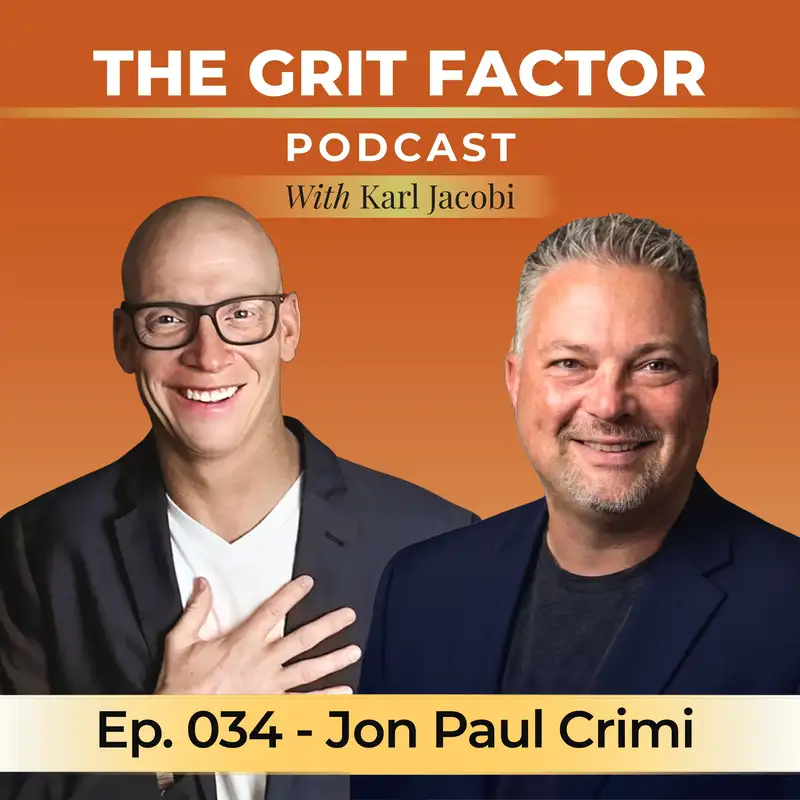
Episode 034: Stabbed at Nineteen. Sober at Twenty-Six. Still Cracking People Open with Jon Paul Crimi
TGFP Audio Ep34
00:00:00 Speaker: Average is the enemy of greatness. Comfort is the enemy of growth. Welcome to the Grit Factor podcast, where we strip away the highlight reel and get into the darkness beneath it. The real stories, the real battles, and the battle plans used to conquer them. I'm your host, Carl Jacobi, combat vet, entrepreneur, resilience and performance coach, keynote speaker, husband and father. I've built, scaled, and exited multiple companies totaling over forty million in revenue. But here's what that highlight reel doesn't show you. Life has been smacking me in the face with a two by four since I was just five years old. Broken home. Constant chaos. No playbook. No safety net. Just grit. And if you're anything like me. You know, you've got another level in you, in your business, your career, your faith, your leadership. You're just not sure how to get there. That's exactly why we're here. Be sure to follow me for more great content, and check out my website success with Karl dot com. Now that's Karl with a K. Now let's get to work. All right. Welcome back for another episode. And today I am joined by an amazing young man out of bend, Oregon, by the way, of South Boston, Los Angeles, my neck of the woods. He's the founder of breathe with JP, a certified breathwork coach and facilitator who's been leading classes for fourteen years and counting. Trained Olympians, trained Oscar, Emmy, and Grammy winners, spent over fifteen years as one of the most sought after sobriety coaches in the country, with a client list that included Hollywood A-listers and a phone that rang in a moment's notice to fly out to movie sets. As if that's not impressive already as it is, he's been featured on Good Morning America and in the Huffington Post in Hollywood Reporter and in a in a countless talk shows and podcasts around the world. Father of two, husband, sixteen years, being sober. And behind all of that, he got stabbed in the head at just nineteen years old. Forty one stitches and almost died from blood loss. Man, what a story already he was what he was. This happened at a party and think none of this would have been possible had he not survived that very incident. John Paul creamy, my dude. Welcome to the show. I'm so excited for this, man. That's it. Thank you so much for having me. I've never had anybody bring up the stabbing incident in the intro. It made me laugh right off the bat. I'm like, oh my God, so we're gonna go. We're gonna go there right away. Um, so yeah, thanks for having me. I'm excited to talk to you today, Carl, man. Me too. Me too man. I was looking at your, your bio and your, your intake, man. I'm just like, man, I could ask so many questions, you know, especially the people you've worked with and the stuff you do. Um, we only have an hour together. Yeah. Fortunately or unfortunately, depending on your perspective, but man. JP uh, take me back, man. Before the breath work, before the, you know, the coaching you're doing that you're so passionate about doing now before the move, uh, to Ben paint me the picture of the nineteen year old John Paul creamy in South Boston. Yeah. Well, so it's actually the south shore of Boston. So there's South Shore and South Shore. I guess it gets confusing for sometimes. So the town that I grew up in. A lot of people from what they call Southie, which is South Boston, moved to the South Shore. Right. Gotcha. And so my town was a little town called Pembroke, Massachusetts. And it's the fifth most Irish town in America, surrounded by the thirteen most Irish towns in America. They call it the Irish Riviera. And so I didn't know this growing up. I just thought everybody had seventeen brothers and sisters and got drunk and punched each other in the face. I had no idea I lived on the Irish Riviera. And it was weird because it was a city mentality in suburbia. So you had this beautiful suburban houses, but like people would steal your bike and beat you up and like all kinds of crazy city shit in suburbia. So it was a very strange upbringing. I only realized that now because I've traveled quite a bit. You know, I've seen the world. Yeah. Yeah. And you don't know any different when you're growing up in it. You have no idea that that's what that you know, this isn't normal. I. I. I. And I have this I, you know, I have this, um French first name. Jean-Paul, right? Yeah. You do Jean-Paul. Are you French? I'm like, I'm not French. I'm actually Irish. I'm Italian and Scottish, which means I like to drink a lot. I don't want to pay for it. And then I want to start a fight. And so with a name like John Paul in South Boston, it was just a disaster because nobody wants to. They're like, we're not calling you John Paul guy. Is it creamy or JP or what? What do you want John? You know, they won't. It's just like it was just a weird environment to grow up in. And yeah, I got stabbed when I was nineteen years old. I was at a party drinking, trying to hook up with a girl. I actually was hooking up with a girl I was leaving with a girl, and some guy stabbed my friend in the stomach. And then he came running by and everybody was screaming, and I said, what's going on? And I grabbed the guy and he stabbed me in the head. And so, uh, you know, I, I got, I didn't even know what happened. You know, I ended up losing all this blood and getting stitched up by a doctor who was like, don't worry, kid, your hair will cover it. All right, let me put this. Now those are listening. He's completely bald guys. So he has no hair. Yeah. Right. Exactly. That's why it's funny. So, yeah, I got to remember that people are listening. They're not watching. I'm not. I'm not bald. I'm actually hairless. There's a difference. So I don't have any eyebrows. I don't have any hair whatsoever. I have alopecia. I lost my hair in my mid twenties. So that and that's a big part of my story actually, because that bottomed me out from drugs and alcohol. You know, I had moved to Los Angeles to become an actor, and I was a fitness model and an actor, and my whole self-esteem and self-worth was wrapped up in my looks. I mean, I don't know if you can tell, but I was ridiculously handsome and and I can tell you're a stud. You're a stud man and humble. And so, uh, I started getting these bald patches on my head and my eyebrows started to have patches and it was like a nightmare for me. And the doctor put me on prednisone, which is a catabolic steroid. Right. Bodybuilders take anabolic steroids. This is catabolic. This is the opposite. It makes you fat and bloated. And I was actually a trainer in Gold's Gym in Venice. So all the people around me are taking anabolic steroids. Right. To get jacked. And I'm taking catabolic to get fat. Like, it's like, this is a nightmare. And I'm, you know, and I've got these patches in my hair and in my eyebrows, and I'm pencilling in the patches and I'm pencilling and I'm drawing in the bald spots on my head to go to auditions for movies. And it was just a nightmare. And I couldn't deal with what was happening to me, because my self-worth and self-esteem was wrapped up in my looks, sadly to say, like, if your self-esteem is wrapped up in your career and you lose your job, if it's wrapped up in your family and you lose your, your family, whatever, then you're stripped away. And then right then what? You're either, you know, you're either gonna kill yourself or you're gonna, you're hopefully going to find something deeper, some deeper meaning in your life, which is what happened to me, right? I, I bottomed out from drugs and alcohol and I decided to get off the prednisone, which was giving me ulcers and decided to stop getting the shots. And the doctor was like, you're going to lose all your hair and your eyebrows, and they're not going to come back. And I'm like, if that's what God wants for me, then that's what it's supposed to be. I love that, and yes, and I only could say that I said that in, in two months of sobriety and sixty days of sobriety, which looking back now with twenty six years of sobriety, it's like, holy shit, you you had the balls to do that two months sober at twenty, at twenty six years old to like, let all your hair go, right? Yeah, yeah. And it was really hard. But I had this massive kind of transformation inside and out. I didn't recognize myself in the mirror. I remember training a client and, you know, I was standing there talking to my client and I looked over and I'm like, who's that weirdo? And then I went, wait, that's me. Like, I moved and I realized I'm looking at myself in the mirror and I didn't recognize myself. And I'm judging myself on top of that. Right? And my clients like, are you okay over there? What's going on? And I'm like, you don't want to know. You don't want to know what's going on inside this. And so it was a really difficult time, but I had this support system around me. I built a support system around me of men who were sober, who were helping me live a sober life and telling me how to live my life in a different way and showing me, I should say, not telling me, showing me how to live my life in a different way. And I also decided to dive into some deep work on myself and start to do a bunch of different things that I had never done before and focus on the inside. You know, they say that fulfillment, purpose, happiness is an inside job. So I was like, okay, yeah. You know, I've always tried to work on myself from the outside in, let me try the inside job and see what that looks like. Yeah. And so I got sober and I heard in sobriety and recovery that if you have had really low self-esteem. When I got sober and I heard if you have low self-esteem, then you need to do esteemable acts. So I was like, okay, what's a what's an esteemable act for me? And I thought, what if I did Big Brothers of America? What if I mentored some young boy, you know, and like helped him and see, you know, see if I can do something like that. And I went to Big brothers of America and I ended up mentoring this young boy. And he was a really, you know, he was a teenager. He was kind of had some problems going on. And that was life changing for me. Like that was the first time I was doing something for somebody else without getting anything in return. But yet I got so much in return because every time I dropped him off, I felt ten feet tall, like I would take him to the Getty Museum and we would do paintball, and I would take him to the arcade and we'd do all this fun stuff. And it was just amazing. And then shortly after that, I started, um, helping guys get sober. Other guys get sober. So I started passing that on and I became really good at that. Um, and because I had was a celebrity trainer, somebody kind of pulled me into this world of celebrity sober companion. They thought, you know, if you can, if you can tell a celebrity to get on the floor and give you twenty push ups, then you can tell them to shut the hell up and they're going to stay sober. And they were right. Like, I'm like, I don't care. I don't care how famous you are. I don't care about your bank account. We're staying sober, you know, and yeah. And so I, I became this celebrity sober companion. I toured with a bunch of rock bands. I, I went on movies, I went on movie sets. I strapped people down on private planes who tried to open the door at thirty thousand feet. Oh my. You know, it's crazy people out windows. I've done all kinds of crazy shit, you know? And, um. Wow. I've I've had to pull people out of crack houses in the favelas of Brazil and just wild stuff. Wild, wild stuff. So it was a wild journey. I realize now, after all, the kind of learning I've done and the studies I've done, you know, my my nervous system was hard wired for fight or flight. And so I was really good in those situations. Kind of like a soldier would be. Right. Yeah. And so in drama, in chaos, I, I operated really well. Mhm. Man, this was so much to unpack there. So much to unpack there. This is great stuff. Yes. This is something I was just I'm glad you touched on this. You you've worked with so many celebrities, so many, you know, actors and bands and so forth. And, uh, one thing I want to touch on, and I think this is where I want a lot of people to really hone in on is, you know, we are oftentimes so wrapped up, so wrapped up in our own problems, right? We're so wrapped up into our own chaos, our own issues, you know, whatever's going on that we forget that somebody else could actually, you know, benefit from our impact. Right? Our story, Our contribution. And every time I'm finding myself ruminating into my own issues, my own problems, and whatever else, I'm challenged like, hey, go, go, you know, go speak life into somebody, go send somebody a message or go spend some some time with somebody that you can uplift. Yeah. Every single time I've done that, it's man to your point. I felt ten feet tall. Yeah. Ten feet tall. Yeah. You can be a this is what a lot of people don't get. They think they have to get to a certain place to help other people. Yes. And that's that's not true. You can be you can be a work in progress and a masterpiece at the same time. You can be working on yourself and helping other people. Listen, I am not perfect. Just ask my wife. She'll let you know, right? I think all old wives can. I am so far from perfect, Carl. But I'll tell you what. I've helped hundreds of thousands of people change their lives over the last twenty six years. Not just a thousand, but hundreds of thousands of people. We were talking before the podcast. It's like, you know, I've done classes in Tony Robbins events for four thousand people. I did the largest breathwork class in Switzerland for a thousand people, you know, and again, I'm not perfect. Uh, but yet I can do work. I have work that really helps people. I have experience that helps people, you know, all that shit that I went through, all those hard things that I experienced that's of great value to help somebody else. That's the alchemy behind it, that I can use that as gold to help some other person go through their difficult time. Yes, I have been there and here's how I got through that. Yes. So so so good. See? Thank you. Because it took me. How old am I? Forty seven. It took me a long time to figure that out, you know, because to me, I told myself a narrative. Nobody wants to hear my story. Nobody wants to hear what I have to bring to the table. Nobody here wants to hear about my experiences. I'm not that perfect person that we see on stages, right? We have this perception that when somebody is on stage speaking or, you know, I mean, you're you're in rooms with Tommy, you know, Tony Robbins. I mean, that's like, that's like the, you know, the, the epitome right there, right there. Right. But we hold these people in, in this capacity that they, they are perfect. We know deep down they're not, but we just have this subconscious illusion that they are right. And it didn't hit me until somebody sent me a video. And I'll paraphrase this, but in essence, the wisdom that we carry isn't for our enjoyment, right? The fruit that we, you know, that we grow in this tree, you know, i.e. wisdom isn't for us. It's for the people walking by us, i.e. like the pear trees, right? The pear tree isn't growing its fruit because the tree is going to enjoy the fruit. It's for the people walking by to grab the fruit and enjoy it. Right? To us. You know the experiences in the mistakes and our stories isn't for us. It's for people that we can inspire, right? People walking by us that we can. This is why we can drop a knowledge bomb in five minutes. It's like we look back like, damn, I need to take my own advice. Like, how did I just change that person's life? Right? And I can't even fix my life. Well, you know, here's, here's the crazy thing about this. It's a journey and you can inspire somebody. And, you know, like Tony says, most people overestimate what they can do in a year and underestimate what they can do in a decade. And I'll tell you a great story. So I was Matthew Perry was a very close friend of mine. And we were, uh, hanging out a lot in twenty twelve. And we were both huge hockey fans. And we were going to all the Los Angeles Kings games. Right. And that just happened to be the year they went on the run for the Stanley Cup. So we were like flying around together to go to the playoff games and hanging out with the Kings. It was incredible. And then it's the final game. It's game six in the Los Angeles Staples Center. They're up. I think it was like four to two or four to three. It's in between the second and third period. There's a little VIP room under the Staples Center that people go in between periods if you're a celebrity. Right. It's tiny. It's not a big room. It's a tiny little room. And I'm in there with Matthew and Will Ferrell's in there, and Vince Vaughn and Zac Efron and all these celebrities are packed in this little room. And in walks Tony Robbins and I go, turn to Matthew. I go, Holy shit, it's Tony Robbins. He goes, really, dude, we've been following the Kings all season, flying around. They're about to win the Stanley Cup and you're excited about. He goes, every celebrity in Los Angeles is in here. You're excited about a gigantic man that just came into the room. And I go, yeah, I go, he's amazing. I had his books and I had his tapes in high school. I had his I read his book. He goes, well, go tell him you love him. I go, listen, people come up to you and bug the shit out of you. I'm not going to be that guy to him. Right. And so, because I had traveled a lot with Matthew and I saw that people would never leave us alone. It was kind of a nightmare. And so I'm walking back through the tunnel to go back into the seats to watch the game, and Tony Robbins looks up from his phone and he goes, hey, man, how's it going? I go, listen, I know I never do this. I know everybody says that, but I actually don't. Um, he goes, I go, I'm a huge fan. I love your work. He goes, what's your name? What do you do? And we start talking and he goes, have you ever been to my seminar? I go, no, I haven't. He goes, I only do three domestically a year, but I'd love it if you'd be my VIP guest next month in San Jose and I get the hell out of here. And he goes, no, no, here, here's my assistant's name. Here's her info. She's going to take care of everything. I go, really? Wow. That's incredible. He comps me VIP side of the stage and I went to that and I'm, you know, I'm at the seminar. This is in twenty twelve. And I had a moment. I had an awakening moment in there where I'm like, I'm done with Hollywood. I'm done with chasing the Hollywood dream. I'm just going to help people. That's what if that's what God wants me, that's what I'm supposed to be. I'm just going to help people. And so I came back, and that's when I found breathwork right after that through Matthew Perry. Ironically, he sort of connected me into breathwork. Yeah. He had done a session with somebody and then he got me a session and I had an experience. And it was a different type of breathwork than the one that I teach now. But it sent me down this rabbit hole of trying all these different breath works out. And so, you know, and then Matthew came to my first class and he's like, this is your gift. This is what you're supposed to do. And I'm like, really? I don't know. I don't know what I want to do. What I learned is, you know, sometimes you have to let go of your dream. I had the Hollywood dream to step into your destiny, which is to do this thing. So good. Yes. And then the full circle moment was last year when Tony Robbins people reached out to me and they're like, we hear you, this amazing breathwork teacher, and we want you to do some stuff for us in one of our, you know, in one of our life mastery courses. And I was like, do you guys know my Tony Robbins story? And they're like, no, we didn't know it at all. And I'm like, let me tell you, like. And so it was this massive full circle moment where I got to go back and teach at a Tony Robbins event. It was such a gift, so incredible. And, you know, it's just like Matthew came to my class two years later when it was sold out, you know, a couple hundred people. And he's like, I told you, I told you this was your gift. And, and so you just sometimes we don't know what, what the universe has in store for us, but we have to be willing to show up and do something different. We have to be willing to have an open mind and be like, I'm going to move out of my comfort zone. I'm going to do something I think is stupid. I thought breathwork was stupid. I was so cynical. I was like, this is the dumbest thing I've ever heard. I'm going to go pay someone to show me how to breathe air. So people say to me like, I've been breathing my whole life. I already know how to breathe. You know what I mean? Like, it's like, you know, I've heard that stupid joke and I'm like, listen, that's the problem with what I do. I shouldn't say problem. That's the challenge with what I do is because you can't wrap your mind around how powerful this thing is, how transformational this thing is. Until you do it because you've been doing you've been breathing your whole life unconsciously. So when I show you, okay, you're going to do this technique, you're going to lay down, you're going to breathe this way for half an hour intensely, and your mind is going to turn off. It's a thing called transient hypofrontality. It's going to turn off the ego part of your brain, the critic part of your brain that talks shit all the time, that tells you you're not enough, that tells you nobody wants to hear your story, that tells you you can never do this. It turns that off and it moves you into your heart. And it's incredible. But you can't understand how that's going to happen until you do it. You actually have to do it to understand it. And this is why I'm always trying to get people to just come to my classes. I'm like, you don't know what it is, and you don't know what's going to happen to you because it's different for everybody and it's different every time you do it. And so until you do it, you don't know. And when I found it, it was very weird and new agey and woo woo. And I was like, oh God, this is awful. Like, what is this hell that I have walked into? Right. And the music was terrible and I was. But the experience, the breathwork and what I felt afterwards, which is what people say in my class is like, Holy shit, that felt like twenty years of therapy without saying a word. Like I cried in a way I've never cried. I let go of things I had been holding on to my entire life, things I had forgotten about, things I didn't realize was living in my nervous system. I let go of all this stuff and then I went, okay, wow, why doesn't everybody know about this? And I had an epiphany in one of my own breathwork sessions, which was, oh, it's because it's new agey. It's woo woo. People want to do things with people they can relate to, right? So I got, I said, if somebody did this like Tony Robbins style, if somebody did this East Coast edgy, Tony Robbins used cool music, added some cool elements to it, coached people through the breathwork in a real great way. Yeah. Then they'd have hundreds of people in their class, maybe thousands. And I was right because the classes I went to had four people in it and they were like talking about aliens and fucking weird animals. Excuse my language, aliens and animals. And I'm like, and you know, Mercury is in retrograde. That's why we're all struggling right now. Listen, stop blaming your messy life on Mercury and retrograde. Your life's a mess because you made it that way, not because the moon cycle. Right? Yeah. Come on. Yeah. So I decided to take a different approach and put the science into the breathwork and do a great demonstration, a great explanation of what's going to happen to you during the session. And people don't believe me. I'll tell them like, this is going to happen. That's going to happen. They don't believe me. I go, if you're sitting there telling, you know, thinking like, that's not going to happen to me for sure. It's going to happen to you. Now. Got that right. Yep. So I do this presentation. We do thirty minutes of the active technique. Then we let out a massive yell at the end like, ah, you know, and then I have you pull moments in your life afterwards, moments of gratitude, moments of love. Right. Because I want you to leave focused on the gratitude and the love. That's man. That's what's important, right? So good. Yeah. So good. Yeah. Real quick, before we keep rolling. Maybe life hit you hard. Business fell apart. Career isn't working out. Relationship ended. Health took a dive. And now you're standing in the rubble. Trying to figure out what the next move even looks like. Or maybe nothing blew up at all. On paper, you're winning. Sure, but on the inside, something's off. If you're not in crisis, you're at a crossroads. And the playbook that built the life you have is not the playbook that builds the one you want. Either way, you're stuck. Not broken. Stuck between who you were and who you're becoming. Most self-help just piles more weight on load you're already carrying. I do not want to do that. I put together a free video series called the Grit Code Exposed, and I want to invite you to check it out. Seven short videos. That's it. The five laws that change everything for me. In every client, I coach the same five that every person who's ever come back from the fire has walked through where they had a name for it or not. No fluff, no ninety minute webinar, no bait, just the free video series. You can start it tonight. Grab it at grit. Code exposed dot com one more time. Grit code exposed dot com. It's free. You don't need any more hustle. You need the next version. And this is how you find it. Check it out. See if it speaks to you. And if it does, I'll see you inside. All right, let's get back to the conversation. I definitely want to dive more into this breathwork because this is what you do. This is your jam. This is honestly an area that I've always been so intrigued about. Um, because I'll, I'll be transparent. Yeah. For most of my life, you know, I've been, I thought I was woo woo foo foo stuff, right? I mean, it's like, ah, whatever. Get away from me. Right. Then you hear, uh, you know, box breathing method. You know, we were taught this in the military, you know, after, before and after ops. And then, you know, there's the Wim Hof breathing method and yeah, and so forth. So there is some truth to that. I say some there is truth to this. I will attest that because every time that I have taken some time to focus on breathwork and so forth, I did feel noticeably different. I noticed my anxiety was much calmer. Right? Yeah. My nervous, my whole state of my emotional state is what Tony likes to say. It was changed, you know, but it's science. You know, there's science behind it. You know, the problem the challenge has been for me is like, you know, people associate it with the woo, but there's actually science out there. And I think we should say something for your listeners, which is breathwork is an umbrella term. It's like saying fitness, right? So if I came on here, that's true, I do fitness. Carl. You'd be like, okay, do you do CrossFit? Do you do SoulCycle? Like what kind of fitness? Pizza in my mouth. Yeah, yeah. So breathwork, there's, there's box breathing like you were talking about, right? Which is breathing, you know, in a certain pattern, right? A certain rhythm. And then there's Wim Hof and then there's, uh, coherent breathing. There's all these different techniques. So I know them all. I do them all. But there's one I particularly focus on in my classes, which is circular breathwork, conscious connected breathing. And this is a really intense technique to clear out stress trauma, uh, you know, grief, you know, generational trauma, anxiety, all these heavy emotions that people don't realize are in their nervous system. And so in the science behind that is, you know, if you do box breathing and you breathe through your nose and you calm your nervous system down, because when you breathe through your nose, that's parasympathetic right. Yep. So that's calming your nervous system. Parasympathetic is rest and digest, and it calms your nervous system down. Breathing through your mouth is sympathetic, which is fight or flight, which is being chased by the enemy. I'm being chased by a tiger, whatever. Or I'm boxing and I'm tired and I'm starting to breathe through my mouth now, right? Yes, yes. And so we're purposely what circular breathwork is? Which conscious connected breathwork is that I teach. We're purposely breathing through the mouth into the sympathetic nervous system. And you go, wait, why would you do that? Well, because that's where the trauma stored, the trauma stored in the sympathetic nervous system, the trauma that happened when you were on tour, when you were, you know, when you were a kid and your father did something or, you know, all these things that happen, or when your mother was pregnant with you and something had happened to her, right? So all these kind of things, the trauma is stored in the sympathetic nervous system. So we're breathing into that in a very specific kind of way with intentionality of clearing these things out. And until you do it, you just don't understand how incredible it is, how powerful it is, and what kind of releases can happen by doing this work. Man. That's incredible. I love how you broke that down. Um, and I know we talked about this in the green room, you know, about, uh, uh, you know, some of the actors, including Matthew Perry. Um, Matthew Perry is one of my favorite actors. Um, um, you know, from friends and, and just my whole family loves him. Um, you know, if we understand it correctly, everything that you're doing now, right? It all stemmed from somebody encouraging you. by the way it was. I still heartbroken, you know. Or rather tragic what happened to him. Uh, you know, about him taking his own life or whatever. However, he didn't take his own life. He he took some ketamine, and he, uh, he passed out. He nodded out in the hot tub. Matthew was not suicidal. Matthew was never a suicidal person. So, um, you know, I was very close with him. And I, you know, I lived with them at different times. And, you know, he was not suicidal ever. He just, you know, he had a drug problem and he, his demons would come back, he would get sober and then he would relapse. And I think he thought he was actually sober when he was doing this ketamine, because originally the ketamine was distributed from a doctor. And because there's doctors out there doing ketamine treatments. And then he, you know, being a rich celebrity, he could get someone to give it to him at home. Right. And so I think he still thought he was okay. You know, this is, you know, it's like, what? But he wasn't. And, um, he's not, and it breaks my heart. And, uh, you know, it's funny because so talented. It's, uh, somebody sent me this thing yesterday. It's an auction that they're having for his stuff, some of his stuff. Right. And I started looking through it and it was absolutely gut wrenching for me because it's like, you know, I lived in his house. So it's like I remember having conversations about the Rocky poster that Sylvester Stallone signed to him. They're auctioning that off. You know, I remember like, there's a ping pong table that I was, you know, hanging out with him when he bought it. This custom made ping pong table. I didn't know how to play ping pong. He taught me how to play ping pong on this ping pong table. We played hundreds of hours on this ping pong table. I put a bid on it, but some Hollywood scumbag is gonna outbid me and take get this ping pong table, which is like it means something to me. It's like it means a lot to me. I would love to get it, but it's probably not going to happen, unfortunately, because people want the memorabilia of Matthew Perry. And it's heartbreaking for me. And I was just going through the stuff and I was just like, oh my God. One of the last conversations we had was about this Banksy picture he had on his wall that I absolutely loved. And that's, you know, everything's being auctioned off that, you know, his family didn't want to keep whatever or but it's all going to his foundation, which is a good cause. And I think that's a good thing. You know, that's good. But it's just heartbreaking to see that, like, here's a man's incredible life accomplishments being just auctioned off to, to his charity, you know, friends scripts and, you know, different things like that and memorabilia from friends. And I'm just like, oh, it's so sad. He could have had such an amazing life. Yeah. And you know, the addiction, it just took over. And nobody, I gotta say this like, because some people think it's a moral failing and it's not. Nobody wants to be an addict, I agree. Nobody likes being an addict, I agree. Thank you for saying it. I agree wholeheartedly. I agree. Ma'am. I gotta ask you, was between onset and offset since you're so close to him. We have. Well, I'll ask you to this. Is he the same person? Right? Because when we look at Matthew Perry in the Season of Friends, you see this goofy, funny, you know, life loving guy, right? Uh, just it's just funny. His face, you know what he does? His face, facial gestures and, and, you know, the way he interface with Courteney Cox and all the other actors, it was just this. It was like, I wouldn't say the centerpiece of the show, but pretty damn close to the centerpiece of the show. Yeah. Right. Uh, pretty close to, uh, I forget the actor's name, but he played the role of Joey. Um, but with the experience of Matt LeBlanc, you mean. Yes, yes. Yeah. Yeah, yeah. Um, is he the same person on and off set? Uh, to a degree. I mean, you know, listen, the show is on TV, right? So true. That's true. I would say he's an R in real life. He was an R rated Chandler. All right, I see that. You know what I mean. Like I got to hear the real you know, it's like people aren't PG in real life, are they? Do you know? You know, nobody's nobody's TV, nobody's TV. PG. PG in real life, I don't think maybe some people are. But, you know, he certainly wasn't. And so, you know, I got to hear the stories that, you know, the public doesn't know that were incredible and hilarious and, and a lot more, you know, R-rated and inappropriate. And yeah, he was one of the funniest people I've ever met in my life. And, um, you know, and I got to make him laugh and he would be shocked, you know? And I was like, dude, you're not the only funny guy on the planet, bro. You know what I mean? You got a TV show, you know, you had a TV show and you crushed it, and you're super talented. But there are other funny people, too. And, like, you know, we had some good laughs together. And I miss him. I miss him a lot, you know? And it's like, I was saying this the other day because I, you know, yesterday actually, because I was really choked up going through the auction stuff. And I was like I said to my wife, I said, grief is love with no place to go. Mhm. And I want to reach out to him. And I want to be like, look at this and look at that. And, you know, he used to send me music for my classes, you know, songs that I use in my class. And he had great taste in music. So we shared this love of music. He, we went to see Mumford and Sons, you know, at this K-Rock breakfast thing. And because it's Matthew Perry, we got to go in early and meet the band. Right. Which is always an incredible perk. And and I asked Marcus Mumford, are these your sons and And Matthew was like, oh my God. He was like, so embarrassed. But at the same time, he thought it was hilarious. Later. And, you know, and so it's just, I think about that when I hear a Mumford and Sons song, you know, I can't hear a Mumford and Sons song without thinking about Matthew. And it's heartbreaking. And it's like, I miss him. Yeah, I can imagine, man, I, I can imagine, I, I feel it, man. I can sense it in the way you talk and how you feel. And I think we can all relate to that. You know, I think we've all lost, you know, some dear loved ones that, you know, we, we still look back and we either either a smell that we experience or something we hear or taste. And it always brings us back to that one person. It's like, man, I miss that person. I miss the the memories we had or, you know, stuff of that nature, which, you know, because of that though, it led to the work that you're doing now, right? It led to your destiny is what you said you had to. Yeah. Without Matthew, there's no breathwork. Yeah. I don't think breathwork ever happens without Matthew. There's no Tony Robbins and then there's no breathwork. There's no breathwork. And then my life, you know, I don't know. I don't know where I'd be, you know, and so I owe him so much in that way. Um, and he talks about breathwork in his book and he doesn't mention me. And so he's like, did you like, I'm like, you didn't mention me, bro. And, and, and then you go on to the next chapter to talk about this hypnotist who got you, who helped you quit smoking for an entire chapter. I was like, really, really feeling the love. Feel the love, man. Yeah. Anyways, you know, that's friendships are complicated sometimes. Yeah. You're right. Well, speaking of breathwork, I want to dive in more specifically to your, your techniques, your structure, your framework, right? Because you pretty much, you know, you strip the quote unquote new age out of this breathwork, right? So walk me through the actual mechanics. I say me, walk us through the actual mechanics of this. What does a JP me. Yeah. Breathwork session look like? How long like this walk us through. It's about an hour to an hour and fifteen minutes long. Right. And you're doing thirty minutes of the active breathwork technique that I was describing earlier. You're doing thirty minutes of this. I do a ten minute presentation and, and show you the technique in this presentation, right? And then we do thirty minutes of breathing. We let out a massive yell. And then I want you to lay and we have you pull moments of gratitude, moments of love, heart moments. It's called an anchoring technique I got from Tony Robbins, right. Because you're wide open after this breathwork, you've had this big emotional release usually, and your heart's wide open and you're very vulnerable. And sometimes some traumas come up, some heavy things. And I want you to leave with gratitude and love. So I have you pull moments of gratitude, moments of love from your own life into your heart and let you know like this is what matters to you. What these moments are. This is what's important to you. This is what you want to create more of and be present for when they happen, right? And so, and then I tell you, lay there for a few more songs. You didn't come here for the breathing technique. You came here to feel amazing afterwards. There's plenty of time to get up and start arguing with people on Facebook and let them know how wrong they are. Okay, you can you can do that later. So just lay here and feel good for a few songs at least, right? And then I come back on. I'm on there the whole time, I should say, but I do a little Q and A at the very end, which you don't have to stick around for the Q and A, but usually people have questions. And the question is usually like, what the hell just happened? Like, what was that like? Even though I do everything I can to prepare you, I've spent fifteen years perfecting the presentation to prepare you for this experience. It still doesn't prepare people. It still doesn't get people ready because it's so powerful. It's so intense, it's so transformational that I can sit here and talk about it for an hour. Carl. And people still won't get it until they do it. And here's the thing. You can do the live class with me Sunday morning on Zoom. You can do the live time. You don't have to do the live time. There's a five day replay afterwards, right? So I have people that come from all over the world and they can't make the live time and they do the replay. But what I'm saying is you can do the live class and then you can do the replay five days in a row. It's literally the same class literally is used in the proper context there, right? It's literally the same class. It's a recording. I'm saying the same things. It's the same music. And you're going to have a different experience every time you do the replay. So you could do the same class five days in a row. And it's a different experience because it's, it's clearing things. It's, it's sort of pulling back layers of stuff that you've, you've held inside onions. And some people, you know, some people, their first experience is kind of like, they're so surprised and caught off guard by the physical stuff that happens in their body that they they can't even get to the emotional stuff. So they might need to do it a couple times because the physical stuff can be so intense for some people. You know, there's a thing called tetany that can happen where your hands cramp up like this and, and it can freak people out. And I'm like, you're, you're fine. You're not having a stroke. You're totally fine. You know? And so I'm preparing people for this. And, um, so the physical stuff can just throw people off so much that they can't get like to the emotional stuff as much or they don't, you know, whatever. So they need to do it a few times before they can get to that let go and be like, okay, I've done this already. This is normal. I'm fine. Let me now get to some of the emotional stuff I need to clear out of my body. Wow, that's so incredible. Let's dive more into who is this for, right? I mean, the person that's listening right now, whether it's your dudes or, uh, you know, those that, uh, well, I mean, there are so many different walks of life, but it's for everybody who wants a shift, who wants a change, who's carrying around some shame, who's carrying around trauma, who's carrying around guilt. It's for people who have stuff that they don't know why they have stuff. Why do I feel this way? I don't understand why I have this depression, I have this anxiety, whatever. Well, trauma is passed on through the DNA. Science has proven that trauma is generational. Now, there's plenty of studies out there. Yes. And so I say, you thought you were screwed up because of your parents. And you were right. It is their fault. Call them and let them know. Don't. Don't do that. Don't call me. I'm teasing, I'm teasing. But listen, listen. I'll give you an example of us. And there's books on this called you know, the body keeps the score and it didn't start with you, right? Yes, yes. But I'll give you an example of a study that they did on mice. Well, first they did studies on mothers that were pregnant at nine eleven, that the babies were born with higher cortisol levels than other babies. Right. They have studies that, you Holocaust survivors, the grandchildren and great grandchildren of Holocaust survivors have much higher rates of anxiety, depression, suicide. Right. So there is it's passed on through the DNA. But I'll give you a little example, a study they did with mice, which is. And they. And oh, I want to before I get there, before I forget, John Hopkins Institute in Massachusetts, did this circular breath work? They did a study with veterans with PTSD, and they had incredible results with veterans with PTSD, helping clear the PTSD, helping treat the PTSD with this type of breathwork. So it's for veterans. And I'm not a vet. I, I've helped veterans, but I have people that I've trained. So I teach, I do teacher trainings. I've done them for the last nine years. I've certified over three zero zero zero people in my method of doing this breathwork. So if you're a coach, if you're a yoga teacher, if whatever, and you want a tool that will ten X your practice with helping people, this is the tool, right? So I have a lot of people I've trained and I have the trainings. I do them in person twice a year, and I also have them online. So people I've had people from all over the world do them online, and then they're out there helping people with this breathwork. So it's not just me doing it. I'm creating people who are doing it. That's interesting. So let me tell you about this study on the mice that they did. So they yeah, they sprayed cherry blossom spray at the mouse, right. And then they electrocuted it. Okay. And now this mouse had a baby. So the next generation, they sprayed the cherry blossom spray and it had a reaction like it was getting electrocuted. Okay. But it was never electrocuted. Now that mouse had a baby. Next generation, they spray the cherry blossom spray. And that had a reaction like it was getting electrocuted fifteen generations. Wow. It went to fifteen. And then they did it with other mice that were never had never had never been electrocuted with the cherry blossom spray at the same time. And they didn't have the reaction. So, so, so trauma is passed on through the DNA. And if we say fifteen generations, we all have it. You know, we all have it some way somehow, but it doesn't even have to be that. It could just be something that happened to you when you were a kid and how you processed it, you know, differently than your sibling. Like you two siblings can grow up in the same house and one has trauma and the other one doesn't. Because it's not. It's not what happened. It's the meaning that we make of what happened to us. So true. Agree. So so true. Yes, yes. Right. You could be in a squad and you, you know, you guys go through the same fight, same firefighter, same situation. And you, you have PTSD and the guy beside you doesn't. Yeah. That's true. Right? Yeah, that's very true. I, I've been in situations I'm, I'm a veteran, a combat veteran. I've been overseas and, um, I, I have some good friends that unfortunately are no longer on this planet, but in, we were in the same situation, same same scenario, same everything. And, uh, you know, unfortunately, they just couldn't be saved. And I've got other friends too, that, um, you know, I wouldn't say they're, they, they still need help, but they're, they're better. They're doing better. Yeah. Right. And yeah, I, I can see that. I can see how people can process trauma differently. Real quick, before you go, if you're still with me this deep into the episode, something in it hits you. Maybe it was the guest. Maybe it was one line. Either way, you're still here. And that feeling in your chest right now, that's the signal. Most people get a signal like that and do absolutely nothing with it. They close the app, life rushes back in. The moment's gone. Six months later, there are the exact same spot. I don't want that for you. So I put something together. I want to invite you to check out a free video series called The Grit Code Exposed. Seven short videos. The five laws. I walk every client through the same ones that rebuilt me when everything else fell apart. And if you listen closely today, you heard them running underneath the entire conversation because everyone who's come back from the fire walks through these five laws. Some find them on their own, some get help, but the laws don't change. Free video series. You can start it tonight. No fluff. No ninety minute webinar. Just the series. If you're going to do something with what you heard today, do this before life talks you out of it. Go to grit Code exposed dot com one more time. Grit code exposed dot com. And hey, before I let you go, thank you for riding with me this long. It means a lot more than you know. Thank you. Well, this work is for everyone, but it's all for me. Especially for guys who who struggle with going and sitting in a therapist's office or group therapy or whatever, because it would be all that would be all of them, I think. Not these days. Not the younger generation. They love to talk about their feelings. You got that wrong. They'll tell you. They'll tell you exactly. They're triggered and you triggered them. And that is responsible for their feelings now, right? Like, yep, that is that's your trigger. You got to figure that out. You got to work on it. That's your problem. That's your trigger, right? So, so anyway, so, uh, you know, that's why I say breathwork is like twenty years of therapy without saying a word. So what happens is a lot of women come to my classes and then they come up to me and they go, my husband would never do this, but he'll do this with you because you're a guy guy, and I'm going to bring him. So I see the husband sitting in the class, right? And I'm doing my whole ten minute presentation. And I look down and I see this guy in the audience and he's got this look on his face like, oh my God, I can't believe she dragged me to this shit. I cannot believe, I cannot believe we're doing this on a Friday night. I paid, you know, forty five dollars a ticket for this shit. And then he. And then he does it and he has the experience and he cracks wide open because I'm like, that's my guy. I'm going to get that guy right. I'm gonna. I'm gonna get lasered in. You're zoned in on him. Speak to that guy. Right. And I'm speaking to him, and I know what he needs to hear. You know, in the beginning, when he's doing the breathwork, he needs to hear you've done harder shit in your life than lay on the floor and breathe. You can do this. It's not that hard because your mind doesn't want you to do it. Your mind doesn't want you to shut it off. So it fights you for the first couple songs. And you have to you have to override that mechanism. So you have to be like, nope, I'm fine. I'm going to keep doing this. I'm feeling dizzy. I'm feeling weird. I'm like, nope, you're fine. If you're dizzy, it's normal. If you're feeling weird, it's normal. Just keep doing it right. So I'm coaching you through the process, right? And then later in the songs, we're like, I can see the emotion starting to come up. I can see the nervous system ready to release some story, something that happened. I'm like, listen, you know, you deserve the peace that you didn't get as a child. You know, you're worth it. You're worth it. You're worth showing up for yourself. And I say that in someone's ear. They immediately crack open because all of us, deep down inside, feel like we're not worth it. We're not worthy. And it cracks people open because we need to hear that. We need to hear that. But we need to say that to ourselves. More importantly, we need to feel that in our hearts because you can hear it, but can you feel it in your heart? Can you feel it in your heart that I am worth it, I am worthy. Right? And so I start to get emotional and I allow the vulnerability to come in. Because what comes from the heart goes to the heart. Carl and Tony Robbins is the master of this. And I, I have the same ability to like, I'm a guy guy. I'm a tough guy. I'm a black belt in Brazilian jiu jitsu. You mess with my family, I will choke you unconscious, but I will also open your heart and put gratitude and love and joy in there. So I have both sides. I'll put you in an armbar first. I have both sides of that man. Like I have the ability to kick ass, but I have the vulnerability to open up when I need to. If it's going to benefit somebody or if I need to do it to, to benefit myself and to model that for my children, to model for my children that like, don't push it all down inside, you know, don't be hard on yourself all the time. I can't say that to them. And then be hard on myself. Right, man? Because if somebody treated me like the way I used to treat myself, I would go to their house with a bat and kick the shit out of them, you know? And so I have to model that for my children. So it's really it's, you know, I cracked that guy open and then they come up to me after the class and they're like, man, I thought this was going to be the stupidest thing and can I give you a hug? And they start, they hug me in the lobby and they start crying on me in the lobby. And this is a grown man. I had a guy in my last class here in town was the captain of the Swat team. Right. And he's like, man, I want you to do this for the whole Swat team. And I'm like, sure, I'd love to do it for the Swat team. I think we should do it on Zoom. He's like, no, we do it in person. You live here in town, right? I go, yeah, I don't think the Swat team wants to break down and cry next to the other members of the Swat team. I think this is why I started doing it online, because I felt like certain people, men especially, would feel more comfortable in their own safe space, you know, with the headphones on. Because once I start the class, it's all audio. At that point, it's not visual. It's not, you know, and so you just close your eyes and you lay down and you do this breathing. So no one has to see you. No one has to be around you. So you can be in your room doing this breathwork and let go of all the shit, and no one has to be there for it. And that's a safe space for a guy. Guy that doesn't want people to see them have this breakdown that they need to have. It's not a breakdown. It's a breakthrough. Ooh ooh. So good. It's not a breakdown. It's a breakthrough. Mhm. That's the whole episode. Yeah. Because you need to. This is the problem. Especially, I think, with PTSD and other people with holding this stuff inside. You're having reactions that aren't appropriate for the situation. Mhm. Right. It's an overreaction. And that overreaction is based out of trauma and things living in your nervous system. So I used to do this because of, you know, being stabbed and being jumped by five guys and beaten up in the hospital for a week. I used to have these overreactions because I didn't feel safe in the world. So if something happened, I would overreact to the situation. The situation would be at a level three, but I was at a level nine because of my past. Stuff was coming up right now because I've cleared out all that stuff in my nervous system. It doesn't mean I don't react. It doesn't mean I don't get angry. It doesn't mean I'm a, you know, this guru who is like never upset. Sometimes the appropriate reaction is anger, is pissed off, is upset to the situation we're living in the world. People do shitty things. Stuff happens. Stuff happens all the time. So sometimes I shit, something's going to happen. I'm going to get mad. But it's a mad. If the situation is a level three, my mad is a level three. It's not a level nine. It's an appropriate reaction to the situation because I've cleared out all that old stuff. I've cleared out all those old stories and I'm not reacting out of the old story. It's recalibrated essentially. Exactly. It's a great way to put it. It's your yeah, your reaction is recalibrated based on the appropriate response that needs to be given. Yeah. Your nervous system right now has an overload. It's got too many tabs open from past situations, and we need to go in and close out all those tabs and do a hard reboot on your system. So we can, we can have a fresh clean, you know, drive going here. Fresh, clean page in front of us. Man. This is this is so good. You know, I was scheduled to do your your free breathwork on this past Sunday. But as I was telling you in the greenroom, unfortunately, it's not free, Carl. It was free for you. My bad. No, it's all right. It's important that I say that. Because if you don't pay, you don't pay attention. You got that right. You got it. And people don't value what's free. And so. Correct. And so I give it to people all the time and then they don't do it. But if I charge them for it, they do it. That's true, I agree. I agree with you. And here's the thing too with this breathwork, like I see people doing it for free sometimes online and I go, oh, they're screwing breathwork. Because when if it's free online, right? You do the first ten minutes, the first ten minutes is uncomfortable. You're like, yeah, I'm good. I don't like this. And you close the computer and you're good. You walk away and you're like, I hate breathwork. It sucks. But if you got some money in the game, if you got some skin in the game, right, you're like, I spent thirty bucks on this. I spent twenty bucks on this. I'm going to do it. I'm, you know, I'm going to do just this one time and try it out. Then you keep going and you push through. There's a breakthrough point. So the first ten fifteen minutes is uncomfortable. And then you break through. And then the second fifteen minutes is easier with the breathwork. And then you have this big release. So you need to, you need to have some skin in the game in order to get through the breakthrough point. Because I've done free classes and I'm like, this music sucks. This teacher is terrible. I'm out and you know, I'm out. And then it was free. But you know what? So I've gone to classes that have been terrible, but I paid and they're like, you don't have to pay. I'm like, oh, I have to pay or I won't do it. Like, I won't do it. So good point. But I've been offering it to this. I've been doing a lot of podcasts and I offer it to the podcast hosts because it's a different conversation if you do the class. Yeah. That's true, that is true. I so wish I had done it now because, you know, for sure I couldn't do it because I was in a hospital. But, uh, now I kind of almost want to do it and didn't have a second episode with you. Well, go do it and then we'll talk about it. You know, it's still there. The offer's still there. You can go do it. I've got classes. I do them every Sunday. Um, and there was a replay for five days. If you can't make the live time. And I always tell people like, you know, listen, don't eat before the class. You don't want to eat two to three hours before the class is based on an empty stomach. Yeah. You don't want to have a big full stomach if you're breathing into your stomach, it's not good. Makes sense. Use headphones, you know, because it sounds better with headphones and just show up with no expectations. And don't get in the car and drive immediately afterwards. And don't text or call any exes. So glad to clarify that last part. Yeah, well, believe it or not, people go, I can't believe you said that because that's what I wanted to do. I wanted to I know I go, I know that's why I said that. Listen, you're not going to send them to me and then they're going to be the person you thought they would be. Well, that's not how this works. How this works is you do this work and then you feel whole and complete inside of yourself, and you don't need that person. So true. I say a lot of relationships have ended because of this breathwork. And people are like, what? I'm like, because the only reason you ever let someone treat you poorly or less than you deserve is because you feel like you deserve that unconsciously on some level. And when you start taking good care of yourself, when you start leveling up and, you know, really taking care of yourself and learning how to love yourself, which sounds corny, but this is how you do it. No, I agree. Um, then you don't let people treat you poorly anymore. Mhm. So they either have to, they have to show up in a different way or they have to go. Yes. So, so, so much value in this episode, man. So much. Now I am going to sign up for this class for sure. I appreciate you sharing all this. There's a lot of different themes I do in these classes. You know, some of the themes are like stress, anxiety, depression or grief, anger, whatever. And I tell people, they're like, what theme should I do? I'm like, it doesn't matter. The theme I weave. That theme through the class, the framework of the class is the same every time I change the music, every class. But the framework and the music is different. The framework is the same, the music is different. The theme is different. I weave that through, but like the breathwork is going to give you whatever you need right now. So you might need something because you're dealing with, uh, some anxiety, some stress around some health issues. Somebody else needs it because of grief. Doesn't matter what the theme is, they're going to get what they need. The person with grief is going to help. It's going to help process the grief, the person with the stress. It's going to help process the stress. Mhm. So good man. Well, those are listener watching. Please dive into this. Please sign up for first course. Sign up for this class. I'm definitely going to sign up for it, man. JP, what are you what are you most man, you've done so much, man. You've done you've helped so many people a listers, celebrities, you know, everybody we we see on TV and on stage and so forth. But what is I mean, the average person would think, well, what's left? But so what are you so fired up now? What gets you fired up the most right now? You know, it's funny because I wanted this extraordinary life. You know, the celebrity life. You know, I wanted to be rich and famous. And instead God said, I'm not going to make you rich and famous. Instead, I'm going to have you help the rich and famous so that you can see that that's not going to fix you, that that's not going to fix this hole inside of you. And so I got to do all this crazy stuff. I got to tour with rock bands, and I got to go on movie sets. And I got to, you know, hang Glide in Brazil and Shark Dive in Australia. I feel like I've done it all at this point. And so what actually excites me is just living a simple life and like playing soccer with my son in the backyard. Like it's really, it's really just the simple things of being present with the people that I love. And that makes you rich, my friend. Thank you. That makes you rich. Yeah. Thank you. That's it. Yeah, one hundred percent, man. This has been a good episode. I think this has been one of my top favorites. Man, I appreciate you. Yeah, absolutely. You. I believe you said this before, but nothing changes if nothing changes, right? If you want something different, then do something different. I would love to do this. Look in the camera. I give everybody 60s. Say to the man sitting in the parking lot tonight. Hands on the wheel. Uh, hasn't been sober. Or their ponder life choices. Talk to that nineteen year old version of you as you're coaching this person who is today. So I would say that. Be open minded. Everybody thinks they're open minded. The most closed minded people on the planet think they're open minded. I've never met anyone that's like, yeah, I'm close minded. I'm not trying that. But like, I'll go, well, are you open minded? And they go, yeah. And I go, well, then try my breathwork class. And they go, no, no, I can't. I'm not going to do that. I'm like, then you're not open minded, bro. You're not, you're not open minded if you're not willing to try it. I thought it was stupid too. But you have to be willing to do something that you don't want to do or you don't think will do anything that could possibly change your life. So you have to be willing to do something different. If you want a different life, do something different. You can't change your life. You can't level up in your life doing the same shit you've been doing. Yeah, it's just a fact. You have to do something new. You have to do something different. So come try my breathwork class and and see what the experience is. Maybe you hate it. Maybe you never want to do it again. That's fine. But come try it and find see what that experience is for you. And then try something else and try something else and keep trying different things until you find something that cracks you open and speaks to you and moves you in a way that you go, this is how I'm going to change my life. This is the process by which I'm going to change my life. I was very fortunate enough that, you know, I got sobriety and I was mentored by some amazing men, and that changed my life. Then I met Tony, and then I used his work, and then I found breathwork right after that, and it was just like, holy shit. Like it was like one thing led to the next. But the reason those things happened was because I was willing to go like, okay, show me what to do, even if I think it's stupid. And then two people would be like, you need to go do breathwork. And I was like, oh my God, that's not what I want to do. That's not what I said. Like the universe is telling you what to do, right? It's speaking to you and you're going, no, no, not that right. You know, I heard someone say the other day, they said, there's it's, you know, you and God and a boat and one of you's rowing and the other one steering the boat. And guess what? I don't know. God don't row. So you got to do the work, bro. Yep. Yes. Yep. As soon as you said. I know exactly where you're going with that, I agree, man. I agree. We gotta do the rowing. He he'll steer the boat, but we've got to do the. And sometimes that rowing is just doing different things right. So if you're if you heard something in this podcast or you thought like, uh, you know, maybe that's okay, like maybe I'll try that breathwork, whatever, and then you're like, nope, let me instead go home and do the same shit I always do, which is turn on the TV, crack open a beer, put my feet up and bitch about the state of the world. Right? Like so true. Yes. That is that. That's exactly your routine already. Like so you have a routine to do the same shit and have nothing change. If you want something different, you got to break that routine and do something different and create a new routine. And for me, I started doing breathwork in the morning every day, and I didn't always do the whole full class. Sometimes I would just do fifteen minutes to turn off this noise in my head. The noise that said, like, how are you going to create a breathwork course you don't know anything about, you know, this or that or whatever the shit talk, right? And then I just know, you know what? I'm going to lay down and do some breathwork. And I would lay down and do that breathwork to turn off that, that critical voice. And then ideas would come in, oh, what if you did this in the training? What if you did this? I was like, Holy shit. It opened up that creative portal in my head to like, oh yeah, that's a great idea. That's an incredible idea. Let me do that. The training I, you know, do today for my teachers is created out of fifteen years of experience in teaching people leading classes of hundreds and hundreds of people sold out. But also these things that came into me from my breathwork that I think are divinely inspired and also happy accidents, mistakes I made that worked out to be great. Happy accidents. You remind me of Ros. Uh, what's his last name? Ah, he's the painter Bob Ross. Bob Ross? Yes, Bob Ross. Happy trees. Happy. Oh, man, I love this stuff, man. I have a Bob Ross energy drink in my fridge, and my son's like, are you gonna drink this? I'm like, no, it's just a novelty. I just think it's cool. It is awesome, man. Well, dude, thank you so much for sharing, you know, the last hour with us, man. I've got some rapid fire questions for you as we close this. But man, this has been by far one of my top favorites, man. Um, you know, covering some very deep things and really going into the trenches. So I appreciate you going, you know, allowing us into your journey with this man. Um, in this season of life, man, what, how do you personally define grit? Grit is the greatest. There's, you know, I love Angela Duckworth's book grit. It's such an incredible book. And I think I think that's been my saving grace really. That's like helped me get to where I am today because I've had a lot of hard things happen. And I just, you know, I've gotten punched in the chin. And like, for me, it's like, I got to get back up again. I'm going to work harder. I actually do better, you know, in challenging situations than when everything's going really well. I'm like, let me, I'm with you. I need that, I'm with you, that challenge. So it's like, you know, I think I define grit as like, how many times can you get back up after you've been punched in the face? If you get knocked down six times, can you get up seven? Yes. Can you keep getting up? There's a statistic out there like the average millionaire or you know, I forget what it is. You know, creates a multi-million dollar company. They have to try like nine different businesses before they do it, before they get there. Yeah. And I mean, I think I'm in that I'm in that class too. It's like I had to do a lot of different things. And now it's funny because everything that I did makes sense for what I'm doing today. It all, it all goes into that, like it all makes sense. And so if what you're doing doesn't make sense right now, Like doesn't it? If everything you've done in your life doesn't feel like it goes into what you're doing today, then keep going. Yes. Agree one hundred percent. One hundred percent. All right. Last two questions. Both of these I kind of prepared you for beginning. Um, when you're in the trenches and you're in the thick of it, uh, is there a quote or a scripture or anything that you tell yourself to pull yourself out of that moment, whether it's a minute or maybe you're, you're just in the thick of the trenches. What is a quote or scripture that you tell yourself? I like the quote, which is the life that you're looking for is in the work that you've been avoiding. And so when I'm in the trenches, I'm like, you're not. This is the work. This is this is how you get the life. Yes. Yes. I got goosebumps on that one, man. Yes. So true. All right. Last question is two parts. Those are listening. I love to ask or offer my current guests an opportunity to challenge my next guest with a question of their own. So Renee Carbone Fleming had this question for you. And again, the, the, the lineup is completely anonymous. Okay. So if so, if you were completely anonymous, nobody knew you and you had a million dollars in the bank. So the next meal, the next bill, everything was pretty much covered for you. What would light you up? Would you? What would you actually do? Mhm. Uh, it's funny because, you know, I'm almost to that place. And, um, I love what I'm doing now. It gives me purpose and fulfillment, but I feel like I've trained enough people to sort of take my place. And so there is, I go back and forth on this very thing, which is stand up comedy, which I've always loved. I could see that or writing a book. Um, and I've been working on a book, but writing a book that like isn't, you know, isn't, doesn't have to do with breathwork, you know, like a more of a fiction novel. Um, the stand up I know I could do. I have zero question about, you know, doing it. I know I'd be good at it. I could tell you what the problem is. I don't want to stay in a shitty hotel in the middle of nowhere for a ten minute set. So that's what I don't want to do. So I'm like, I don't know, you know, like, is that the lifestyle of it? Because I'm, I'm quite aware of the lifestyle. Yeah, yeah. I imagine you are, man. And having an insider knowledge, I guess can best guide you, you know, accordingly. Right. You know, having that exposure for sure, man. Awesome. I love that dude. All right. What would you love to challenge my next guest with? What would be the question that you would love to ask? I would say it's kind of a two part question, which is, what in your life are you most grateful for right now? And where do you feel like you need to do the work on yourself and this moment. Mhm. Where do you feel stuck? Mhm. Your next guest is going to hate me. Not after this episode. Yeah. Awesome, man. Well. Thank you. Awesome. Well, thanks for having me. It's been awesome today. I really enjoyed it. Thank you man. Appreciate it. All right. For the person that's listening, man, they want to learn more about you. They want to connect with you or they want to take your class. Where can they find out more about you or connect with you or even take this class? So I have a website. I have two websites, uh, breathwork teacher training. That's where all my online courses are. But my main website is breathe with JP dot com. B r e a t h e w I t h JP dot com. People do breathe with JP. It's breathe with JP so you can take that class there. You know, there's drop down menus. There's bars and boxes. It'll say classes online, you know, search around the website. It's amazing to me. People will like, scroll over the class button and then click on contact and be like, how do I find the classes? I'm like, you scrolled over the button to get there. Come on. Like do a little bit. Do you not know how to navigate a website in twenty twenty six? Like who? It's not that hard. I've literally had to try and make it idiot proof, but they keep building better idiots. I don't know what it is. I'm teasing, I'm teasing, I'm teasing. You definitely need to go. Stand up comedian definitely needs to stand up in some way, shape or form. So yeah, so the the classes on Sunday, it's twenty nine dollars. I offer a discount your first time because everybody loves a deal, right? So ten dollars off your first time. So it's nineteen dollars. Come do the class show up fully do the work, do it all out and see what's there for you. Be willing to just do a little bit of work to change your life, and you've done something harder in your life than lay on the floor and breathe. Come on, let's go. You got that right. That's so true. Agree. Agree. Well, again, John Paul, man, thank you so much for coming here and sharing your time with us, sharing your wisdom, sharing your passion about breathwork. I'm definitely going to take advantage of this course. Um, and I definitely encourage everybody that's listening or watching to please do this. So again, thank you. I honor and respect you for coming here and just sharing a moment with us, man. Thanks, Carl. Thanks for having me today. Absolutely. To those who are listening and watching, the gap between average and excellence is just action, guys, even in perfect action, don't just listen to JP. Please take one thing he shared today and just use it. Sign up for his class. That's not that's got to be a non-negotiable. Sign up for his class. Be the reason somebody doesn't quit. Don't just keep this episode to yourself. Someone in your circle needs this right now. JP again, my dude, thank you so much. Thank you.
Creators and Guests