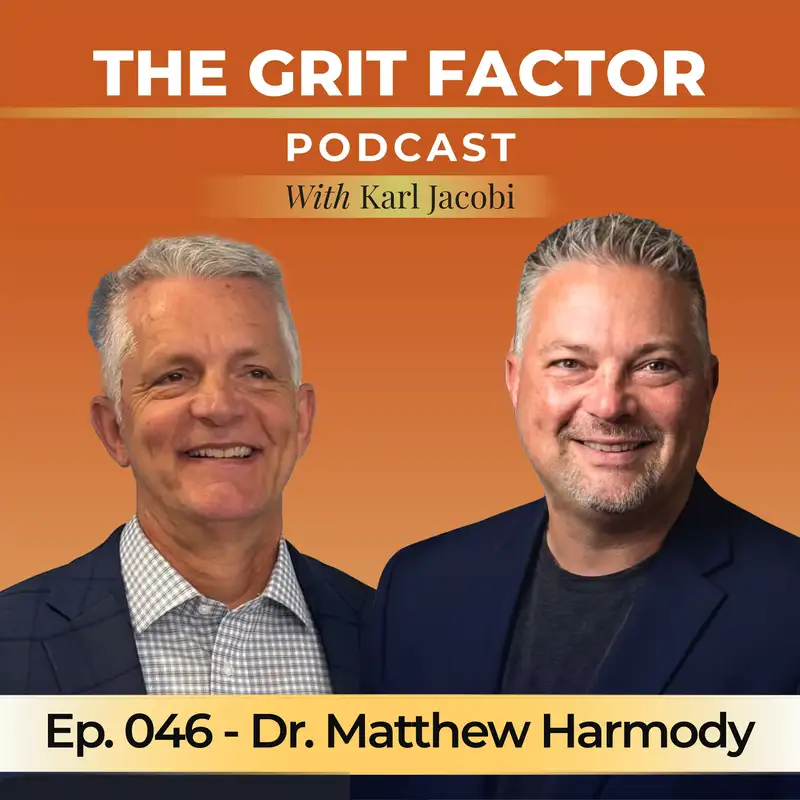
Episode 046: I Couldn't Save My Father. So I Gave My Kidney to a Stranger with Matthew Harmody
TGFP Ep 46 Audio
00:00:00 Speaker: Average is the enemy of greatness. Comfort is the enemy of growth. Welcome to the Grit Factor podcast, where we strip away the highlight reel and get into the darkness beneath it. The real stories, the real battles, and the battle plans used to conquer them. I'm your host, Carl Jacobi, combat vet, entrepreneur, resilience and performance coach, keynote speaker, husband and father. I've built, scaled, and exited multiple companies totaling over forty million in revenue. But here's what that highlight reel doesn't show you. Life has been smacking you in the face with a two by four since that was just five years old. Broken home. Constant chaos. No playbook. No safety net. Just grit. And if you're anything like me. You know, you've got another level in you, in your business, your career, your faith, your leadership. You're just not sure how to get there. That's exactly why we're here. Be sure to follow me for more great content, and check out my website success with Karl dot com. Now that's Karl with a K. Now let's get to work. All right. Welcome back for another episode. I have an amazing story today that is rather inspirational to say the least. From the outside, this man looks like he looks or looks like the highlight reel. Retired E.R. doctor, world record holder, first time author with a story that reads like an adventure novel. But that is not the reason I want you to listen to him today. I want you to listen. Because before any of the records, he sat next to his own father and watched kidney failure take him apart, and with all of his training as an emergency physician, he still could not fix it. And instead of letting that break him or take him or tear him down, he turned around and gave one of his own kidneys to a complete stranger. Then he went and climbed the highest mountain in every state in this country to prove that the people who gave a piece of themselves don't get smaller, they get bigger. If you've ever loved anyone because you couldn't save or wondered what your best chapter was already behind you. My friends, this hour is for you. Matt, my dude, welcome to the show. Thanks, Carl. It's great to be here. Yeah, man, I'm super excited for this because as I was reading your bio in assembling this and just kind of reading up on your story, it's one thing to say you climb the highest peak or highest mountain in some state or some states, but every single state, that's this man. That's that's not that's not an easy feat. So before the mountains, before the, you know, the before the book, before any of this, take us back to the young doctor. Um, harmony. Right. Who was he back then before kidney failure ended? You know, where kidney failure came into the picture. Paint us that picture of that life you had back then. Yeah. Actually, Carl, it was, uh, basically a serial number of events and not so much, um, simultaneous. I was, uh, an engineering student, uh, in a way several hours away from home when I got an unexpected call from my mother. She told me that she had dragged my father to the Cleveland Clinic. Uh, which, knowing my father was no small feat, he must have been nearly on his deathbed for someone to be able to do that. And as it turned out, he was in very dire straits. They found that his both his kidneys had completely failed and that he was going to have to go on what's called emergent dialysis to save his life. And, uh, that was just as devastating turn of events, especially for my father. And, uh, and also for the rest of our family. We were, you know, three kids, relatively young. I was twenty at the time. Oh, wow. And, um, it completely changed the, uh, the course of the family and certainly my professional and avocational direction in life, um, came home and, uh, you know, proceeded to try to help my father in any way I could. But nine years of dialysis. For any of your listeners that know someone with kidney disease, especially on dialysis, um, it just as you alluded to in the introduction, it just wreaks havoc on the body and it was just a steady decline. And it was otherwise a strong, healthy, vibrant veteran. Um, this mechanic did everything for himself, uh, big outdoorsman to just leading a very feeble life. And after those nine years, he had had enough and really saw no light at the end of the tunnel and decided to withdraw from taking dialysis. And of course, you cannot live without either functioning kidneys or, uh, being on dialysis, which is, uh, three times weekly process for most people. And he subsequently passed away. That um, whole experience, uh, interacting with his medical team on a regular basis, reading up in the medical library about what I didn't even know what dialysis was at the time. But yeah, as an engineering student, it helped because it's, you know, basically a filtering process, though a lot more complex than that. Um, that led me to go back to medical school at age thirty. And, um, I was in corporate America wasn't terribly fulfilling. Um, I was successful, uh, in, in those roles that I had, um, early in my career, but it just wasn't fulfilling, wasn't rewarding in any way, especially compared to, um, healthcare and medicine. Mhm. Man, that's a thank you for sharing that. You know, the deeper version, you know, the deeper story and all that. They really kind of helps connect the dots, especially, you know, as I was reading it from my perspective. Sound like you're already in middle school, you know, in, in the medical field. Um, and as you're talking about going to med school in your thirties or at thirty, in my mind, you know, I'm hearing, you know, some voices maybe. Wow, at thirty years old, you know, a lot of people think, man, it's, um, not too late, but it's like, you know, what made you want to, you know, to do it then or there's voices in our minds is probably trying to make us think, man, thirty years old, you know, with all the stuff you still have to do in med school to, you know, to get your M.D. to get out of residency, you're talking, what, eight, ten years? Right. Uh, in emergency medicine, which is what I practice for twenty five years. It's a seven year, um, process. Four years of medical school, Three years of residency. Yeah. So, um, it was a long haul, granted. And it was a real tough entry into, you know, a school in a class that was made up of mostly twenty two year olds that were, you know, a lot of them were knowing that they wanted to be a physician from a very early age. So they had all the coursework and all the experience. Um, those first, especially a couple of months were a rude awakening, a lot of memorizing for someone that's not terribly strong at that. But I can relate, you know, most most things that are difficult in life, um, are often worthwhile. And, um, I kind of a firm believer and always stressed this with our two boys, uh, that, you know, easy decisions, hard life, hard decisions, easy life. Um, it's so good. Yeah. And I just, um, and sometimes you have to also overlay the, the quitting early philosophy and not just torturing yourself with, um, you know, sticking to something, you know, can also have adverse consequences. And um, while hindsight's twenty twenty, you know, I was doing well in the corporate world. So that I think made it all the more difficult to make the transition, you know, when things are miserable, you hate what you're doing. You have all a bunch of other negative factors. You know, it's usually quite easy to make a change. Yeah. But, um, to kind of go from a decent, comfortable, I know you've stressed people stepping out of their comfort zone and moving from something that's, uh, kind of routine and taking a chance to improve oneself and make a bigger difference in this world. I can completely understand that. And, um, you know, I guess some context of the changes that you had in your life, right? I mean, you know, you go from a, what was seem like an easy automatic life where, you know, life was just kind of automatic for you. Right? But there was no sense of joy, peace, fulfillment or any of that. You just kind of going through the motions and, um, and pivoting into a completely different season of life where, um, it is harder, right? It, you know, you have to learn new things to your, to your point. Uh, and I can completely resonate with this when it comes to taking tests. Yeah, I, I, I am, I am a great, you know, I'm that guy who, you know, can't get himself out of a paper bag, wet paper bag when it comes to tests, you know, but for you, your mission was bigger than numbers, right? And so many people when. And I'd like to hear your thoughts on this, in that in that season, going back to those seasons, do you feel it was to your advantage where you come in as a more seasoned person? Right. With a little bit more wisdom, a little more season, you know, seasonality, for lack of a better saying it, right? You've got some experience behind you, um, in the working world and life and so forth. Do you feel that gave you kind of a, a leg up on all the twenty two year olds or twenty year olds who haven't yet experienced life, you know, in that period of life? Oh, absolutely. Carl, I would completely agree with that. Um, I, I really focus on the long term as much as possible, um, kind of a weekend warrior endurance athlete. And we can talk a little bit about that as well. So I'm used to putting, you know, especially running and the sport called adventure racing. I've been in multi-hour, even multi-day events where it's, you know, it's the long term. It's not the one, you know, got lost here for a few minutes or, you know, fell tripping over some rocks on the trail, what have you. But it's the long term. And I just had to kind of bite the bullet for a couple of months. Yeah. You talk about schoolwork? Yes. They were all primed to do well, that is my most of my classmates in that environment of memorization, learning facts. But then we quickly moved in to an area of study that's called physiology. So it's basically, you know, how does the body work and having an engineering background, um, they just made that come so easily to me. You know, it's, you know, why, why does how does the heart pump blood, you know? And what, what what are the blood vessels there for and how do they work? And what happens if you lose blood? Uh, that was just all common sense. I could easily remember all that because, um, there was a process involved. And then especially, uh, one final point to your comments about, um, life's experiences, you know, when they kind of let us loose on the wards, uh, in your third year of medical school, it's all about relating to people. It's all about problem solving. Yeah. It's all about kind of being a detective and gathering information and, um, condensing it and coming up with a problem list and, um, make hopefully making a diagnosis and a treatment plan. And you just, you just would do much better with life experiences. And, you know, most of my classmates had worked some odd summer jobs and maybe did some research in the lab, but that was the extent of it. Having said all that, um, if I had to do it over again, I'd go back to medical school sooner. It may have been a little bit easier. Yeah, I, I, I think, uh, you know, hindsight is always twenty twenty, right? I mean, absolutely. But, but, you know, I'm with you as I look back, it's like, man, I wish I could have done this earlier. I wish, wish, wish. But wouldn't you agree, though, that the journey that we've been on, regardless of all the things we've had to go through, the chapters, the seasons we've walked through, actually positioned us perfectly for what we are, where we're at today. Right. Um, you know, all the things we've been through, all the different events and life experiences, um, that's what forged us into the people that we are today. right? You know, your chapters and your life experiences. Same as mine. And I'm only saying this because there are individuals out there, you know, that, you know, that are pondering, you know, not pondering, but they're they're ruminating on all their decisions they made, you know, poor me, poor me, but just the ruminating on decisions, right? Mhm. But, you know, I want to tell that person, you know, that, uh, you are exactly where you need to be. And, um, so yeah, the point I made earlier, briefly, Carl, is, uh, about quitting early. That I think comes with a lot of misconceptions, but I believe it was Steven Levitt, doctor Steven Levitt of Freakonomics fame that either did the study or covered it in one of his podcasts that, uh, took a group of volunteers that were at a kind of a crossroads about, uh, making a big decision. It was mostly involving a career decision. Should I leave my job? And he had everyone agree to, um, flip a coin and stick with their results. In other words, heads, you stay in your current job, tails you leave, and then they follow it up with folks. Um, after I think a few years, I mean, a reasonable period of time. And they found that people that made the change, that being, uh, either pursuing a different career or different job were much more, uh, satisfied, happy. And all those scales that measure that type of thing. Um, so I find that interesting, you know, quitting early doesn't mean, you know, try a bunch of things. Don't, don't be dedicated, don't work hard. It just means, you know, I think you reach a point of diminishing returns. Yes, we all are, are part of our experiences. But, um, you know, if I were to shave a year or two off my engineering career when I was kind of, uh, you know, just not really going through the motions, still working hard, but, um, I think I probably would be better off. Um, yeah, but again, it's easier said than done. Yeah. You're one hundred percent correct. It always is, you know, and, um, it always will be, you know. Real quick before we keep rolling, maybe life hit you hard. Business fell apart. Career isn't working out. Relationship ended. Health took a dive. And now you're standing in the rubble trying to figure out what the next move even looks like. Or maybe nothing blew up at all. On paper you're winning, sure, but on the inside, something's off. If you're not in crisis, you're at a crossroads, and the playbook that built the life you have is not the playbook that builds the one you want. Either way, you're stuck. Not broken. Stuck between who you were and who you're becoming. Most self-help just piles more weight on load you're already carrying. I do not want to do that. I put together a free video series called the Grit Code Exposed, and I want to invite you to check it out. Seven short videos. That's it. The five laws that change everything for me. In every client, I coach the same five that every person who's ever come back from the fire has walked through where they had a name for it or not. No fluff, no ninety minute webinar, no bait, just the free video series. You can start it tonight. Grab it at grid code exposed dot com one more time, grit code exposed dot com. It's free. You don't need any more hustle. You need the next version and this is how you find it. Check it out. See if it speaks to you. And if it does, I'll see you inside. All right, let's get back to the conversation. I had to take us back for a moment, you know, because as I mentioned in the intro. When you're when your father had passed away from kidney failure and so forth, you made the, the, the not so easy decision, incredibly challenging decision, in fact, to give your consent or not said it, but your one of your kidneys to a complete stranger, you know, take us back to that moment, right when that happened, what was on your mind? What Like, what inspired you to do something like that? Because a lot of people that wouldn't be the first action, right? Or even their second action for you though, that was pretty much one of the first set of actions. So take us back to that moment. What was going in your mind? What inspired you to do that? Sure. And if you ever meet a kidney donor and obviously you're audience is meeting one here, you'll find that everyone has a pretty unique story. Um, in my case, it actually starts back when my father first had kidney failure. Um, I also add that obviously since I'm a kidney donor and, uh, here talking with you today, Carl, uh, donating a kidney, uh, while you're alive is, uh, a perfectly reasonable thing to do. Unfortunately, my father did not want to consider a living donation, especially from a family member, and I would have been on that short list, along with my two uncles at the time, he felt that in his kidneys failed at fifty, which is fairly young. It is. He felt that he'd lived a full life to that point in time, and that he did not want to jeopardize anyone else's life. Uh, my father was such a huge mentor, mentor, and figure in my life that I felt that, you know, was one of the big opportunities. I had to turn the tables and help him as he had helped and guided and lifted me up throughout my young years. And I always saw that as a missed opportunity. And fast forward a bit, you know, working in emergency departments, uh, actually seeing dialysis patients most every day. And they almost all reminded me of my father and what he was going through, went through. And I felt at that point in time, and there really wasn't an aha moment. But, um, I felt that if I couldn't help my father, that I could at least help someone else. And I didn't have anyone in my circle that I knew was in need of a kidney. Um, so there's a process in this country whereby you can make an anonymous donation and the kidney goes to the best match person that resides on the transplant list. Interesting. Yeah, that's, that's very insightful because, I mean, as I'm listening to you talk about your story and so forth, you know, that was one of the questions that was on my mind is, you know, if you're going to donate, you know, why not? You know, ask your father. And as a father, and I think you have kids, I'm not sure if I don't remember if I asked you that. Yeah. I have two boys that are in their late twenties. Yep. Yeah. Awesome. Um, you as a father, I can I can definitely relate to to your father's position. Right. Because you know it taking something from one of your kids. And and I don't know how I would feel about that. You know, I would probably try to position them for the best life possible. And, and, um, I don't know, for me personally, I can certainly understand your father's position, you know, and as a as a son, I know that could probably be, um, you know, I'm just trying to picture, you know, where, how I would see that, you know, but yeah, it's, it's hard from all perspectives. It is. Um, you know, my father didn't get a chance to meet my, uh, my wife, um, he did not get to experience any grandchildren. Um, so he, you know, he missed, missed out on a lot in life. And ironically, Carl had donated in twenty seventeen. My boys at the time were about the same age I was when my father's kidneys failed. Oh wow. And of course, the questions come up. It's like, you know, donate to a stranger. What if someone in your family needs a kidney? Uh, so, you know, I had to address that with my brother and sister. I have two nieces that have, uh, medical concerns that put them at slightly higher risk of needing a kidney someday. Mhm. Um, and, of course, two high school aged sons at the time. And, you know, I had had to have, you know, give that a lot of thought and contemplation and, um, you know, at the end of the day, you know, I guess it's kind of like money and other assets. I didn't want to take it with me. So, um, you know, and the small chance that someone in my circle would need a kidney, I just didn't think that was justifiable in not donating when I could to someone that needed a kidney at that point in time. Makes sense. Makes sense. Well, fast forward from that. You know, a lot of individuals, right? I again, I'm assuming here, not that I've ever been in that position where I've donated anything. Um. You decided to not just, you know, participate in some events like you, you went to every state and what you alluded to, you're a freaking beast, man. Especially in a retired life. A lot of individuals would retire and go play golf. And I'm sure you probably play golf. Um, so, um, not well, I'm right there with you. If you ever come down to my woods in Sarasota, you know, you gotta look me up. I'll help. You look good. Trust me. Yeah. Um, um, speaking of quitting early, I. I should have quit golf a long time ago, but it is a lot of fun. Many, many people enjoy it. Obviously, I'm not just trying to disparage anyone that loves that game. Um, but and I'll probably play more as I get older. I, I've played on and off since I was a kid and pretty much been about the same caliber player ever since I was a kid. So I can relate. I can, I can definitely. And uh, yeah, so, but you know, you decided to, you know, do what I think would be the last people's or on a lot of people's last mind if I even said that correctly. It's Monday. Um, you're, you decided to go travel on a, you know, to highest mountain top of every state. Like take us to that moment, man. Like what? What triggered you do that? Like what inspired you to do that? Not just one state, but every state, every mountain. Like walk us through that, man. Yeah. So I've, I've done a lot of endurance training and racing really since a very young age, everything from marathons, ultramarathons. I'd mentioned adventure racing, which is a kind of a multi-discipline sport that's based on map and compass and out in the wilderness, locating points, running, mountain biking, paddling. That sounds fun. Um, and it wasn't really much of a hiker or climber until I got a random email, uh, a few years after my donation, looking for people that were willing to, uh, go and climb Mount Kilimanjaro in Tanzania. And that kind of actually set off two important changes or kind of redirections, so to speak, in my life. Um, one, I was what I call a private donor I donated in twenty seventeen. And really only my immediate family and my physician partners knew about it. Okay. And, uh, my partners, primarily because I was going to be out of work for about four weeks and want to reassure them that I'd be coming back. Um, but not until this Kilimanjaro climb in which the goal was, of course, to raise awareness. So it's kind of hard to be private about something and raise awareness at the same time. So yeah, it's kind of I got, I got my first social media accounts and, um, did you know PR work with the group's assistants? And it was a great experience. And it really was the first time that it was all about the experience and spending time with folks and raising awareness and not, you know, uh, did I finish did I win kind of thing? Uh, I can remember standing, uh, in the Raleigh-Durham airport with my wife dropping me off at O'dark thirty. And she asked me quite pointedly, you know, how would you how would you feel if you don't summit? And it was really the first time that I said, you know, it's really about the experience. And I think I'll be okay with that. So, um, you know, most people have a hard time relating to going to Africa and Tanzania. So we wanted to bring something closer to home. Getting to your question more specifically, and Dave Ashley, our team captain, who's a very experienced mountaineer, um, decided to do, uh, put together, uh, the event of climbing the highest point in each of the fifty states, as you've mentioned. And, he started doing recon work and really climbing all of the summits in advance so that we could put together a very complex logistical plan. But he also, um, found that there was a Guinness World Record for it. So that made it a lot more interesting. You know, our team of five kidney donors were all fairly competitive. So that and that just brings more energy and interest. Um, because we had, you know, good social media following, we had a lot of people show up at trailheads that either just provided emotional support or brought food or some even climb some of the high points with us. And, um, all that put together closer to home. Guinness World Record at stake, um, certainly increased our ability to raise awareness for kidney donation. And, you know, a lot of people when you talk to them, Maybe not those that live in Alaska, but most people know where their state high point is and many of them have actually been to it. So I think it became much more relatable to folks versus, you know, a trip far away to Africa. Yeah, it makes sense for sure. And honestly too, that in my opinion, I'm of the belief I, I would actually think that was a lot more complicated, a lot more tougher to do what you did, right to go through all fifty states, go to the highest peak. And to me, I'm sure those that are actually done it probably, Carl, you're smoking crack. But you know, that's just my belief. It it would require a lot more mental toughness and endurance and so forth to do all fifty states because you could have easily said twenty twenty four is enough, twenty four is good. Just twenty four is good. Twenty twenty six is good, right? Like you could have easily have talked yourself out of, you know, instead of fifty, it'd be forty nine or forty eight. And honestly, you would have every excuse. I hate to use the word excuse, but you know, you got one less kidney, right? So there is a voice in our mind like, Matt. It's okay. You, you, you're a kidney donor. You know, people would excuse you. It's okay to if you didn't do all fifty states, right. They would still give you recognition. So give us a secret. And I'm saying this in quote unquote secret, but give us a secret. Like what kept you going? What kept you going? You know, in spite of the fear, in spite of the noises, in spite of all that, what kept you going? State after state peak after peak. Yeah. You raise some great points there, Carl. I would. I would say that the more difficult decision was maybe not necessarily doing less than fifty, but doing them at a slower non record setting pace. And there was even discussion amongst the team about that. Um, you know, there were so many obstacles. There were so many changes to the plan. Uh, the biggest challenge we faced was that the, the Pacific Northwest had record snowfall, uh, the previous winter. And we started out, um, in Alaska in mid-May. And a brief anecdote about the trip, uh, we started in Alaska and went to Hawaii. Then the team gathered in an RV meeting our RV that we rented in Chicago, kind of as a central place. And then we went counterclockwise through the For us. So a little bit of respite in the kind of the upper Midwest. But then when we hit in Montana and Granite Peak is the high point there, we couldn't even get the RV to the trailhead because of the snow. And the climbing team had to hike in two miles just to get to the trailhead. And I think, you know, it's a, it's a competitive group. Um, you drove a long way to get to that near that high point or that trailhead. Yeah. And you kind of look at the sunk costs and we're here and we're just going to put our heads down and go, um, I think obviously again, in hindsight, um, skipping several the difficult ones in the Pacific Northwest and coming back to them a couple weeks later, um, which we ended up doing for some of them, um, made a huge difference. Um, so yeah, I think there may have been things that we would have done differently. But, you know, you're kind of in the heat of the moment, you're on the clock. Yeah. And, um, trying to, you know, keep up with everything in it. Yeah. It was, it was trying, um, sleeping in a moving RV. Um, you know, if we weren't climbing, we were moving, we got to a trailhead at two in the morning and it was cold and raining out. Climbers got out and did their thing. So, um, yeah, it's, you know, we, we had, and you can certainly read the book and hear all the details. But you know, there were some personality challenges, but, you know, everybody was tired. Everybody was often hungry, uh, poor sleep and, uh, sometimes having to recover very quickly before the next, uh, trailhead was reached. Um, yeah, it really added a lot of, uh, challenging considerations on the trip. I can imagine. I, I, I've been on some road trips, some, you know, I'm, I'm prior military and so I, I've been on, you know, missions, both combat and non-combat and, um, you know, being in an environment where you're stuck with that person for an extended period of time, you know, uh, yes, personalities can flare for sure. Um, you know, especially when we're tired, hungry, or just, you know, we're homesick or, um, or all the above. Right. And, um, yeah. So what inspired you to keep going though? I mean, what inspired you to, because, I mean, again, you know, a lot of people would stop at five, ten, twenty, thirty, but what inspired you specifically to keep going, to keep fighting to to to to keep coming. Going through the weather. To fight the hunger. To fight all those things. What kept you moving forward? I think there was several reasons. One, a commitment to the team and you know, to use a military term, the mission. Um, I don't yeah, I kind of live in the back door of Fort Bragg. Um, I don't have any military experience, but, um, our captain, Dave Ashley, retired, uh, Air Force officer. Um, so I think yeah, supporting each other, not wanting to be kind of the weak link and letting your teammates down. I'm sure you can relate to that. Carl, with your experiences, uh, I think having, you know, a specific goal in mind, um, obviously doing all fifty and doing it in record time was the goal. I think that helped. Um, I think we, we received so much inspiration online. Uh, we provided frequent updates on social media and just had a ton of support. And like I said earlier, we had in some states a tremendous turnout, uh, of supporters and even just meeting people in the, you know, the parking lot and people asking us, you know, what we were doing. Um, and that was, um, that epitomized what the goal was, was to raise awareness. And I think the final straw, and I think it was not really a straw in a negative sense, but, um, it was in California when we were after Mount Whitney, um, we had, um, we received an email from, um, one of our nonprofit organizations that, um, I'm a big part of now, as is Emily and other teammate in leadership role there. She had sent me an email saying, hey, we had our first person register to be considered for a living kidney donation. Um, that was strictly based on his seeing our story and our record attempt on social media so that, you know, that that was a kind of a low moment. Yeah. Uh, as far as being tired, we were in a laundromat for the umpteenth time washing clothes and, um, you know, stocking up on fuel and food. Yeah. Uh, and that just, you know, that that's why we're out there for, um, opportunities and, uh, a message, uh, like I shared, that's, that's so good. Especially, I know that I know firsthand that feeling, you know, where you're, you're questioning a lot of things, maybe not externally, right? You're probably not, you know, questioning as to your friends or teammates or anything, but just inside you're like, man, is this really worth it? Is this what I'm experiencing right now? Is this really worth it? And then you see something like that. It just really gives you that warm fuzzy feeling. It's like, ah, thanks. You know, I'm not sure what your faith is, but, you know, there is a sense spiritually that this gives you the bigger picture. Like, this isn't about us. Right. Um, life is not about you. It's not about me. It's about the bigger picture and the impact we could bring on this world. And daily. It seems like I'm often reminded of that just when I'm starting to think, you know, poor me, what was me or whatever. I'm reminded that there's a bigger picture here, you know, and and I'm humbled, you know, and I'm humbled by it. So I was actually, uh, along the faith spiritual journey. Carl. I was born and raised Catholic. Big turning point in my life was going to all boys Jesuit High School in Cleveland, whose motto was men for others. And it kind of kept me out of the public schools and probably busing at the time. And, um, I went from, you know, kind of sleepwalking through school to having to be serious and competitive academically to keep up with kids that came from all over the city. And I've, I've tried to live that, um, since then. Um, and I've kind of, you know, I'm an engineer and retired physician, so I'm pretty objective and live by rules and goals. I just can't help myself. But I would roughly measure how many people I could impact Based on what I was doing at the time and doing being not today, but, you know, months and years. So yeah, as an engineer, I worked in the oil industry. So I would argue that it may have been on the negative side. I did, you know, did some volunteer work mentoring and some basketball coaching medicine. Certainly I probably saw four thousand patients roughly a year plus all their family for twenty five years. And I was also an EMS medical director. So I had some input, um, on our state's EMS system. So again, expanding that realm. And now, you know, I retired somewhat on the early side to be able to pursue a kidney donation advocacy work, which is the bulk of what I do now. And again, the numbers, the number itself is not important. It's the mental exercise of Yep, going through it. And, um, yeah, I'm heavily involved with our, uh, our church and, um, I'm chairman of the board of the National Kidney Donation Organization. Nice. Um, and it's the largest nonprofit advocacy group in the country, and we have about five thousand five hundred members and provide all kinds of resources for people. And I might add here, Carl, that, you know, my, my experience and background does not drive me to ask everyone I meet, hey, do you want to donate a kidney? Uh, I certainly will, uh, talk your ear off about it if you ask. Um, you know, oh, I didn't realize you could donate a kidney or what's that like or. Yeah. Aren't you limited in what you can do now? So I'm happy to dispel all those myths, but, um, it's not all about being a kidney donor. There are many other steps that people would find a lot less severe. Um, you can become educated, making sure that if you're at risk, you can get tested for kidney disease. Um, or you can encourage family or friends to do so. Um, you certainly can sign up on your driver's license to be a deceased donor and donate organs and tissue that way. Um, and if you're, you're so inspired, uh, there's plenty of people to talk to. Um, I do mentoring through our organization. So we feel that, um, you know, it's important to talk to someone that's walked the walk and can give you their experience and the experience of others. So, um, yes, so adding up those numbers is again, an exercise, but important to me. Yeah. Makes sense for sure. I certainly understand. You know, it's something I've learned is this is recently, especially in this in that season of life and even in this season of life, it's it's hard to measure impact because I impact in lives that you will never know. Right. Um, people that see you in social media and it's not those lives that impact, but when you impact them to impact others, right? There's that indirect chain that occurs there, right? And I'm only saying this because we oftentimes only see the direct lines of impact that we think we're impacting, right? Yes. Like, you know, telling a young lady, um, you know, that you love her smile or you hold a door open for her and she's had a pretty horrible day. And that was the pivotal moment that like, oh my gosh, you know, somebody recognized me, right? Well, that pivotal moment probably just changed her life and trajectory of so many other lives around her because of one thing you did for him or her, right? Absolutely. And so, and I see this because we oftentimes want to try to quantify the impact of people and so forth. We don't quite perceive this, but it's all the indirect trajectory of lives that we change that we need to be mindful of. Um, fast forward a little bit because we said this numerous times, but I actually want this out there. What is the actual record that you set here? Um, what was the record for the time all that put this out there? Because I don't think we actually talked about it, uh, in specifics. Yeah. The time was forty one days in one hour. That's incredible. Less than one. Like, oh my gosh. It's like less than a day per state. Yes. And considering the fact that the climbers took about eleven days just to do Denali in Alaska, which is where we started. Yeah. Um, so you reduce it now to forty nine states. Um, in what, thirty days or so? Insane. That's incredible. Yeah. We tackled, you know, especially through my neck of the woods in the southeast. Um, we had one or two days that being a twenty four hour period in which we had five or six high points. So, you know, the relatively close together, not necessarily all super easy, but yeah, there, there are also what we call walk ups. You can drive to the parking lot and walk a couple hundred yards. And, um, you know, that would be here in Florida. That's right. Florida. So a lot of people ask, uh, most people know the highest point, the highest state high point, uh, in the country. But people often ask, where's the lowest? And it's yeah, it's a little old Britton Hill in Florida. Two hundred and forty five or so feet. Yeah. There's yeah, there's not a lot of high spots here that is for sure. Yeah. I know we moved here excuse me a couple of years ago and um, you know, we came from here from Alabama in really in Alabama for thirteen years. But um, yeah, there's definitely not much for mountainous terrains. So real quick before you go, if you're still with me this deep into the episode, something in it hits you. Maybe it was the guest, maybe it was one line. Either way, you're still here. And that feeling in your chest right now, that's the signal. Most people get a signal like that and do absolutely nothing with it. They close the app. Life rushes back in the moments gone. Six months later, there are the exact same spot. I don't want that for you. So put something together. I want to invite you to check out a free video series called the Grit Code Exposed. Seven short videos. The five laws. I walk every client through. The same ones that rebuilt me when everything else fell apart. And if you listen closely today, you heard them running underneath the entire conversation because everyone who's come back from the fire walks through these five laws. Some find them on their own, some get help, but the laws don't change. Free video series. You can start it tonight. No fluff. No ninety minute webinar. Just the series. And if you're going to do something with what you heard today, do this before life talks you out of it. Go to grit Code exposed dot com one more time. Grit code It's dot com. And hey, before I let you go, thank you for writing with me this long. It means a lot more than you know. Thank you. Man, this has been such a great conversation. A lot of insight. So you briefly mentioned talk about some of the myths. You know, talk to the person out there, you know, educate them because for me, I'm learning right now. I'm learning here from you about live kidney donation. I've never really, you know, had a reason to or even thought about, you know, exploring that. But you know, this real quickly, you know, dispel some myths out there, talk about, you know, the, the, the living kidney donation and things we're not thinking of and all that good jazz. Yeah. So the most I'll just run through a few of the most common. Carl. Um, one would be um, is there an age limit? So in most, at most transplant centers, you need to be twenty one. There are some rare exceptions to be eighteen and be a donor. I know of at least one eighty year old that's donated and several people in their seventies. Um, wow. I would summarize that point by saying, um, the transplant centers would much rather have an older, healthy person than a young, unhealthy person. Mhm. Makes sense. Number two, um, I can't afford to be out of work for four to six weeks or how ever long that recovery may be. Yeah. Um, there are organizations in place, such as the National Kidney Registry that actually reimburses lost income up to a certain point. Oh, wow. And, um, you know, their primary goal is to eliminate barriers and obviously, uh, the financial concerns of donating and being out of work is a huge barrier. Um, I would say third. Um, and of course we've touched on this throughout this conversation. Um, I don't want to be limited in what I can do after donation. I like to, you know, fill in the blank, walk my dog, go on hikes, ride a bike, play golf, what have you. And really, there are no physical limitations. Um, and I, yes, I enjoy endurance activities. Uh, I know folks that do far, far more challenging things than I do. Um, so there's really no limit. And, you know, I guess three a would be you don't have to be an athlete to be a donor. In fact, most people aren't. Um, you can, you know, it's helpful to be active. Uh, that usually means you're healthier. Um, but people go back to their regular routines, back to their desk jobs, back to their, you know, morning walking the dog. um without any um any restrictions whatsoever. The complication rate, um for the surgery itself is on par with a woman delivering um having a vaginal delivery, um, full term birth. So, um, you know, we take that for granted, you know, women deliver babies by the thousands every day in this country. True. Um, and, and most people, if you ask them, would understand that delivering a baby is not zero risk, but it's so very low that it doesn't keep us from doing that. Makes sense on a regular basis. So those, I would say are the three most common questions or comments that I get. Interesting. Okay. Help us understand, you know, because it's not something that I'm routinely involved with. Obviously, you know, which you are. What is the, the need, right. Um in terms of kidney. Is there a is there a mass difference between people that need them versus availability or what is what is that difference look like now? Yes. It's, um, it's a great question. I'm glad you brought it up, Carl. Right now there's over ninety three thousand people on the transplant waitlist just for kidneys. And it's by far the largest, um, number, um, for an organ. And that list, uh, generally grows year after year. And we only transplant about twenty five thousand kidneys a year in this country. And about two thirds of those are from deceased donors, um, one third being from living kidney donors. So that's in the six to seven thousand range. But a living kidney is so much more a value to a recipient. Um, it lasts longer on average twice as long. So in the twelve to fifteen year range, um, it allows the recipient to be on less medications that they have to take, um, to help prevent, um, the fact that they might reject the organ and it's, and it's just life changing, um, for the recipient to, um, be taken off dialysis. So it's a huge need. Um, the risk factors for developing kidney disease mostly rely around, um, high blood pressure, hypertension and diabetes. And there's just such a growing incidence of those two chronic conditions that the need for kidneys like likely will increase. So, um, there's a lot of us, you know, working hard to increase awareness to help remove restrictions. Some of the things that we just talked about and, um, yeah, it's a solvable problem. Um, I wouldn't wish being on dialysis, having kidney failure on anyone and, um, anyone that's been around or knows someone well, that's on dialysis certainly can relate to that. Yeah. I actually know a pretty good friend of mine who passed away, um, five or six months ago, uh, he was on dialysis and unfortunately it just over, over time, he just quickly declined. It seemed like it was getting faster and faster the closer the end came. Right. But ninety three zero zero zero people. Wow. Like, uh, and. I'm, I'm kind of speechless here. Ninety three thousand of course, I know that number is going to change only because if you look around, um, you know, people, you know, the obesity rate is climbing at a substantial rate, you know, uh, which is heartbreaking. And because, you know, we're getting fatter and fatter by the country getting unhealthier by the day, by the generation, uh, in my opinion. And, um, I think, uh, man, that's, that's a scary number number ninety three zero zero zero. And it's only going to get worse. Yeah. Much to your, your friend's story. Um, not only is there such a huge number on the wait list, but about fifty percent of those people will die before they receive a kidney. So it's just a really a slow death sentence. Um, it's, it's life saving, don't get me wrong, but, um, there, there's a better solution out there and it's kidney donation and the best, the gold standard is the living kidney. Sure, man. Wow. Well, fast forward to today, Matt, I know you're you've been accomplishing so many things. Your, your book, which we didn't even really talk about, really want you to talk about your book. Um, what are you most fired up about today that the world has not yet seen of you? Oh, that's a great question. Um. I'm really hoping to. This may be a little weak of an answer, but, um, my goal is to spread awareness and the book, you know, honestly, is, is simply a platform to do that. Yeah. And my hope is to be able to begin to speak, uh, nationally into large audiences about the need for kidney donation. And again, uh, not everyone can or should be a donor, but simply raising awareness, you know where to send your loved one who is developing kidney disease so they get accurate and useful information. Um, you know, that's those are the primary goals to get more people on the driver's license, deceased donor list. And again, if you're so moved, um, and you want to ask the right, you know, ask the questions and get the right answers. Certainly being a kidney donor, um, would be awesome. Yeah. Well, you mentioned this several times, your book, what is, what's your book about? What, you know, where can they find it? Yeah. So the title is Ascending America. And we've touched on the main topic of it. It, it covers the adventure. Uh, so it's a nonfiction book about the whole story of the trip, how it came together, how it went. Uh, there's a lot of drama. There's a lot of, uh. It's like life. It's not a perfect story. Right? And, um, I think people find it interesting and exciting watching the time, you know, the clock count down against us and see how we fare. Um, I would say, though, Karl, the best part of the book is reading about us five donors and our donation stories, as well as the stories of our recipients, uh, by far and away just very compelling. Uh, my story, if you can believe it's a little bit on the dull side, in my opinion, uh, compared to my teammates. And then thirdly, uh, of course, being a physician, I couldn't help myself. But I think one of my superpowers powers, Karl, is being able to translate complex medical concepts and ideas into layman's terms and language. Uh, so part two of the book takes the reader through the whole transplant community, all the way from what causes kidney disease, which we just touched on. Yeah. What's it like to be on dialysis all the way to the future of transplantation, which, you know, may or may not include, um, transplanting pig kidneys into humans? Mhm. Wow. Didn't even think of that one, to be honest with you. Interesting. Interesting for sure. It is interesting for sure. Man, that book definitely sounds, uh, you know, interesting. I definitely like to get my hands on a copy for sure because, uh, I always like to see, uh, trips like this, right? You know, adventures. That's where I was looking for adventures, you know, to hear how people overcame, you know, obstacles, whether it's a personal conflict obstacle or whether obstacle or any of those different things, right? I always love to see these kinds of stories and, and pull nuggets of how we can implement into our own lives. Um, and, uh, especially makes us really reminds us just how, um, you know, we all have problems, we all have things we have to try, you know, go through and trials and tribulations and, and, uh, you know, where I could pull nuggets of wisdom I love to extract from. So yes, it's a obviously partial Carl, but it's an entertaining read. It's, um. Yeah, I don't want anyone to walk away thinking, uh, it's kind of a boring medical book. Um, you could have absolutely no interest in kidney donation and still enjoy the story. It sounds like it for sure. I mean, I'm just picturing, I'm picturing, you know, this this, uh, van, if you will, this RV, you know, from from state to state to state rest stops and all this stuff. You know, people that are tired and hungry and going through these different weather events. And yeah, I'm just kind of imagining it as you're talking about it, man, I love these kinds of stories where, man, where can people find you? They, they want to be, you know, more educated. They want maybe they're impacted by this episode or your story or, you know, where can they connect with you and learn more about kidney donation or just learn about your book? Where can they connect with you to support you or encourage you or just connect with you in general? Absolutely. Yeah. Thanks for that, Carl. My website is the single best place to go and that's Matt Carmody, MD dot com. You can find all the various online places to buy my book if you're so interested, but it's really a central place for learning about kidney disease donation. Um, and there's an opportunity to sign up to get on my email list, which I always promise people, it's, it's relatively infrequent, but I like to just, uh, raise awareness with, uh, sure, you know, you know, personal interest stories that are out there that I think people would find interesting. And you can always contact me through my website if you want to have a one on one discussion about anything, kidney disease or donation. Awesome, man. Cool. I appreciate you throwing it there. Definitely going to be throwing it all in the show notes. So listeners or those who are watching, make sure you go in the show notes, get the information, get his book, um, you know, learn about his story, learn about everything he's put out into this book. Because I, I know I'm definitely going to get my hands on a copy. All right. Rapid fire questions as we start to wrap this up in the season that you're in, man, bringing awareness and doing all the things that you're doing in this season of life? What is what is your personal definition of grit right now? What does that mean for you? My definition of grit would be, um, having a purpose that far exceeds the journey and the difficult obstacles that you might face, um, in pursuing that purpose. Amazing, man. Amazing. I can tell you, you're a very purpose driven individual, man. That's, that's very inspirational. Absolutely. Our last two questions, when both of these are kind of prepared you for in the greenroom, when, when the lights are, when the lights are out, you're in the trenches, you're in the thick of it. Is there a quote or scripture or directive that you tell yourself to pull you out of those moments? Is there anything that jumps to mind? Yeah. Um. A little a little bit depends on the circumstances. Um, I, you know, adventure racing, you know, finds me out, you know, at night if I'm doing an overnight race, often by myself, map and compass, uh, you get lost or hurt, you know, it's self rescue. So there's a lot at stake. Um, and you can make mistakes, navigation errors, uh, maybe try to jump a rock or something and misjudge it and fall with potential injury. And, um, I often thank God for those moments where, uh, something could have happened. Um, you know, you lay down your bike because you get stuck in a rut that you can't see at two in the morning and you're tired. Yeah. Um, there are many times where I could have been, you know, potentially seriously injured and had trouble getting out to help. So that's one instance. And I think the other is, um, especially in the advocacy work, you know, sometimes you get a little frustrating trying to reach people, trying to set up meetings. It's kind of small potatoes, but I just think of my father and, you know, the, you know, the difficult race isn't anything that I've ever done personally. It was the nine years that he suffered on dialysis. And, um, you know, having to bug someone again about a meeting or. Yeah, publishing something, uh, is really small potatoes compared to what he endured. That's a good point. That is a very good perspective shift to have for sure. Right. Um, yeah, I have to remind myself of that too. Awesome, man. Well, last question comes in two parts. Um, those are listening or watching. I love to give my guests an opportunity to challenge my next guest with the challenge of their own. And guys, the lineup is completely anonymous. They have no idea who the guest lineup is, so it's completely anonymous. And so far these questions have landed perfectly. So Matt, George Tinsley, my previous guest, had this question for you. And this is perfect as I'm talking about this out loud. What legacy are you going to leave? I would hope that people would see my legacy as my high school motto, men for others and being a servant leader. Mhm, mhm. That's amazing man. And you're talking through your story. I can tell your very legacy driven. That's one hundred percent sure. What is the question that you would love to challenge my next guest with? Yeah. You've had so many great questions. It's been a great conversation along the way. I haven't, uh, wasn't able to set aside much, uh, mental space to give this much thought, but I would ask your next guest, was there ever. A moment that you would have considered quitting earlier? Uh, that being in the, you know, the right context of not being a quitter and not. Yeah. You know, applying yourself. But, um, did you ever stick with something far longer than you probably should have because you were having trouble considering making a change and what that might look like. Sometimes people are just too busy to set aside the time to to say, to look at what's my next chapter in my life. And so they basically just put their head down and plow forward. I certainly am as guilty of that as anyone. But yeah. Would you have considered quitting early? When you look back on, um, all your, uh, all the chapters in your life? Mhm. That's a good question for sure. It's a good one. And looking at my guest, it's very, very fitting. So I can't tell who it is either. So yeah. So you have to tune in so well. Awesome. Matt. It's been such an amazing time this last hour that you've spent with us. And thank you so much for sharing all this, sharing your passion, sharing, you know, the journey, brief journey about the world record you guys set and, but sharing your mission behind, you know, the kidney donation, the kidney failure epidemic. That's only going to get worse, in my opinion, especially after listening to you. But thank you for sharing your story, sharing your wisdom, and sharing all of this with us. Man, I really appreciate you and honoring you for that. Yeah, Carl, this has been a great conversation. I really appreciate you inviting me on. And, um, I wish you well. Yeah. Likewise. Man. Man. Likewise. All right, guys, those listening to watching the gap between average and excellence, you know, this already is just action, even in perfect action. Don't just listen to Matt do one thing he shared today and use it. Be the reason somebody doesn't quit today. Don't just keep this episode to yourself. Someone in your circle needs this right now. Send it to him again. My dude, thank you so much for Stepping Arena. It's so good to have you. Thank you so much. Absolutely.
Creators and Guests