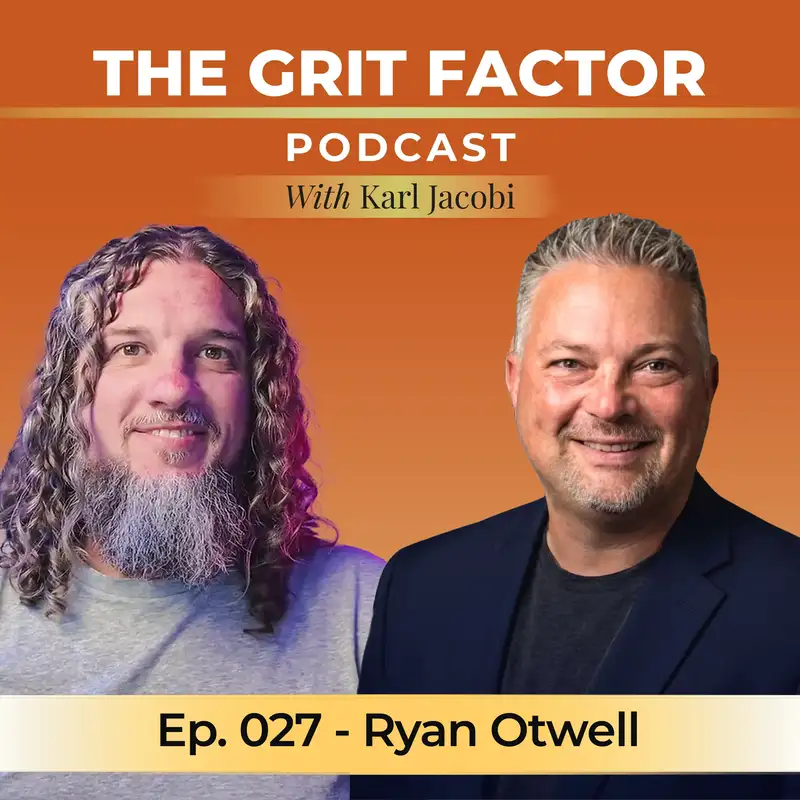
Episode 027: Ten Years Lost. One Decision Changed Everything with Ryan Otwell
TGFP Audio Ep 27
00:00:00 Speaker: Average is the enemy of greatness. Comfort is the enemy of growth. Welcome to the Grit Factor podcast, where we strip away the highlight reel and get into the darkness beneath it. The real stories, the real battles, and the battle plans used to conquer them. I'm your host, Carl Jacobi, combat vet, entrepreneur, resilience and performance coach, keynote speaker, husband and father. I've built, scaled, and exited multiple companies totaling over forty million in revenue. But here's what that highlight reel doesn't show you. Life has been smacking me in the face with a two by four since I was just five years old. Broken home. Constant chaos. No playbook. No safety net. Just grit. And if you're anything like me. You know, you've got another level in you, in your business, your career, your faith, your leadership. You're just not sure how to get there. That's exactly why we're here. Be sure to follow me for more great content, and check out my website success with Karl dot com. Now that's Karl with a K. Now let's get to work. Welcome back for another episode. Today I am joined by a proud husband, father, homeschool dad of two boys, owner of a seven figure e-commerce business, doing significant year over year growth. And I'm not just saying this to say it, I've actually had I've been able to look underneath the hood so I could validate that claim. He's top one percent of his niche speaking. He's spoken on stages. He's also a board member at a non profit shipping clothes and other basic necessities to needy Christians in the Philippines. Loves to enjoy the freedoms his business has provided his. Him and his family. He's restless, rebellious. In fact, we're just kind of chuckling in the green room before we hit the record about his rebelliousness. Says normal is boring and I cannot agree more. What's the use of being normal in these days? And on paper, every one of these credentials adds up to what would think would lead to a college diploma or something of that nature. It does not, because he has a season of what he calls the lost decade. And that makes a good episode title, actually. And this is where the conversation starts. So Ryan Otwell, my dude, welcome to the show, man. Thanks, Carl. I'm glad to be here. It's always good to talk to you. And I know we've been trying to set this up for a while, but, uh, you're busy. Your podcast sounds like it's doing awesome. You got a packed schedule, so I'm glad I could find a slot to slip in here. Yeah, man, I always enjoy our times together, dude. Really do. Man. Just talking and shooting the breeze. And yeah, I enjoy doing a show, man. I really enjoy having conversations and and, uh, yeah, in that time too, you're in the Philippines, you know, doing a couple of things, spending some time with your team, which is really inspirational. Uh, and guys, you know, I know I'll say this later, but follow him on social media, like Facebook and so forth. You can get a glimpse into the pictures that he shared about connecting with his team, the mission trips that he does in the Philippines. And this time around, he did it with his whole family. He didn't just do it by himself. He took his whole family, which is pretty amazing because, uh, quite frankly, you know, um, in today's times, we tend to not enjoy that right to take advantage of that. So yeah, awesome experience for everybody. Yep. And honestly. I remember the conversation that you and I had. I remember it to this day because I was I was actually outside at Starbucks. I was enjoying a day out because it was beautiful, sunny, kind of like it is today. And, uh, well, we're in South Florida. Not many days where it's beautiful and sunny. Right? Uh, but I remember to the day, man, where you were, you had the opportunity to go on a mission trip. And you're doubting yourself, man. You're like, man, I don't know. I'm just not this, you know, biblical scholar and this and this. And I'm just like, bro, stop. Right. And we'll get into this later. But I, I just remember that conversation as I'm looking at you. Those are your watching. I'm sorry. That are listening right now. I just want you to imagine if you watched a series chosen or any of the biblical movies, um, this amazing young man has a very close resemblance to the actors that play Jesus on these movies. So we'll get into this funny. Yeah, I'll drop that one real quick. This, uh, while we were visiting somebody's house, this little girl was looking up at me. She was like five years old, and she's just looking at me and she pulls on her mom's shirt. She's like, Mama, is that Jesus? So yeah, I think, uh, you know, it was it was appropriate. Very much so. Very much so, man. Very much so. So again, if you're, if you're just listening, just imagine this character, if you will, you no longer hair a little bit of curly peach fuzz all over his face. I'm not kidding. I'm kidding about peach fuzz, but it's nice growing beard, just that visual. And of course, if you're watching, you see it, right? So. All right, man, let's get to it, dude. Ryan. So take me back before any of it. Right before the business, before Jesus, before rehab. Before the divorce. Paint me a picture of young Ryan in his late teens. What was home like? Man? What was the inside of your head like before this last decade started? Sure. Like, um, I think I, I had a good life actually, like grew up with, um, me and you have some things in common and some things that are very different. And I think one thing that we have in common is we both moved around a lot growing up. Yeah. Um, there was one point in my life where my parents lived in more houses than years. They had been married, they had been married, I don't know, thirteen years of marriage and lived in fourteen houses or something crazy. So, um, we moved around quite a bit and that, you know, that had to do with my dad's work and things like that. But, um, that impacted me, you know, that was hard, uh, especially going into teen years, especially for somebody who's introverted anyways. Um, it's hard to, you know, establish yourself and then move and re-establish yourself. Um, but outside of that, I actually, I had a good life. I had good parents, you know, uh, middle class upbringing and all that raised in the church. Um, but, you know, just just like anybody in life, um, life happened to me. And, um, you know, this is, this is something I had to learn over time that, um, even, you know, you come up coming up in the church, you see a lot of a facade a lot of times, right? Like, yeah, a lot of people, you just assume like, oh, they're in church and everything's good in their life and look at them and, but, you know, usually that's not the case. And it's definitely not the case forever. Like everybody's gonna have their, their things they go through. And so, um, my dad was a preacher as well. He was a full time law enforcement. He was full time preaching. So, um, I think we were kind of held to a higher standard, but I also held my parents to a higher standard because of that. And, so when things did happen, when things did start to fall apart, probably impacted me more than than I should have let it. Mhm. Um, but yeah, things, things did happen. Um, we had some, some trauma in the family that, uh, really ripped the family apart for a while. And this was right as I was, um, coming out of high school and, um, kind of caused me to, I can't say it caused me to take a bad turn, but I definitely allowed it to push me in that direction. Right. It's it's yeah, it's my choice, my, my decisions. I'm in control of my life. But, um, I think a lot of people could relate to this. I use those as excuses. Right? Mhm. Um, so yeah, my, my brother was my older brother. He was actually taking off, going off into the military. Um, so I lost that stability and our family was going through some crisis and there was, um, it was just a really bad time. And I had put my, my faith and my trust in people. Right. Which is, which is really dangerous. And it is people will let you down and you can't put them on a pedestal. You have to know they are people. That's true. That's so true. That's good. Yeah. You let yourself down. You let other people down. Well, you can't expect others not to do the same. You know, they are people. Yeah. Um, so putting all my faith in people, all my trust, you know, in my parents when, when things, uh, got shaky and rough that that just fell apart all around me, um, started, you know, hanging out with the wrong people, started getting into drinking and drugs and all that stuff. And then there was a few things there that, um, really precipitated that to get worse and worse and worse. I am an obsessive person, I would say. I was about to get into that personality and like, that's really good in some aspects, right? When you digging or talk about business, when you're digging into business, it's good to have that obsessive nature of like, I'm going to solve this problem, I'm going to beat this thing, I'm going to grow this business, whatever it is. But when you when you have some mental issues, when you're dealing with, you know, depression and trauma and you're obsessing over that, that's not healthy. That is destructive and really, really bad. So drugs and alcohol is a wonderful solution for those problems. Because if you can't stop thinking about the thing that helps you not to do that, right? Yeah, a lot of people, um, I mean, anybody who's struggled with something like this can fully relate to what I'm saying. Um, people who have not dealt with these issues probably think it sounds ridiculous, but When I hear people who are suffering with like severe drug addiction, um, and then people who've never been there will, will say things like, well, they, you know, they just need to get help. They just need to quit. Like who would do that to their life? Like they're making bad choices? Who would do that? Drug solves two things. And it's, it drives all of human behavior. Mhm. It, it pushes you away from the pain. It numbs the pain. And it's extremely pleasurable at the same time. So to those people who, who couldn't relate to something like that, it's like, you don't know how good it feels and you don't know how much pain they're in at the same time. That's that's that's man, that's so good. And this really gives you some insight as to why a lot of people use this as an outlet. You know, fortunately or unfortunately, depending on your perspective, you know, my advice was different. Um, but, uh, I never got into, you know, alcohol and drugs to that degree. I mean, I experimented back in high school and, and so forth. But let's take it back for for a moment, because you mentioned you went through a lot of traumas or you went through some specific events, if you can, if you can't, I respect that. Right. But, you know, give us some insights in what you can talk about in the sense of like, what was some specific events that occurred? What were some things that, uh, yeah, that, that caused this trauma for you? Sure. Yeah. Um, generally speaking, it just, it was things that involved infidelity. There was, um, there was attempted suicide. There was like months and I don't even know how long. Like, you know, I, a lot of these, um, times in my life were just kind of jumbled around in my head and as you can imagine. Why. But, um, I don't really remember how long A lot of these things were going on for, but, um, there was at least months and months of just like, you know, extreme fighting and problems and, um, disconnect in the family where it was just like the, the family was shattered. Right. Like everything was just apart. And at the same time, like I had a younger brother in the house, he was much younger than me. And, um, you know, my older brother was gone and I felt alone and nowhere to turn to. But I'm supposed to be like a good example for my brother. And I wasn't being a good example there. So yeah, it was just, it was just kind of what I was saying earlier, you know, I, I built my, um, my dependencies around people. Mhm. And then when the people let me down, I didn't have another foundation, even though I was, I was, uh, coming up in the church and I believe in God. I didn't have my own faith there. Right. It was. Yeah. Makes sense. Yeah. Makes sense for sure. Thanks for sharing that and allowing us a peek underneath the, you know, the cover, so to speak, to get a glimpse of this, right? Because I mean, everybody's flavor of the cereal is different, but it all boils down to the same thing, right? It programs your brain. It programs you to respond with different vices, whether it's drugs, it's alcohol, it's porn, it's, you know, whatever, you know, I mean, there's tons of vices that people rely on now to cope with that trauma, to cope with that tough season, you know, and so, you know, thanks for sharing that. Um, you touched on this and you touched on this, you know, for the benefit of, of, or using it as a superpower versus a, um, a weakness, uh, about being obsessive. You know, you said that you're obsessive. Uh, and I can, I can kind of attest to that. I've seen your how assesses you could be. And I mean that in a loving way. Right. So don't don't take that as a hit. But you said obsessiveness serves you well in business, but not when you're dealing with trauma. So walk me through the first time you notice, you bring that. You notice your brain would not stop. Was it in school? Was it after a specific day or event in the family? When did you finally realize that the thing in your head was not normal? And that's probably not a good question to ask, but you get what I'm asking here. Yeah, I, you know, I, I think I noticed it even before this family trauma happened. And it was with like around girlfriends. Mhm. And like when I had a breakup or, you know, a girl didn't like me the way I liked her or whatever that was, um, I would not be able to let that go and like, it would keep me up at night and I would just toss and turn. It would just like frustrate me to no end that I couldn't stop thinking about whatever it was. I couldn't get thoughts out of my head. Um, so then yeah, when, when, uh, when the trauma, when we were going through all those issues. Yeah, it was just, um, be thinking about it all day, make you sad and then you try and go to bed and you can't, you're just tossing and turning at night, just running through your head. And then, you know, when I'm on to something good, like I'm excited about this new business venture, the same thing happens. Like I can't sleep, but it's a, it's a, it's a positive case, right? Yeah. So yeah, it is, it is a superpower. And it's also a super weakness at the same time. But I think being aware of that is, is very useful. I agree with you one hundred percent. And one thing I want to make note for the listeners out there, what Ryan is talking about here is being aware of your weaknesses, but leveraging them as a superpower, right? I mean, if you know, you're obsessive, you know, leverage it as a superpower and as a strength. But at the same time, realizing it can also be a hindrance. You know, because to your point, you know, if you're obsessing over a specific problem instead of a specific solution, you know, we need to reverse the script there, right? Because so many people are obsessed. In fact, I was on a phone call earlier today, ironically, you know, this cat was totally obsessive over the problem instead of the solution. It's like, hey, man, how about we flip the script, flip the programming because, you know, we're going to see what we're focused on. So if you're focused on problems, guess what? That's all you're going to see. But if you're focused on solutions, you'll find opportunities for solutions. So real quick, before we keep rolling, maybe life hit you hard. Business fell apart. Career isn't working out. Relationship ended. Health took a dive. And now you're standing in the rubble trying to figure out what the next move even looks like. Or maybe nothing blew up at all On paper, you're winning. Sure, but on the inside, something's off. If you're not in crisis, you're at a crossroads. And the playbook that built the life you have is not the playbook that builds the one you want. Either way, you're stuck. Not broken. Stuck between who you were and who you're becoming. Most self-help just piles more weight on the load you're already carrying. I do not want to do that. I put together a free video series called the Grit Code Exposed, and I want to invite you to check it out. Seven short videos. That's it. The five laws that change everything for me in every client I coach. The same five that every person who's ever come back from the fire has walked through where they had a name for it or not. No fluff, no ninety minute webinar, no bait, just the free video series. You can start it tonight. Grab it at grit code exposed dot com one more time. Grit code exposed dot com. It's free. You don't need any more hustle. You need the next version and this is how you find it. Check it out. See if it speaks to you. And if it does, I'll see you inside. All right, let's get back to the conversation. But fast forward or maybe not so much. Fast forward. Uh, you mentioned there was some trauma. You start, you gave some, uh, you know, some, some insights there. Uh, I'm not going to, of course, ask you for details or anything in nature or names, but take me to the first time you reach for something to make the noise stop. Um, was it a substance was at a moment with friends. When did you cross the line from a kid carrying something heavy to a kid carrying something, uh, or using something to carry it? Sure. Yeah, probably. Um, it was the the first job I had was at Ryan's Steakhouse washing dishes, which, which is a, a buffet. And there's like thousands of dishes a day, you know, it's not not the best job. Um, and it was, it was okay as far as entry level, but it was not a good environment. And there was, you know, adult convicts working there in the kitchen and, and troubled youth working there in the kitchen. And then there was me. And then I was going through, you know, emotional distress at the same time. So that, that was, uh, that was the time that I started, um, experimenting with, with drugs and alcohol and things like that. Um, you know, beers would come out in the kitchen sometimes after after closing and then, uh, you know, just making friends at work. Yeah. And, um, that, that gives you that outlet of like, you're not caring about, you know, all this crap going on in your life and you're just hanging out and having a good time. Mhm. Um, so I, yeah, I think that's when it started. Um, and that's when I first experienced, you know, smoking pot to the point where like, oh, I'm not even, I'm not even thinking about all this stuff. Mhm. But it would come back later, right? Yeah. So that's, that's where that cycle starts of self-medication of just trying to block it out. And this is fine. I'm, I feel good this way. So let's go this way. Mhm. It's understandable. Right? I mean, we, we do this. It comes there's a lot of pains that we try to numb, whether it's for combat veterans or, you know, I mean, both of us have similar pasts or types of different paths. And, uh, we do things to cope instead of dealing with the issue or dealing with that past, we just do these things to cope with it, right? We use it as a coping mechanism and we justify it, you know, in that moment. Right. Um, I kind of chuckled here for, for a moment when you said Ryan's one because your name's Ryan, right? Um, but little, little funny story as you're talking about Ryan's Steakhouse and just visualize guys, if you're listening, this steakhouse where you know, this is the environment, right? It's, you know, mostly individuals that are there for, uh, second chance or they're there, they're there. They're not the most, uh, they don't have a decorated history in a good way. It's about the best way I can summarize that. Um, right. But anyways, so I'll give you a funny story, man. Um, this is back when we lived in Alabama. Our kids were your kids today age. And, uh, so my wife used to work at a, I think she was actually before she got her RN and she was working as a CNA at a retirement home. And so she would work on a weekend. So what I would do either Saturdays or Sundays is I would take our kids to Ryan's Steakhouse for breakfast. Right. You're chuckling because you know, that's probably where this is going. But oh my gosh, I still remember this vividly man. But three weekends or was it three weekends? At least two weekends in a row? Um, our son would, uh, you know, get this plate full of food, right? Go sit down. I'll go walk away to get my food and I come back, sit down at the table, and there's vomit all over the freaking floor. And I'm like, oh, Lord of mercy. So we just got up and left, you know? And, uh, so that last one, the last time we went was, you know, it was all over the place. Like, yeah, it's, this is a sign we need to go. Um, so there you go. Those are you that love Ryan's steakhouse. We're sorry, but not. Man, I don't even I don't even think they're around anymore. I think no, I don't think they are. You're right. I, I mean, shortly after that, it's when they closed down. Um, understandably so. At least the location where we used to live. It's actually not the building itself, but the parking lot adjacent to it. They use it as an extension of the car dealership next door. Um, those of you who are in enterprise, Alabama, you know exactly where I'm talking about. So. All right. Um, so you used the word excuse in you intake and I, I love this because, well, we'll dive into this more. But you said for years to use the trauma and the emotional baggage as an excuse to stay on the path instead of taking personal responsibility. So take me to a year that was the deepest in that decade, this decade where we start to get into the the lost decade, the decade of whatever that is, whatever I said. Yeah. What did your day actually look like? Right. I mean, when did you actually decide to wake up? Um, you know, well, I'm stubborn, so it took me a long time. Well, walk us through that, man. Walk us through the moment where you finally realized there was there was many years that went on past that, that family trauma. And like, there was there was some, some baggage I carried from that and some seared memories that I carried from that. And I, I, I made it through college. I was always, always a smart kid. And so, um, it didn't take maximum effort to to get grades. So I was able to, um, graduate college with an engineering degree. Um, during that time, I got married and I brought all of those problems into that marriage. And, and also, um, my wife at the time brought her own baggage and her own problems into that marriage. Um, so it was, um, it was something that we, we probably made each other worse in a lot of ways. Mhm. Um, and after, after several years of marriage, um, there was infidelity on her part. Uh, she had an ongoing affair for, for a long time that, uh, I couldn't deal with, as you can imagine. Yeah. Of course. Yeah. And I was already emotionally unstable and, and, you know, dealing with substance abuse, um, working a job in a career that I absolutely hated, which was engineering. Just because you're good at something doesn't mean you should do something. Oh, just. Yeah. Um. So true. So yeah, it was not a, not a healthy marriage. Um, we did try to reconcile and I think I was putting in more effort than she was. And ultimately, um, that that marriage fell apart. Um, I, I was working another job and this is where I was, you know, basically living on my own. No, no wife, no girlfriend anymore. And I had, uh, my brother moved in with me. He was kind of doing his own thing. Your younger brother or older brother? My older brother. Okay. And just this was a period where, like, a lot more depression was, was coming into my life. And I, I was diagnosed with chronic depression. I hate that like, I don't, I don't believe in any of this diagnosis. So I can, we can get into some of that later as well. But yeah, I was, I was dealing with severe depression. Um, I was, I was really getting to the point where I was suicidal myself and the drugs were getting worse. And because of that, you know, the, the dopamine highs and lows, serotonin spiking and crashing was, was making it worse as well. And it got to the point where like one day I had to go to work and some somehow I was still functioning. Right. I don't know how, but like I was still functioning. I was doing my survival mode. Yeah, I don't know. I can, I can just do that somehow. Um, but only for so long. And it came to the point where, um, I had to go to work the next day and it was like four o'clock in the morning and I was still up and I just, I couldn't go like, I just couldn't go to work. And so I, I called my dad and I told him I need help. Like, I can't do this. Take your time, man. I told him to come get me, I need help. So he did. And then, uh, that was the, the start of that was the, the start of a recovery. I would say that, um, in and of itself had many highs and lows as well. Yeah. Um, but yeah, he took me, took me to a place, um, ran through some questionnaires with somebody and they said, you know, he, he should probably go into a facility like we should check him into a facility. So I went and did that. And, uh, that, that was, that was about the lowest point. Like, how long were you in that facility for? I was, I was only there for a few months. It wasn't, it wasn't that long actually. Um, but yeah, I remember like sitting outside and like telling my dad, like, uh, I asked him to pray for me because like, oh, wow, I couldn't, I couldn't say a prayer myself. Like, can you, can you do it for me? MM. Sorry. Oh, you're good man. You're good. Take your time, man. Yeah. Yeah. But he told me that day. I don't know the exact words he said, but he told me, um. I know you can't see it, but. One day you can help somebody. You can help somebody else. Yes. And I know that's true because I've done it. And, uh, but it was like, you know, ten years later, which is a whole nother lesson. And that's, that's really why I'm here today. Like, um, I don't like talking about this stuff. As you can imagine. It's hard. Understandable. Understandable. But somebody, somebody can benefit. Right? Yeah. Mhm. Anyway. So man, this, this. Thank you for, for sharing this, man. Uh, and you're, you're talking through this man. You know how much I love that dude. And, uh, as you're talking through this man, you're starting to give me a little emotional now, man, as you're talking through this. I remember how he was talking about how proud he was of his dad. He was right, because he was talking about the one person that changed daddy's life, you know, because his dad was a raging alcoholic, abusive. And for the bulk of his life, he had a rhythm. This is how he's so good now at reading people and inspiring people, because he had to learn that early on, right? He had to learn how to be able to read his father when he came through the door. Okay, is this the happy father coming through the door, or is this the raging alcoholic where I have to protect my mom and sister? Right. Um, but he, he said he he was forever grateful for the person that changed his life, his, his dad's life. And it's unknown who that person was. And as a result, not only through his dad's work, but his work, hundreds of thousands of lives have been impacted. Hundreds, right? Life is messy. Life is dirty. And it will hold you down if you let it. And I hope those who are listening or watching right now are understanding that life gets messy for everybody. There is no perfect there. Whoever paints this shit on a freaking social media is absolutely delusional. Their life is just messy and it's okay. It is one hundred percent okay. And and I know beyond a shadow of doubt, at least one person is going to, you know, hear your story, hear what you have given, and be like, Holy shit, there's hope for me. There's hope for me. Because Ryan did it. He pulled through it. If he can do it, I can too. Yeah, absolutely. Absolutely. And I like what you said. Life. Life is messy, right? Like, yeah, we don't get that choice to walk through the fire, right? Like you're gonna walk through the fire maybe more than once. That's not a choice. You have. The choice you have is, are you going to be consumed by that fire? Are you going to let it burn you up, or are you going to be refined by that fire and come out the other side Golden. So yeah, to know like this is something like I struggle with a lot and I still struggle with it is like getting stuck in your, your problems getting stuck in your diagnosis. We talked about that. I know people that, that to this day are still holding on to their trauma and their victimhood. And man, that's not those things happen to you. You're a victim. That's not your choice, but how you respond to it. That's your choice and it's your responsibility. Nobody's coming to save you. It's yes, it's. And it's your opportunity to walk through that fire to show somebody else. Yes. Come over here. Yes, this one's better. Yes, I agree, man. This this is gold right here. This is gold. It is not your fault, but it is your responsibility, right? You know, uh, the fires that we go through. Don't get me wrong, there are self-inflicted fires that we put ourselves through, right? But the fires, you know, with the cars that we are dealt in life. Yes. Life happens. Life lives us. Um, in fact, I was just talking to a guy today. I'll keep his name anonymous, but, you know, just last year, he lost two of his kids, two of his three kids, you know, and you probably know who I'm talking about. Um, and this year he's like, it's been, it's the last two weeks it's been constant two by fours right in the face, you know? So, you know, talking to this amazing young man, he's not young, but I'm calling him young because, well, we need these kinds of compliments. But life is messy, man. But life happens for you, not to you. And that's the biggest thing I've had to reframe for me. Because trust me, most of my life I was playing the victim mindset, right? Um, you know too much to what you're talking about earlier. I mean, I've been through more homes and states than I could count. I was homeless twice before I could legally drive, you know, I could easily have said, oh, poor me, woe is me. And life would just give me, you know, oh, it's okay. We understand. It's okay. You didn't didn't have a great upbringing or you didn't have whatever, a trust fund or what have you. It's not my fault, but it is my responsibility. It's not your fault, Ryan, that you went through those things that you've had to go through. However, it is your responsibility to change, which I want to say. I've really admired you for the responsibility you decided not show is decided to take for your family, man, because I took a picture of you. I took a picture of you. Dude, when we're out front at the, uh, at the resort, at the last conference that you spoke at and you had. I'm not going to mention his name, but you had your youngest son's, uh, hand in your hand and he was just looking up to you. I'm like, that's it, that's it. Right. Oh that's awesome. I appreciate that. And I want that picture. So Thank you. That's it. You know, but but you had every excuse, man. You had every excuse. And people would have said, it's okay, Ryan. We understand. We get it. But she said, no, man, I, I've had enough. I there's more out there for me. You decided to pick up your, your bag excuse and say, let's go because there's people that are counting on me, right? Mhm. Yeah. So I want to, if you don't mind, I want to touch on that a little bit more because. Yeah, go for it. Yeah. I do know the guy you're talking about and um, we don't have like, I, I've talked to him several times. We, I wouldn't say we're very close. Um, but I know who he is and, and we've communicated, but, um, I, I look at him with a lot of respect because of this and he has no idea of that. Maybe he will now, but um, yeah, yeah, it's easy to see, you know, how we're impacting our family and our inner circle and our children. But even if you don't have that or, or you do, um, there's people outside of that circle that you have no idea are watching you and they're watching how you, how you respond, how you react, how you carry yourself. And it's impossible not to be an example. It's impossible not you don't live in a vacuum. And when you make poor decisions in life that impacts the air around you, the people around you, the society around you. And that gentleman. I've got a lot of respect for him because I don't know how I would would be able to, to walk through that fire, but I can see him doing it and he's showing up and that's, that's massive. Um, there there's a, a couple at church that I know, same thing. It's like I never had a close relationship with them. And I think the first time I ever met them was at their baby's funeral. And like I think like, I can't imagine what that would do to me and my marriage and my relationships if I had to go through what they went through. But I've watched them over the years come through that and their that would wreck a lot of people's faith, their faith in God. It grew them. It drew them closer together and closer to God over time. And that has a massive impact on me to see that, to watch them, to see how they respond. Yeah. So yeah, I would, I would encourage everybody to think that way. Like somebody somewhere is watching you. Yes, one hundred percent. I agree as you're talking about that, I don't know if you had a chance to listen to this podcast just yet, but, uh, we just had an episode released on Friday, episode twenty three, um, with Kang Dang, um, talking about the loss of his child, the loss of his son, you know, and how he had to navigate that and how that brought him not just him, but his whole family to Jesus, especially his wife. And I'm not going to get into details. You have listeners, you know, you have to pull up the podcast. But it was when he shared this speech, uh, at the same conference you and I were at, I think, in fact. Mhm. You could hear a pin drop even afterwards. You can hear a pin drop, right? Like usually when people give speeches and so forth and talks, people clap and you know, all this. But it was a, you could hear a pin drop to your point, the, you know, people in that situation would typically be driven further away from God. However, it brought them closer. And with that, I want to start to pivot into this transition. Um, because I know you and I could talk for hours as we did what, two or three weeks ago, we got together in person with Ryan, uh, and Silas Anderson for a quick lunch. Yeah, it was supposed to be. We knew better. Come on. We knew better for, uh, for a quick lunch, but, um, you said on your intake, and I want to read it back to you because it really, for me, it landed especially right after releasing the episode twenty four, uh, of the podcast or is it twenty three? I think it's actually episode twenty three, um, that you cannot fix yourself before you come to Jesus, right? You, you have to bring your mess to him and ask him to help you clean it up. Yeah, absolutely. So, and you know, that's like when I, I, I was telling my dad, like, I felt like I couldn't pray, like you got to do it for me. Um, and then, you know, maybe there's something there. Um, but I, I did, um, stay away from church for quite a while because of that feeling of like, I still struggle with this today, right? Like I still often feel like I don't fit in with this, uh, this group of people who are so polished and look, you know, it's so amazing how amazing they are. Um, but at the core of my issues earlier, it was like, I felt like I was too dirty and I, I have to clean my life up before I could come to Jesus. And it doesn't work that way. It does not work that way at all. Like you gotta bring your mess there and drop it at his feet and say, help me. You don't wash yourself before you take a shower, right? That's true. That's true. At least not the last time I checked. You don't heal yourself before you go to the doctor. Like these are the reasons you go for these things. So yeah, I think, um, I could have used some, some grace towards myself in that aspect of like, you know, letting myself, uh, be there and accepting. Yeah, you, you know, you don't deserve to be here. That's the point, right? Yeah. He wants you here. Yeah. And, you know, he'll help you get to where you can be. Well, that's an interesting point. Let's let's put a pin on this for a second, because what you just brought up, I think, and I, I can attest to this. I mean, I still battle with it, I'm not immune. Um, but you bring up an interesting point, you know, is that self critic that we have, um, you know, uh, were the past were, you know, there's this voice in our minds that reminds us, hey, what are you doing here? What are you doing in this group? What are you doing in this church? What are you doing in this business, this relationship, this whatever is trying to remind you, right? So that's an interesting point. So talk to that person for a moment. Ryan, if you don't mind. I would love to hear your thoughts on this. What do you say to that person where that allows, that allows? Hello. The noise is so loud that they think it's real. Like, and in a lot of ways, sometimes it does feel real. Mhm. Right. So talk to that person like I can't relate with everybody. I can only relate to, you know, what was in my head and, and the things I struggle with. And I know there's some people that think a similar way that like, that's just not who I am. Or, um, I used to have this mantra of like, be yourself, like, be true to yourself and like how destructive that can be. Yeah, I've completely changed that to, I tell myself constantly be better than yourself. Ooh. And like you, we have these ideals of like, who we could be, who we should be. Mhm. But definitely we can be better and whatever, whatever aspect that is. Um, and so when I, when I have these issues of like, um, I don't belong in this room, I don't belong in that place. I don't belong in this role in my business. Yeah, that's probably true. I right now am not who I need to be to be in that room, in that place, in that role. But I can be. Mhm. So what is what is holding me back from that? It's probably not the room and the people in the room. It's probably me. Right. I'm probably the issue. Yeah. And yeah, I'm always my biggest problem. And my we all are. But yeah, but yeah, that's where I land is like, um, okay, be better and then tomorrow be better. Yeah. And then tomorrow be better. Better. Yeah. I like that, man. Uh, that's an interesting perspective. I did not you took a a left turn there. I'm like, whoa, I didn't even expect that. Um, but that's so true. You know, we often inflict this on ourselves. We develop these stories, you know, of what people are thinking about us when we go to these rooms or go to these situations or these businesses and so forth. Ninety nine I can't say one hundred percent because it's an absolute statement, but ninety nine point nine percent of the time it is false. People are too, you know, sprung up in their own issues to worry about us. Right. Yeah. Um, they have their own messy life to deal with. Yeah. And the ones who don't like I've noticed this as well. Like there are people that you're going to bother. There are people that will complain and notice you and they have nothing going on. Yep yep yep. Yeah I agree. Well, you said your intake in this kind of spins into, uh, an interesting point. You said on your intake that you do not call yourself an addict. Um, you went to the various types of meetings and you sat in those rooms, but you refused to introduce yourself with that phrase, which is interesting to me. Now, mind you, I don't have this background, but, um, but most people would call that denial, but you called it identity and I would love to hear why. So walk me through your thinking. Why does those four words matter so much to you? Sure. Um, I think I need to preface this because like, I, I don't, I don't want to mess up anybody else's life. This is me in my life. Of course. Yeah. Um, there's a, there's a quote that says something like, the one eyed man is king of the blind. And, you know, that's the same with wisdom, right? Like we're here imparting all our our amazing wisdom, me and Carl. But we're, we're, we're just fools as well. So, so true. Be careful. You know, just because I say it, you know, don't believe it. Um, be careful who you listen to, who you take advice from. Know your situation, surround yourself with mentors. And now let me tell you what I think. Yeah, I think it's I think it's extremely important the words you use about yourself. And I will hear people talk about positive affirmations and in the same, same context, talk about admitting you're an addict. Mhm. And to me, that's a clash of ideas. I think when you are when you are saying, I'm an addict. You are. You are taking on that identity. This is who I am. Mhm. And does it? Does it totally relinquish responsibility? No. Probably not, but it definitely separates, gives you a separation from that responsibility. I would say other things like I'm a sinful man. I struggle with substance abuse. I've made a lot of poor decisions. Mhm. I have no problem saying those I needed help. Like I, I needed to go into that facility, I needed help. I am not an addict. That's not who I am. It's true. And I would say that for for anybody who's dealing with that, the same thing I told you I was diagnosed with chronic depression. Mhm. Should I take that on? Like, because this is what people do. Sure. That's true. I have I have chronic depression, I have anxiety, I have this, I have that, and you were you were just seeding that into your belief system and your heart like, that's it. That's what I am. And then it, it kind of shuts down your, your view of what's possible and what you can do and how you can succeed and how you can improve yourself. So that that's why. And like, again, I really want to say like, um, I'm not, I can't tell other people who deal with these things to do it my way. If, if that, if you're finding, um, a path through there and that's helpful for you, that's, that's what you need to do. But for me, I just, it just bothers me to no end. And I could not even like, say that like, yeah, certainly understandable. I mean, you hear me talk a lot about this, right? And I think we severely underestimate the power of our of our words, you know, because we tend to think that we, we don't have there's no power in them, right? Um, for example, you know, when we stub our toe, uh, on the corner of the bed, you know. Oh, I'm so stupid, you know? Well, newsflash, your brain does not have a filter to, to remove these momentary frustrations and to say, oh, let's admit that from the court records. Right. Um, this is further cementing what you've already believe about yourself. Right. So to your point, I, I think those are all valid points in the sense of whatever you say out loud is reconfirming or reaffirming the beliefs that you already hold true about yourself, right, wrong or different. That's exactly what's happening is you're programming your subconscious. Um, yeah, I'm a, I'm a risk taker and I'm obsessive. Yes you are. It's a fine line. Yeah. You know, people can say, you know, I have ADHD, so I can't succeed because I have ADHD or somebody like, dude, I got ADHD and I'm like crushing it because of my ADHD. Yeah, it, it's important. I think I, I hear you, man. Real quick, before you go, if you're still with me this deep into the episode, something in it hits you. Maybe it was the guest, maybe it was one line. Either way, you're still here. And that feeling in your chest right now, that's the signal. Most people get a signal like that and do absolutely nothing with it. They close the app, life rushes back in. The moment's gone. Six months later, there are the exact same spot. I don't want that for you. So I put something together. I want to invite you to check out a free video series called the Grit Code Exposed. Seven short videos. The five laws. I walk every client through. The same ones that rebuilt me when everything else fell apart. And if you listen closely, you heard them running underneath the entire conversation because everyone who's come back from the fire walks through these five laws. Some find them on their own, some get help, but the laws don't change. Free video series. You can start it tonight. No fluff. No ninety minute webinar. Just the series. If you're going to do something with what you heard today, do this before life talks you out of it. Go to grit Code exposed dot com one more time. Grit code exposed dot com. And hey, before I let you go, thank you for riding with me this long. It means a lot more than you know. Thank you. All right. You are a risk taker because one thing I will. It wasn't really relevant to the introduction, but you just recently bought a, you know, a, you know, some a portion of the business to scale your, your business substantially. Um, you're like, all right, let's go. Let's do it. You know, it's like, damn. All right. Cool. So, well, let's move on, man, because, you know, I want to give some not not that we haven't already given the audience some juicy stuff, some tactics and some amazing wisdom from us fools to, to inspire lives. But you said something. Your intake that made me smile. Um, but I'll, I'll finish what I, what I'm going to say here that you have this morning routine. You know, you do walks kind of Bible prayer, reading, journaling, uh, just a gratitude line of one or three sentences on your mind. So for the, you know, for the person who's listening, who's grinding through their day with no ramp, right? Walk them through your version. Um, what does your first ninety day or first ninety minutes of your day look like? And what does that gratitude line or why does it mean so much for you? Yeah, it centers me for sure. Um, and you, you pushed me to this for a while. I think it was like pulling teeth for a while. It was. I don't have time. Like, how am I going to fit another hour into the day? Like, how is that possible? Like, it's just. I can't do it, Carl. I can't do it. But yeah, it it, it is, it is really important for me. And, um, it comes and goes. I get out of the routine and I got to get back into it. And what's what's interesting about that is like the days that I do it, it's not always just like, oh, I feel amazing now that I did my routine. But what does happen is if I get out of it, I really notice like I'm out of my routine and I feel like I'm out of control, out of that, like, like if I haven't done, if I haven't had my morning routine for a week, I feel like my life is out of control. Like I have no control of my schedule. I have no control. I'm just at the mercy of everybody else's whims, you know? Yeah. So that's where I thought it was very helpful and grounding me and feel like, okay, like I'm in control of the day, this is my time and I'm going to do these things. And then it does force me to say a prayer. It does force me to read scripture. It does force me to have gratitude in my life because I have to check a box that I did those things. So yeah, it's very it's been very helpful, very, very helpful. I appreciate you sharing that, man. And I hope those that are listening are walking away with some tactical things that you could do in your life. This is something I, that I have been, um, you know, kicked in the teeth to do because at the end of the day, to your point, man, this is the only time of the day that we can control, um, before we start our day, right? So starting our day with a win with a big old w whether it's, you know, uh, doing a walk or going to the gym, you know, essentially making the promises that you make to yourself, I think is so, so important that we really underestimate the importance of it. Mhm. Um, especially the gratitude part, especially the journey component of it. Um, yeah. You're right. You know, it's not like a huge dopamine hit when you don't do it or I'm sorry, when you do do it, but when you don't, you feel off centered, you feel off kilter, right? Um, funny story, my one of one of my coaches, Nate Green, uh, that I'm working with for almost two years now at this point. Geez, he could almost instantly tell when I'm off my routine just by how, what kind of message I send him, how my tone sounds when I speak to him. He's like, you didn't do your routine this morning, did you? I'm like, crap, man. You were in my house. He could tell, man, I'm just like, all right, got you. Sorry. He was like, hang up, go freaking put your vest on. Just do a walk. I don't care what it is. Just go do something. Yes, sir. Yeah, yeah. And it's I mean, this is simple stuff, right? This is not like some epiphany we've had, right? Yeah. And for me, it's like my my priorities are faith, family and freedom. That's it. Faith, family and freedom. And if I'm telling people that and I'm telling my children that, and I'm telling myself that, but I'm not making that a priority, I'm losing. Yeah. So that's a good point. That's, you know, that's where I've, I put that first in the day, right? Like get into the word first in the day. Because if you wait, you're not going to do it at the end of the day, right? Yeah. So it is, it's, it helps you align your priorities and, you know, make sure you're getting the, the most important stuff in first. Agree man. Agree lots amazing knowledge bombs here guys. And to to Ryan's point, it's nothing like it's, you know, some spec tactical thing, right? It is simply just, you know, outlining some things you can do first thing in the morning. Doesn't have to be complex. Just do ten push ups or squats or do some kind of sticks, reef ten paces every day. Right. So all right, well, fast forward to today. Two home school boys at the kitchen table. Uh, you know, you have, uh, life on purpose with your whole family, right? Your wife, your, your two boys, a seven figure business, uh, top one percent of your niche man speaking on stages, building a YouTube channel, uh, board member like, man, this is like just, you know, the life that you live, right? Um, so that being said, I love to hear what are you most fired up about now? I get fired up when you rattle all that stuff off, but it's only a portion of it. You know, you know, you know, you know, that, um, that concept of the gap and the gain. Yeah. So like, I struggle with that constantly of like, I still have these ideals in my head of like where I want to be, where I can be, what we can achieve. Um, and we're not there. Right. So like, I, I'm just measuring the gap of like, we're failing because we're not there. Yeah. But it's so good to, to remember like, oh, yeah, we've, we've come really far actually. Like I used to be stuck in a cubicle and I hate it. And I had a one year old child at home that I never had a relationship with because I would commute to work before he woke up. I would get home an hour before bedtime, and I didn't have a relationship with my son. Mhm. I've I've built and sold a business since then. I've gotten into this. The second business, uh, that we're in now. And I work more than I've ever worked in my life, But we've built a lot of flexibility and we are still, um, we are still on a hot pursuit for freedom. And what that means has changed for me over the years, but we have a lot of flexibility. My wife has been able to stay home. She's she's running homeschool, running the home, building an awesome home for us. Um, we've traveled to multiple countries around the world multiple times. Um, we've got millions of credit card points that we, we can use to fly and stay. And we, we stayed in a hotel that J.Lo was at. I remember this. That was a hunger, right? How can I. Yeah. Look back and be like, okay, yeah, I was in a rehab facility and I, I was in a cubicle and like, had no hope. And now I'm like in a hotel with JLo. Like I should measure that gain. Yeah. So yeah, you're one hundred percent correct, man. So you just, you just hiked your own self up. You need to do that more often. I'm ready to go again. Let's go do something. Let's go. Man. But the other thing. You you you you you you. I fail to mention, uh, you kind of alluded to it, but I want to put the dart right on it. That you just took a five day vacation completely unplugged without working one bit. Right? To a lot of people, that just sounds like, uh, you know, a fairy tale, right? Um, especially what you just talked about, you know, in a cubicle, the, the, the, the last decade that you went through. So this is why I so love the journey that you shared, because if you allowed your mind to fall victim to the excuses that you could have given yourself to. Your wife and kids would not have the amazing young man that is sitting right. I say right in front of me, virtually sitting right in front of me. You have a beautiful family man. You have an amazing life. And I know you know, I know you know that. But sometimes hearing it from somebody. Provides that, right? Yep. Absolutely. Thank you. Yeah, man. So where can the person that was resonating with you that is like, man, because you're working on some projects, maybe you're, you're ready to reveal those things. Maybe you're not. Um, so, you know, where can the person find you and what are some projects you're working on that might be, you know, of interest to the person that's listening right now? Sure. If anybody wants to see the, the business that I'm currently doing and that we are launching, uh, content around right now, they can check out a new new YouTube channel, a two amazing. Anybody that's doing Amazon that might make sense. Anybody who's not that makes zero sense. a number two. Amazing. And you can check out kind of the business model that we're working on the Amazon marketplace. Um, or if you just want to treat me a message, um, you could try and find me on Facebook or, um, on x f b a underscore amazing. Awesome, man. Awesome. Yeah. I've, I've really, you know, admired your work with the Ada flips game. You know, those that are in the space, you know, it's industry lingo. If you're not in it, you won't know, but that's fine. But, uh, you know, Ada flips is something you've been doing really, really well with. You've done tons of course content and all this kinds of other things too, which we didn't really talk about really. Um, right. So like I said, I mean, we could talk for hours, but it's unfortunately our schedules. Well, we'll do a part two next year. Hey, I tell you what, if, if, uh, if the audience says it, we'll do it, man. If the audience says they wanted part two, we'll do a part two. Um, and so far, every opportunity I've given that to has been taken. So, um. Well, awesome. So I want to throw this out there. You know, you serve on a board of send the light, right? You've been to the Philippines twice. You ship out clothes and it's, you know, really support the Christian community in the Philippines. Um, is there anything is there anything that the listener that. Let me rephrase this. Is there anything that the listener can do to support you in that mission? Yeah, absolutely. We are, um, always accepting financial donations. Um, I don't take any money from this. Nobody else takes money from that. This is, I think our overhead rate is like two percent, which is unheard of in the nonprofit space. So, um, I mean, all we're, all we're paying overhead for is like website hosting and stuff like that. Credit. Credit card processing, that kind of stuff. Um, so anything that comes through. Passes right through to the cause. So we accept financial donations and that's used to pay for shipping the balikbayan boxes. And we also use them for some church projects like we've, we've helped build a well for somebody, we've, um, we've helped build buildings, things like that. But one of our primary goals is actually sending physical goods over there. So we, we pack up donations. So we accept physical donations. And if you want to, you want to send them, we can accept those. But either way, financial, physical, we can give you a tax write off. And yeah, if you want to find out more about that, send dash the dash light dot com and you can see some of the work we're doing over there. But yeah, really impactful, really cool. And going over there was really neat because, um, I got to hang out with some of the guys that were coming up to me and being like, hey, like this shirt came from you guys. Like, that's pretty cool, man. That's gotta be pretty rewarding, man, to see your, you know, to see the results of that kind of work in real life. Right? Um, whether it's donation fiscally or, you know, with money or it's donating clothes, food or anything in nature, it really helps hit home more when you, you know, when you have that human connection. So all right, man. So you said you, you want to leave a message, uh, or to leave the audience with this, you know, somebody that needs you to step into your potential, maybe a family member, a stranger, um, you know, so forth. I want you to, you know, for the next thirty to 60s look into the camera and say, say what you would say, the version of you that sit in the rehab ten years ago. Twelve. However many years ago it was. Get up. Somebody needs you. Somebody, somewhere, sometime, someday in some way needs you to show up. And they need you to show up today so that you can be the person they need tomorrow. So good. Man, I got goosebumps. Woo! I'm so fired up for this episode. Get released man. Step into your potential, man. That's it man. That is it. All right, as we wrap up, man rapid fire questions. If you've listened to this podcast, you know exactly what I'm getting into. If not, that's okay. Right along with us in this season of life. What does grit mean for you, my man? For me, it means getting back up. Mhm. There's a quote. I have no idea who said it, but they said I am never down. I am either up or I am getting back up. And that just always resonated with me. Um, I wrestled in high school too, and I, I, I had that tenacity of like, I was not undefeated. I had a really good record, but I wasn't undefeated, but I was never beat easily. I would get back up and I would get back up and I would get back up. So that that just that one resonates with me. Nice, I love that. Man, I know you wrestled in high school, man. Another reason why I love you. All right. Cool. No, I'm not gonna wrestle with you, Carl. Oh, man. That's right. I don't want your wife coming after me. Oh, man, I love that we can have these kind of conversations in my season of life, man. You know, especially in today's times, man, there's always these talks of what we can add, right? Adding systems, adding strategies, adding whatever. At at add in order to level up growth also requires subtraction. So in this season of life, what is one thing that you're actively removing or subtracting for yourself to level up could be something to, you know, could be something you had to unbelieve or unlearn or some type of friction you had to remove from your life. What is something that you're actively working on? Yeah. For me, it's letting go of control of all the parts of my business. Like that's hard. You mentioned that I took five days off and like, to me, that was such an accomplishment. Some people listening to your show will resonate with this. The entrepreneurs will understand this. Some people will think this is ridiculous and insane. I worked for seven days a week for several years, so that that five days of complete disconnect was a big step. Yeah. And but it showed me like, okay, you can and you need to more and more and more. And that is very front of mind. Um, I am actively, um, trying to offload tasks in my business, like let go of that control, you know, that I have an issue like, oh, nobody can do it like me. So, um, that's what I'm working on. And what's cool is, uh, AI is actually helping with that of, of building some of those automations. It's like nobody should be doing this really pushing data around. It's just, yeah, I know AI is something you and I could geek out on for hours on that. Man. I, I know man. Well, cool. Last two questions. Uh, so, uh, both of these are questions that I kind of prepared you for in the green room before we hit record. When the lights go out or you're in the trenches, What is a quote or directive or even a scripture that pulls you through that time? So I would just recommend anybody who has not read the book of Ecclesiastes, the whole book, just like read it in a couple of days. If you can do it in a day, do it in a day. Just get the big picture of that book and just know like life is but a vapor. It's all vanity. Life is vanity. It is searching for too much wisdom is vanity. Searching for too much glory. And wealth is vanity. Um. Enjoy the wife of your youth and enjoy the labor the Lord has given you under the sun. This is, you know, this is what he's given to you to enjoy. Yeah. And just know it's all vanity. But at the same time, that book tells you whatever you do, whatever you find your hands to do, do it with all your might. mate. Mhm. So how do you pair those those concepts up? Like that's life. Yeah. Like it's true. And I can't speak to somebody who doesn't believe like, um, I, I find it hard to, um, I went through a lot of these processes of not believing and believing and searching for my faith and, you know, not not knowing what's real. And so I did, I did a lot of soul searching for this. And I think, um, that's a whole nother topic for another day. We could, we could talk two hours on that one. I agree, but if, if you don't, if you don't believe, I think it's really hard to have purpose and meaning for one hundred percent. And if you do believe and you're not getting into the word every day, what are you even doing? Yeah. So, um, I would, I would say that's one that I'm always coming back to is like, yeah, it's hard. Get over it. Like life is vain. You have an opportunity today. Go do it with all your might. Because you're working as unto the Lord. None of this is yours. You have today. Yeah. Enjoy your wife. You're rich. Already you have a wife. She's amazing. Yeah. One hundred percent. So that whole book, I would just. I would just take that whole book together. Mhm. So good. Adopt that philosophy. That's so good, man. There's. Yeah, there's there's definitely a lot of wisdom and, and, uh, knowledge that we can apply in that man. So good. For sure. All right, man, as we wrap it up, man. Last question comes in two parts. Those that are listening for the first time, always love to ask my guests to challenge them with a question of their own. And guys, the lineup is completely anonymous, right? So in the room, I gave Ryan no indication of who my next guest is, because I have been rotating these episodes around to fit different formats of the things we have going on. So that being said, my previous guest, Josh Cronbach, uh, owner of, uh, Encore Business Group, had this question for you. Do you have what it takes to keep going? Absolutely. See, I told you every question has been perfect. Every question has been perfect, right? I have no choice. I will keep going. Ooh. So good. Yeah. I mean, look back over your life. Yes, you do have what it takes to keep going. So whether you choose to do it or not. Right. Or decide. Yeah. And you know, that's, that's something that helps me is when I, when I look like I have these problems that I have to deal with, I have this hard thing that bubbles up in the business or whatever. And I make a big to do about it. Right? Like I have this problem. It's so hard. Yeah. But then I'm like, oh, yeah. Like I went through rehab. Like that was a lot harder. That was that was like way harder. Yeah. So you can take those, uh, those things that you've overcome. You can take them with you for the rest of your life. That's true man. That is true. One hundred percent, man, I agree. All right. So guys, I will be dropping in the show notes. You know, everything he's, you know, linked in terms of his websites and how to find him. All of this information will be dropped in the show notes. So please reach out to Ryan, thank him for coming on the show, for being vulnerable, for allowing us a small, small glimpse in behind the scenes of the journey he's walked under. You're gonna have your job. You're gonna have your hands full. All right, so what would you love to ask my next guest? We gotta wrap this up like five minutes. So we all have, you know, a better life that we know we can achieve the next level, whether it's financial or personal, whatever it is. I want to ask the next person, what is the primary blocker in your life that is keeping you from getting to the next that next version of yourself? Ooh, I like that. Part to get to next level. Love that man. Awesome. Heck yeah. Well, Ryan, my man, I appreciate you coming on the show today to give us a glimpse in behind the scenes and really allowing us to see the fires that you've had to go through the seasons of change and, you know, the rise to the occasion, right? I'm kind of, you know, I hear this eye of the Tiger song in my back of the head, you know, as I'm, you know, talking about this. But you truly did choose or decide to, to resurrect yourself from the ashes, to lean into your faith and to ask for help not only asked your dad, but also to ask God, Jesus like, hey, I'm surrendering all this to you. So again, man, man, I really appreciate and honor you for, for coming here, being vulnerable and allowing us to go on this journey with you, man, for the last hour. Thanks, Carl. Appreciate it. Yeah, man. Absolutely. All right. For those that are listening and watching, the gap between average and excellence is just action, even imperfect action. Don't just listen to Ryan. Please. Just take one thing that Ryan's talked about today. Even if it's just in the next twenty four hours, do not wait until next week. Be the reason that someone doesn't quit today. Don't keep this episode to yourself. Someone in your circle right now needs this. Send it to him again. Ryan, my dude, thank you so much for stepping into arena today, my man. Thank you Carl. Absolutely. Have a good one.
Creators and Guests