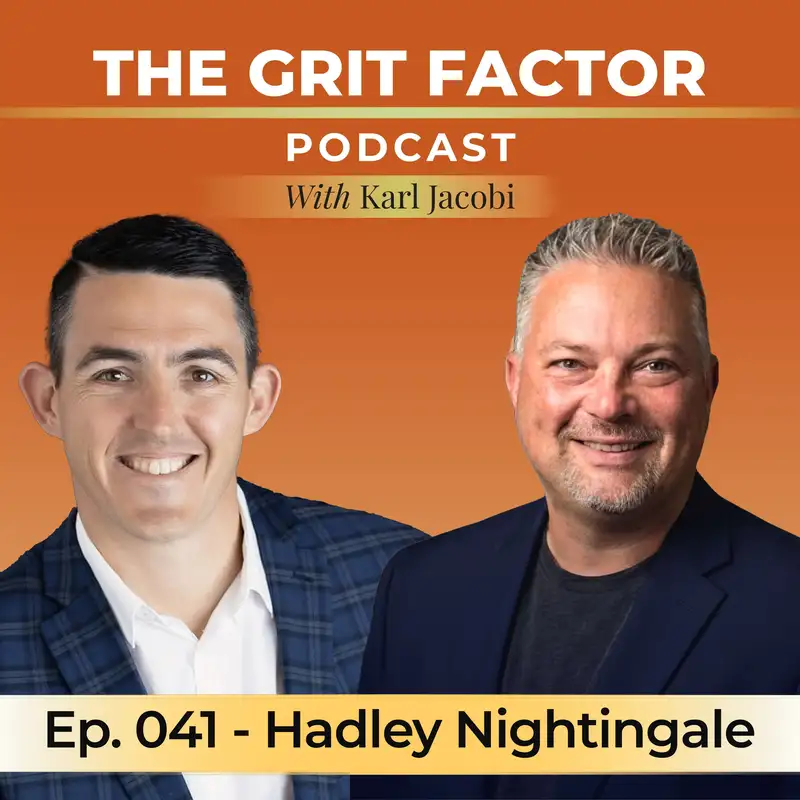
Episode 041: Two Lane Road. Two Hundred Tons. No One Coming to Save You with Hadley Nightingale
Episode Summary
Hadley Nightingale bought a farm at nineteen years old, right before the Global Financial Crisis hit, with a mortgage the bank handed him the way mortgages got handed out in those days, if you could fog a mirror, you qualified. He had no business experience and made decisions that put him underwater fast. The fallout sent him to the Australian outback, driving road trains nearly two hundred meters long and weighing up to two hundred metric tons down two lane roads at sixty five miles an hour, working fourteen to seventeen hour shifts, six or seven days a week. He never saw the money from the farm again. He spent his twenties in mining camps and truck cabs instead, twelve to fourteen weeks on, two weeks off, watching colleagues who had been doing the same work for thirty or forty years with nothing real to show for it beyond the paycheck.
He moved back to New Zealand at thirty, determined to build a life he could actually be present for. He met someone. They had a daughter. And then, at eight months old, with everything that should have made the relationship work, he made the hardest decision of his life and walked away. Not because he stopped wanting to be a father. Because staying would have meant raising his daughter from inside a version of himself he could not respect.
What followed was not a clean resolution. It was seven years and counting of court battles, lawyer's letters making accusations he says were not true, a custody fight that outlasted every prediction he made about when it would end. Along the way he built New Zealand Property Buyers from two people to a team of thirteen, helped over one hundred clients, and learned that the same lesson the mines taught him, that no one is coming to save you, applies just as much to grief and custody court as it does to a two hundred ton truck. The grit that got him through the outback could not fix a court system. The only thing that could was learning to let go of what he could not control and pour everything into what he could.
This episode is for anyone gripping something right now that cannot be solved by force. A fight. A business. A relationship. Sometimes the only way through is the opposite of everything you have been taught.
In This Episode, You'll Discover:
- What life actually looked like driving road trains across the Australian outback, fourteen to seventeen hour shifts, six to seven days a week, getting paid per load, and developing the philosophy that if you can keep the wheels turning, you make more money
- Why Hadley pivoted from road trains to mining camps, the twelve hours on, six and six rotation, and what made the consistency of mine work more sustainable than the unpredictability of the open road
- What it cost him personally to watch colleagues who had been on the same site for fifteen, twenty, even forty years, with marriages numbered two through five and nothing real to show for any of it beyond the paycheck
- The decision to walk away from his daughter's mother when their daughter was eight months old, and why Hadley frames it not as leaving his daughter but as choosing to become the version of himself she actually needed
- The seven plus years of ongoing court battles since, the lawyer's letters making accusations he says were untrue, and how he learned the hard way that you cannot speed up a system, parent the other parent, or control an outcome that was never his to control
- How Hadley's solutions-focused mindset initially worked against him in the custody process, why nothing in family court moves at the speed business problems move, and what changed once he stopped fighting the timeline
- The simple operating principle Hadley credits most for his business success, do not try to do everything, pick one thing and nail it before adding the next, and the costly lesson of running three businesses at thirty percent each instead of one at full strength
- How Hadley deals with imposter syndrome as an entrepreneur, the energy healer's reframe about results mattering more than feeling qualified, and why the comparison trap created by social media is doing more damage to people's contentment than any previous generation ever experienced
Key Takeaways:
- No One Is Coming to Save You. In the Outback or in Court. The mines taught Hadley that lesson physically. The custody battle taught him the same lesson emotionally. You cannot outwork, out-tough, or force your way through a system designed to move at its own pace. The grit that serves you in business sometimes has to be set down entirely in favor of patience.
- The Only Person You Can Change Is You. Hadley's framework for relationships, business partnerships, and every kind of conflict in between. You can raise your own standards. You cannot raise someone else's. The people meant to be in your life will rise to meet you. The rest will fall away, and that is not a failure. That is the process working correctly.
- People Are in Your Life for a Reason or for a Season. Not every relationship is built to last forever, and that does not make the ones that end less valuable. Some people serve a specific purpose for a specific stretch of time. Recognizing which kind of relationship you are in removes a lot of the grief that comes from expecting permanence where none was promised.
- What Is My Life Going to Look Like in Ten Years if Nothing Changes? This is the question Hadley used both to leave the mines and to leave a relationship that was not working. If the honest answer is the same or worse, that is the signal something has to move. Most people avoid asking the question because they are afraid of the answer.
- You Cannot Speed Up What Is Not Yours to Control. Hadley's early instinct in the divorce process was to fix it fast, the same solutions-focused energy that worked in business. It backfired in family court, where nothing moves quickly regardless of how badly you want it resolved. The lesson transferred directly into how he now runs his business: control what is yours, release what is not, and stop spinning your wheels on outcomes that are out of your hands.
- One Path Until Successful. Hadley spread himself across three business lines simultaneously early on, assuming three streams at partial strength would add up to one strong income. It did not. Growing thin is expensive. The lesson he would give his younger self is to master one thing fully before adding the next, the same discipline that built every wealthy person he has studied.
- Imposter Syndrome Does Not Mean You Are Unqualified. It Means You Are Growing. Hadley still feels it. The advice that reframed it for him came from an energy healer who told him that whether she feels enlightened after twenty years does not matter to her clients, because she gets them results. Entrepreneurial people rarely feel like they have arrived. That feeling is not evidence you do not belong. It is evidence you are still pushing forward.
- Comparison Used to Be Local. Now It Is Global and It Is Lying to You. Hadley's parents' generation compared themselves to their actual neighbors, who had roughly the same life they did. Social media now puts a nineteen-year-old's rented Ferrari in front of everyone, every day, presented as normal. That comparison trap is manufacturing discontent at a scale no previous generation ever had to navigate. Most of what you are comparing yourself to is rented, borrowed, or staged.
Timestamps:
- [00:00] Karl introduces Hadley Nightingale: road train driver, mine worker, divorced dad in a seven-year custody battle, founder of New Zealand Property Buyers
- [03:00] What a road train actually is: nearly two hundred meters long, up to two hundred metric tons, sixty five miles an hour on two lane roads
- [07:00] The schedule: fourteen to seventeen hour shifts, six to seven days a week, paid per load, and the philosophy of keeping the wheels turning
- [11:00] The pivot to mining: twelve hour days, six and six rotation, meals prepared, a gym on site, and why the consistency mattered more than the money
- [15:00] What that lifestyle did to relationships: colleagues on marriage number two through five, fifteen to forty years on the same site, nothing to show for it
- [19:00] Moving back to New Zealand at thirty: the decision to find a life he could be present for, and meeting his daughter's mother
- [23:00] Karl's ad break: The Grit Code Exposed at https://gritcodeexposed.com
- [24:00] The relationship, the daughter on the way, and the moment at seven or eight months that everything started to fall apart
- [28:00] The hardest decision of his life: walking away from the relationship when his daughter was eight months old, and the values misalignment that made staying impossible
- [33:00] You can only change yourself: the line Hadley drew, and what he learned about trying to fix another person's mindset
- [37:00] How to know when a relationship is actually over: the dread of going home, the better-or-worse ten-year test, and the judgment from people who have never walked the path
- [42:00] What life looked like in the early years of co-parenting before the court battle escalated, and the shift once custody litigation began
- [46:00] Karl's ad break: The Grit Code Exposed at https://gritcodeexposed.com
- [47:00] Three and a half plus years of court hearings, lawyer's letters making false accusations, and learning that lawyers are paid to throw mud regardless of truth
- [51:00] Why his early solutions-focused approach to the divorce backfired, and the lesson that nothing in the court system moves quickly
- [55:00] What he can and cannot control: releasing the timeline, and why fighting for the past voids the entire reason he left in the first place
- [59:00] The personal cost and the personal gain: becoming more emotionally aware, learning to feel instead of just marching forward
- [01:03:00] How seven years of legal threats changed his relationship with fear in business, and why the first lawyer's letter terrifies you and the tenth does not
- [01:07:00] Imposter syndrome and the stopwatch face: the energy healer's reframe about results mattering more than feeling qualified
- [01:11:00] Social media's comparison trap: why a forty-year-old without a jet and three Ferraris feels behind, and why most of what people see online is rented
- [01:15:00] What Hadley is most fired up about: getting clients real results in real estate, and the difference between a great salesman and an outcome that actually works
- [01:19:00] The lesson that built the business: one path until successful, the cost of running three businesses at partial strength, and the team meeting that proved it
- [01:24:00] The sixty-second message to himself: focus on what you can control, and the saying about overestimating a year and underestimating a decade
- [01:27:00] Grit defined for this season: having the option to spend time with the people you care about, not the bank balance
- [01:29:00] The directive: take the next step, even a small one, and exhaust the body to quiet the mind
- [01:31:00] Steven Dolan's question from Episode 40: if you could go back and start your business again, what two things would you set up differently?
- [01:33:00] Hadley's question for the next guest: what experiment have you run that failed but left a big mark on you?
- [01:35:00] Hadley's answer: buying the farm at nineteen right before the Global Financial Crisis, and why hindsight only exists because of the experience that earned it
- [01:38:00] Where to find Hadley and Karl's close
Resources & Links:
- Reference: Tony Robbins (referenced for the "take one more step when you hit the wall of fear" principle)
- Challenge: The Grit Code Exposed at https://gritcodeexposed.com
Connect with Hadley Nightingale:
- Website: https://newzealandpropertybuyers.co.nz
- Instagram: https://www.instagram.com/hadleynightingale/
- Facebook: https://www.facebook.com/Newzealandpropertybuyer/
- LinkedIn: https://www.linkedin.com/in/hadleyn/
- TikTok: https://www.tiktok.com/@hadleynightingale
Connect with Karl Jacobi:
- Website: https://successwithkarl.com
- LinkedIn: https://www.linkedin.com/in/karljacobi
- Facebook: https://www.facebook.com/karl.jacobi
- Instagram: https://www.instagram.com/successwithkarl
- YouTube: https://www.youtube.com/@KarlJacobi
- TikTok: https://www.tiktok.com/@successwithkarlj
Creators and Guests

Host
Karl Jacobi
Host of The Grit Factor Podcast, Resilience & Performance Coach, Founder, Entrepreneur, Combat Veteran