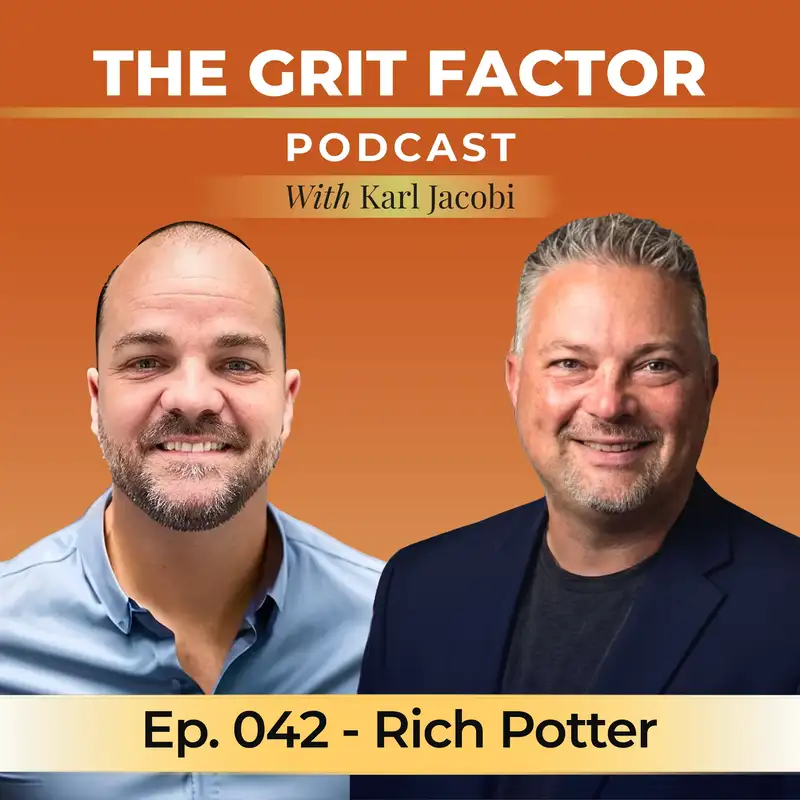
Episode 042: Fourteen Million in Sales. Panic Attacks Every Morning with Rich Potter
TGFP Episode 42 - Audio
00:00:00 Speaker: Average is the enemy of greatness. Comfort is the enemy of growth. Welcome to the Grit Factor podcast, where we strip away the highlight reel and get into the darkness beneath it. The real stories, the real battles, and the battle plans used to conquer them. I'm your host, Carl Jacobi, combat vet, entrepreneur, resilience and performance coach, keynote speaker, husband and father. I've built, scaled, and exited multiple companies totaling over forty million in revenue. But here's what that highlight reel doesn't show you. Life has been smacking me in the face with a two by four since I was just five years old. Broken home. Constant chaos. No playbook. No safety net. Just grit. And if you're anything like me. You know, you've got another level in you, in your business, your career, your faith, your leadership. You're just not sure how to get there. That's exactly why we're here. Be sure to follow me for more great content, and check out my website success with Karl dot com. Now that's Karl with a K. Now let's get to work. All right. Welcome back for another episode today, my friends, I am sitting down with somebody I've known for quite a few years at this point. Full transparency, him and I came up in the same Amazon world. But don't pigeonhole this guy into the Amazon world. We're just talking about his updates before we hit record is exposure. I say exposure time is literally five percent of what he does in his business now. So however, I've watched this man operate up close and I've wanted his story on this show for quite some time. Here's what I need you to know. Walking in from the outside, he looks like a guy who just wins. He kept getting knocked down and building something new every time. Corporate sales. Then his own companies, then franchises. But that's not the reason I want you to listen to him today, my friends. I want you to listen. Because behind every one of those wins is a man who in twenty nineteen, made a decision that cracked his mental health wide open. And he has built everything you see now, while fighting anxiety and panic attacks that still show up every single morning. And that, my friends, I can definitely resonate with. If you've ever had to hold yourself together with one hand and build with the other, you need to listen up for the next hour. Rich Potter, my dude, welcome to the show, my man. Hey man, thanks for having me, man. I've been, I've been looking forward to this. We just haven't been able to sync our calendars for a few months, but I'm excited to sit down with you and have a conversation. Yeah, man. Me too. Dude, I know. We we actually did sync up to have, uh, you know, to have this earlier, but I had a technology breakdown. Nothing wanted to work, dude. I was so frustrated. So it was kind of embarrassing on my part. I told my assistant, hey, send, send, you know, send an email and let him know we gotta reschedule because nothing was working. But, um, but yeah, man, I'm definitely excited to dive in because I've known you for several years, man. I've had the privilege of just watching you build things and speak on stages and do a lot of the same things that I've done. Right. So well. Dude, again, man, you and I are cut from the same teeth in the Amazon world, right? So I already know a piece of your grind, but if let's, let's get the audience up to speed before any of the businesses you spent over a decade in the corporate world, right? So take us back there, man. Paint us a picture of that life, the big accounts of the stability. What a good day look like for you back then. Yeah for sure. So I went to Arizona State, got a business degree at Arizona State. And, uh, my last semester there, I was going to one of those career fairs and, uh, met, met the company that I would work for for the next twelve years. Um, they're a little electronic component distributor out of Texas that has, they happen to have a local sales office here in Arizona. So, uh, met them, got recruited by them. They moved me out to, to Dallas Fort Worth for a year to go through training. And that was like, it was only supposed to be six months. Um, but it was right at that two thousand and eight crash. Um, so I was supposed to go open up a new sales office in Saint Louis after my training and everything that was happening with the economy, just like put that on hold, they decided not to open the new office. And so here I had a job, but I didn't have a job, right? Like I, I went through the training to go work, but then there was nothing available because the whole there was a hiring freeze and everything. So like luckily they kept us trainers, trainees on. They didn't let us go. They're just like, you're gonna have to go work in this business development group. You're gonna have to grind, find your own accounts. Good luck. Like, we're not going to fire you. You're not going to let you guys off. But once there's openings in sales offices around the country, we'll start placing you right? Right in the frying pan. Yeah, yeah. So so six months turned into a year, but then someone got promoted at the Arizona office. So I was able to move back to Arizona. So it all worked out for me. It just took a little bit longer. So, um, I was basically a sales executive selling electronic components business to business, basically anything that goes on a printed circuit board or like little plastic connectors, that's what I was selling by like the thousands, tens of thousands. So yeah, so I got to Arizona. I basically got like the trash accounts that, you know, everybody kind of like handed off to make a desk for me. Um, the value was probably on accounts, right? Yeah. No, absolutely. Yeah. Yeah. Yeah. So it was like there's about a half a million dollars worth of annual spend that these accounts represented. But to kind of give you like a frame of reference, like the closest person to that was doing two million a year average people are doing three, four million to like make a decent income. Right? So I came in on the low end, fresh college graduate and, uh, you know, within five years, I built that up to a fourteen million dollar desk. I was nice number one sales person in the region for several years. Um, yeah, it was, it was, it was great. It was cool. I was on fire. You know, I thought that, you know, I was going to stay there. Most most people there had been there their whole career. So I'm like, I'm gonna be here my whole career. Um, I love this place. And then, um, gosh, I was probably there maybe seven years or so. Um, my largest account got bought out by a company in India, and this one account probably represented maybe sixty to seventy percent of my commission. Oh, wow. Right. So I was worried. I thought for sure sixty to seventy percent of my commission was going to disappear overnight. They were going to move all production to India because it's cheaper. Um, and so I went home and I told my wife, I'm like, we got to figure something else out, some sort of side hustle business, something. Uh, because real quick, my income could be decimated. Right? It actually didn't end up turning out that way. They ended up moving a bunch of production from India to North America. So my, my account even got bigger. But that fear, that panic got me thinking, got me looking. Um, so we started looking on like Craigslist and Facebook and a biz buy sell just to just generate some ideas, right? So we've actually found a photo booth business for sale in Phoenix. And I started looking into that and we didn't end up buying it, but I love the idea of it. So we decided to start a photo booth business. So I went to my dad and I asked to borrow ten thousand dollars to go buy a photo booth and launch a website and stuff like that. So my dad gave me ten grand and we were off to the races. So, uh, we, we quickly turned that one photo booth into two photo booths and a bubble soccer rental division, all within about four months, hired our first staff to, to run events and, uh, had a lot of fun doing it. So that was, that was like, so I'd been working for them probably about eight or nine years when we started, uh, when we started that business. Mhm. Um, so we, we had a good time doing that. Um, you know, we did events for like NASCAR and Larry Fitzgerald. And even for a time we were traveling with, uh, Garth Brooks and Trisha Yearwood on the Garth Brooks Stadium. That's cool man. Put my photo booth on their semi and like, they would drive it to the next city and I'd fly in and do the event. It was super cool. So that is dude. That is. You better get some. You better have some autographs, man, or else it didn't happen. Oh dude. We would do two events a year for Larry Fitzgerald. And, uh, every year I wanted to take my jersey and get him to sign it, but I just couldn't bring myself to do it. That's crazy man. Well, dude, about a year into that is when we started in the Amazon space, right? So like, I still hadn't replaced my income. Um, you know, I still at this point, like I was all, all, all in on being my own boss. You know, I didn't want to work for someone for the rest of my life anymore. And so about that time, I saw a friend make a Facebook post about selling on FBA and how they were doing. Great. And so this buddy, I actually went to high school with, um, his brother founded Bucked Up Energy, right. And that was like their start of bucked up energy was, was FBA. Um, they were doing other things at the time, but it turned into bucked up. Yeah. So like, I reached out to him, I'm like, what are you guys doing? What is this f b a thing? Like, I didn't know there were third party sellers on Amazon and I didn't either. I can relate, man. Yeah. And it's probably about the same time as you. So I've been selling on Amazon for about twelve, thirteen years now. Um, so we, I learned what it was and because I was in distribution, like I understood the wholesale model. So, uh, about that time, like we found, uh, Jim Cochran's community and they were pretty big into retail arbitrage, but it didn't really resonate with me. Um, so being wholesale space, that's where I went. I went to wholesale and that's what we've done, um, our whole time on Amazon. So, you know, we, we built up a pretty big business pretty quick. I mean, we were doing a million a year within by year two. And, uh, it was about then. So about three years after I launched that photo booth business, I had replaced my income between the two businesses. And that's when we jumped in and I quit. My job went full time. And that's probably been, I guess about eight years ago now. Wow. I've been self-employed, done several different things in that time since then, but those are the two businesses that helped me get where where I was and helped me leave my job. That's a good story, man. You know, I've seen you come up in the same space that, you know, I say I grew up in too. I pretty much, you know, grew up in a sense of like entrepreneurial life. I didn't know it as entrepreneurship. I just knew it to what you just said. I just didn't want to be pigeonholed to an income to instability. Right. And, uh, but my, my, for me, it wasn't that volatile where somebody, you know, I could lose sixty, seventy percent of my income on a whim, right? But take us back to that moment for real quick, because you think you not intentionally hit something. And I want to bring this out because there's a lot of people that's listening to you right now, especially in the business that you're in, what you just talked about, right? The sixty to seventy percent loss, a lot of people were phrasing that. Right. But you decided instead to bet on yourself. So take us to that decision. What made you believe that you could build something on your own when safe was the move? The go to is, you know, instead of finding another job. Yeah. For me, like safe wasn't finding another job though, right? Like, dude, I could see that happening again, right? And yes, you know, I never had, of course, never had the foresight of AI, but like, that's what everybody's facing today, right? So that dude. So in my mind, I could, I could find a new job, I could find a new account, but those accounts could always disappear. They could go out of business, they could move their business elsewhere. You know, I love the idea of sales because I felt like there was there was no limit to what I could do. Like income wise. Mhm. Agree. But but but as I got a taste of entrepreneurship. I felt like it was even better. Like the ceiling was even higher than what? What it was in sales. Yes. Right. So, like, my income was no longer attached to a certain percentage of what I could sell. Now, I could keep one hundred percent of what I could sell. Right. So like this light bulb went off and I'm like, that's where it is. Like that's, that's where my future is. Yeah. So it was, it was an income freedom. It was eventually became a time freedom, you know, like it wasn't right away. Like I went from working forty hours a week to working eighty hours a week for a while. Uh, but it also made it so that I could step away at any time. You know, my kids had something. We traveled a lot back then. Right. So I was able to just book a vacation and leave on a whim. Like it really created an incredible level of freedom and an incredible level of like, potential, like what we could accomplish is what I saw. So for me, that was, that was it right there. Like I felt the trap was the job. Um, at that point. So that's a, that is such a good point. And I've had several guests on already talk about how that is the trap, right? And don't get me wrong, not everybody, not not every person is meant to be an entrepreneur. And that's fine. You know, there's entrepreneurship, right, where we still have the same mindset of, of an entrepreneur, but, you know, using somebody else's pocketbook. Um, but I love what you said there because you fell in love with sales. And I want to hear your perspective on this for the person that's listening to you. Oh, I can't sell. I could never see myself in sales. Um, here's a newsflash. We're always selling, Right. We are always selling, especially if you're married, especially if you have kids, especially in any environment you're always selling. So why not get good at it and leverage it to build increase your ceiling, right? Yeah. I'm not a natural born salesperson. Um, I mean, if, if, if I can do it, anybody can do it. I'm an introvert at heart. Um, I have the ability to like turn it on when needed. Um, but, but I am truly an introvert and if this introvert can, can learn how to, to sell and I really like, I sell myself, right? Like I'm a people person. I'm a listener. You know, I probably, I think that's one thing I'm good at, like better than most is I listen to people and so I can learn who they are and what motivates them. And that, I think is what makes me a good salesman is my ability to learn to listen and then connect with people. It's not that I'm a pushy, you know, like all the all the sales strategies down. Like, that's not me. I'm a relationship guy. I listen and I understand the person's need and that's what makes me a good salesperson. Well, that's just that's so good right there. I mean, that's true relationship capital in full in full play, right? It's establishing rapport. And I love what you said there selling yourself, right. Because the end of the day, that is exactly what you're selling, right? You're selling yourself on the ability to solve that person's problem or not be able to solve it. Cool. You know, put them in a direction where they can be solved, right? Um, but at the end of the day, that is what exactly what you're selling them, you know, is you, you know, um, love that man. That was pure gold right there. Real quick, before we keep rolling, maybe life hit you hard. Business fell apart. Career isn't working out. Relationship ended. Health took a dive. And now you're standing in the rubble trying to figure out what the next move even looks like. Or maybe nothing blew up at all. On paper, you're winning. Sure, but on the inside, something's off. If you're not in crisis, you're at a crossroads. And the playbook that built the life you have is not the playbook that builds the one you want. Either way, you're stuck. Not broken. Stuck between who you were and who you're becoming. Most self-help just piles more weight on the load you're already carrying. I do not want to do that. I put together a free video series called the Grit Code Exposed, and I want to invite you to check it out. Seven short videos. That's it. The five laws that change everything for me in every client, I coach the same five that every person who's ever come back from the fire has walked through where they had a name for it or not. No fluff, no ninety minute webinar, no bait, just the free video series. You can start it tonight. Grab it at grit. Code exposed dot com one more time. Grit code exposed dot com. It's free. You don't need any more hustle. You need the next version and this is how you find it. Check it out. See if it speaks to you. And if it does, I'll see you inside. All right, let's get back to the conversation. So let's let's fast forward a little bit. Um, I'm not sure exactly the timeline, but somewhere along this face, because I view you like myself as a serial entrepreneur, a serial Builder, right? We're not talking about, you know, the Kellogg's type of cereal. We're talking about, you know, somebody who's building consistently. You've done multiple businesses, which, you know, fast forward a little bit, you're doing franchise brokering, which we're going to dive into in a moment. But somewhere along the ways, you know, there was a business you got into that wasn't as successful, right? So take us back to that time. I think it was a gym, if I remember correctly. Um, take us in that moment, in this moment of life where you're questioning things. Yeah. So that all kind of happened about the time I decided to quit my job. Um, a local gym became available for sale and it was a franchise snap fitness. Um, and it was, it was a turnaround opportunity. Like it was kind of struggling. Um, it was more or less breaking even. Um, but I had met with the owner a series of times and decided to, to do it. So we bought the gym. Um, and It. So like you said, I'm a franchise broker now. I spend all my days now trying to match people with the right opportunity that fits their personality and their strengths. And this for me, like, I wish I would have known that there was franchise brokers at the time because this wasn't a fit for me. Right? Even though like I loved being in the gym, I love being working out and being active, it wasn't a very good fit and the corporate support wasn't very good. I mean, in fact, it was terrible. I did a week training at corporate and then never heard from them again. Right. And, and the owner didn't disclose a couple of things that I found out later. And we started losing memberships. And after a couple of months in, like the stress just built and built until I started having, I wake up in the middle of the night panic attacks, uh, it triggers some sort of anxiety in me that I had never felt before. Um, so it was just like it was this panic of like, oh man, like everything I've built, I've got this incredible Amazon business, I've got this incredible event business, and now I invested in this dying gym and I'm going to lose everything. And I just started catastrophizing. And that's not who I am. That's not anything I've ever done or whatever. But that's, that's what was happening to me. Yes. And, and I knew that because it wasn't a good match and these things were happening. Like I knew for me, sometimes I think you need to push through things and I think you need to figure it out. You need to learn and you need to. But this wasn't one of those things. And I realized that real quick. And so we decided to put it on the market and decided to sell it. So we owned it for a little bit less than a year. We found some some people that bought it. Unfortunately for them, the timing was terrible. It was great for me. We sold it. I think it was either November or December of twenty nineteen, which was a disaster for them about four months later. Right. So and they were doing so well, they were building membership like it was a good fit for them. They were building up the memberships, they were cleaning things up. They were doing great. And then Covid hit and they ended up closing their doors. So like I said, we got super lucky. But unfortunately for them, they did not. Uh, but yeah, it's just it wasn't a good fit for me. And with everything I was trying to do, it was just, it became too much. Mhm. Um, so it makes so much sense right there. And let me ask a question because you said something there that I think every person, especially if you're an entrepreneur or any builder of any, any type, you say something I really want to highlight you felt you felt this presence, I would say presence, but you felt this, this tightness where you felt like regardless of how much you put into the business, you just see yourself in it, right? In other words, there's a lot of people listening right now. They're like, ah, I feel like I need to quit or I feel like I need to stop or just move in a different direction. But you have a different perspective. I want you to explain that a little bit more. Like what actually caused you to actually put this on the market versus just persisting? I think there's a number of things. Like I already had a couple of really good working pieces that, that that could sustain my lifestyle. That that was, it was working. It wasn't something I needed, right? Like it was something I wanted and I wanted to be successful at it. And I'd never failed at a business before, you know. Um, there was a little bit of a sense of pride there that like, I can't walk away from this because I'm not a failure. I don't fail at anything, I do. Yeah. Right. And, and I don't know, like it was just, I don't know what it was because like most of the time, I'm not going to quit. And it's not that I quit. I just realized it wasn't right for me at that time. And so I had to, I don't know, I think people, they spend too much of their lives doing the wrong things or, you know, just, I don't know, it could be living in an unhappy marriage. It could be a terrible job. Like whatever it is, we we love to complain about it for years. And I wasn't going to be that person. I wasn't going to be the person that complained about my business for years. I just like it was time and it was a very quick decision, but it was it wasn't how I wanted to live my life. And so I, I just had to get out of it. And for me, like that was just selling it and going back to what I was good at my other two businesses. Yeah. So that's really good there, man. And I think that's important to hear because you made that decision fast, right? Um, instead of prolonging it and procrastinating it In and not having the uncomfortable decisions or conversations and, and confrontations. Right. And I say confrontations even with ourselves because to your point, you said, man, I'm not a failure. I'm, you know, I don't fail at stuff. And that's a great point, right? But there is still that little noise in your mind that's still that little voice that says, you know, it tries to label whatever it is. It could be a failure, it could be crisis, it could be a number of different things. You know, when something doesn't work out the way we intended, right? But for you, you you immediately declared, hey, I'm, I'm not a failure. I, I do succeed at things. This just wasn't a fit for me at that time. Right? And that's perfect. I mean, there's dude, how many how many businesses does an average millionaire do before they become a millionaire? It's not the first one, second one, third one or fourth one. It's usually on average Nine six to nine businesses that actually they have to go through to become a success, to become a millionaire. Right. So, um, so for those who are listening or watching, I just really want to make sure you, you notate this because if I understand correctly, you, you move swiftly, you immediately recognize that this was not a fit for you. And it wasn't because you were a failure or anything of that nature. It's just clearly wasn't a fit for you. And that's okay. Right. Yep. Um, yeah. So you told us that season really costed you money and a lot of nights and weekends, but the bigger costs and what did your head. Right. Severe anxiety and panic attacks that you never had before. Um, so did it only start at that point or was there a specific moment you realize this wasn't just stress anymore? Yeah, it was, it was then it was in that probably two to three month period. Um, after I bought it, that something triggered. I don't know what it is or what it was, but never really never experienced it before. You know, I experienced stress on a much different level. Um, but this anxiety was, was totally different. Um, I can imagine man. Yeah, I can imagine. So you built businesses after businesses. You're the guy who could figure everything out, right? And here's this gym and your own brain probably telling you you could not. Right? And what I'm aiming at is all the people out there that try to start something, whether it's a fitness program, it's a business, it's a relationship, whatever. We've all got things that we've tried to do and it, uh, it didn't work out right. And for me, I'd love to hear your thoughts on this for me, I've had to get into the mindset of and this was of my own doing. My own coach says this, you know, reinforces this to me is what are the lessons I was meant to take away from that season, right? Like what, what are the lessons I need to extract? What's the dead weight I need to drop? So for you in that season, what were some of the lessons that you needed to learn in that season so you could carry forward to be even more successful? Yeah, yeah, I didn't know it at the time, but there was a change I made in that season that, um, directed me to, to coach it. Um, it was very shortly after that, that, um, I had a couple conversations with, with Jim Cockrum, um, and his Amazon coaching community and decided to, to start helping other people. Right. Until that point, it was me, me, me. Like, what can I do to grow my businesses, build my wealth? And there was something that I don't I don't know what it was, how it happened, but it just kind of pushed me a different direction. Like I can build great businesses for myself. At the same time, I help other people do it. Um, so I spent the next few years, uh, partnering with Jim and creating, uh, different wholesale courses and different courses for Amazon community and then helping people, uh, start or grow or build their, their Amazon businesses. Um, and that, you know, sense has turned into a world of hundreds of businesses that I now help and coach. And so it evolved into what it is now, uh, kind of outside of the Amazon coaching space. But, uh, there was something that that was really healing for me when I turned to helping other people. Mhm. That's so good right there, man. I that's essentially the law of reciprocity work in full effect right there. You know, when we stop and I've said this, and I remember when I keep saying yesterday, like yesterday was Monday, my day is all messed up. But when we start focusing on other people, right? Our problems, not that they never go away, but our problems aren't as big as they used to be, right? And the universe or you know, whatever. However you want to view this, when you start caring for other people, when you start looking at other people more than yourself, your needs and everything that you may need in that point will just be taken care of, right? I mean, that's just the way life works, you know, and I'm off to remind you of this. You know, life is bigger than us, right? It's bigger than you. It's bigger than me. It's bigger than both of us put together. Right. Um, but by the mere fact that you shift your perspective from not woing on your own situation or things that's going on in your life to like, man, I just changed that person's life. Man, I just changed that person's life and probably kids future lives, right? And when you do that, man, it just, it just changes your perspective. It really does. And I've had that perspective shift in my own life, man. Um, and it's hard, right? I mean, it's hard not that we're selfish, but it's hard to have that kind of focus because humans. Right. We are always looking about our own interests, right? What I mean by that is, man, I've got bills coming up. I've got this, I've got this, I've got how am I going to make this work? Instead of, man, how can I help this person? How can I help this person? Yeah. I think my, my instinctual nature is to like, draw in, to think of myself first to, to kind of self isolate. And so it's taken some time and some practice to, reverse that right. And to, to look outside and to, you know, to help others. But it's, man, you can really create a very rewarding life when you do that. And I think that's a bigger win in my opinion. Man, I learned this the hard way, man, I love to hear your thoughts on this. And I think you saw this story in me. You saw this in my life, man. You know, I, I grinded for ten plus years, almost fifteen years non-stop in building businesses, the same space, right? Amazon, multiple things, multiple ventures. However, man just woke up one day. Dude, you're, you're kind of relaying on the same note with the gym. I just was miserable, right? No joy, no fulfillment, no nothing. But I was always in grind mode, you know, focusing on my own needs. Focus on what my kids need, focus on my wife needs, focus on all those things. But other people. And as I'm talking this through with you, dude, I'm realizing that that's when things started to change for me is when I started to focus on, you know, other people, right? Whether it's through coaching or just straight up helping other people in their own struggles, um, or building their own businesses or doing other things in their own lives. But two things that you said changed everything for you, man. First, you said you don't actually have to you, you have huge swings to win. You can start small and start strategically. And second, that mentors, coaches and citizens matter. That you do not have to go it alone. Which I love personally. Not because I do coaching and mentorship as well. But look back over the last five years, we as a society have gotten so freaking isolated. Right. And so what an awful thing to say right now. So for a guy who bought, you know, this gym and on instinct built everything solo. Outside looking at it seems like to be a full reversal, right? Who showed up for, you know. You know, were you in the middle of it? But when did it start? It all make sense? I think you started to say this here, but I want you to bring this full picture when it actually start to make sense for you for those two different, uh, shifts. It, it was, it was like it was Covid and it wasn't like Covid, but that's the time period, right? Like that's how it all, it's all when it all started happening. Um, and I, it happened, it was interesting because Arizona was a little bit different. We were definitely a little bit more lax with, with how we treated Covid. Yeah. Um, but it was that time period where I think I really started developing some really deep relationships with some people, um, people that I was close to, you know, my office manager now, who's been with me for eight years, uh, got really close with him, uh, a couple of my neighbors. You know, we we'd sit on the back patio and hang out till three a m because there was nothing to do the next day. Right. So it, like, it forced us into this, um, situation where the rest of the world was closed off to us. But my inner circle became really tight. Mhm. Um, so, you know, I, I don't know, I think as men sometimes we don't foster those relationships very well. And I'm still guilty of it today. Um, you know, but, uh, just this weekend, I reached out to a couple buddies and we went and, you know, had a couple drinks and ate dinner and watched the game, you know, like I, I, I haven't always been that person, but I think it's important for especially us men who tend to isolate inside of businesses that we try to develop, foster those those relationships, but it wasn't until it wasn't until Covid, that isolation within Covid that that I started to try to be more intentional about that, which is, which is a weird time to be intentional about. We're told not to, we're told to stay away to distance. But that's, that's the timing for me is when it all happened. That's very interesting to hear, man. And that's a great perspective. So two things occur for you. You know, one is you got super well, I say two things happen for you, for you, you actually got more intentional with your inner circle, right? And I could see that, right? I mean, you're, you're home all the time or, you know, you're in your local city. You were in Alabama before we moved here. So I could certainly relate to that. Um, while we did have a pretty tight shutdown, majority of the state was like, yeah, f you, we're not doing that. You know, um, go pound sand essentially. And so, but that's such a good point, man. And we're both dudes, so we could both say this out loud. Us dudes by default, in my opinion, I'm of the belief of this that we just don't talk to people, right? Because we think we could do it on ourselves. We can't, you know, we don't need anybody else or we've may have been hurt before and we just don't want to let our guard down again, or we're just, you know, too macho to bring other dudes in our lives to, to, you know, to, uh, to surround ourselves with people. Right. Um, that's such a good point, man. I think it's only gotten worse for so many people since Covid because of the whole distancing, because of the whole isolation, everything's been pushed virtually. Um, especially in the era that we live in. You and I were both in Amazon space, everything. Dude, you don't ever have to leave your home anymore. No, no, you really don't. And a lot of businesses, a lot of jobs now are remote. Like, yeah, we're, we're further isolating from from each other. Yeah. You know, I mean, heck, I can have everything delivered. I can have my groceries delivered. I can have, uh, you know, people come over and clean my vehicles or groom our dog or I never have to leave the house, you know? Yeah. And that's not how I mean, through evolution, like we are a very social, we are creature, you know, we're used to sitting around the campfire for hours telling stories, right? Like that's, that's who we are at our very base genetic level. And that's not how, what the society, what we've evolved to in this society now. So that's such a good point. We are meant to be in communities. We are meant to be social. We are meant to be, you know, pouring into each other, helping each other and not sitting in isolation. In fact, isolation is where people get hurt, literally get hurt. You know, that's where you start developing stories. That's where you start, you know, coming up with these narratives that ninety nine point nine to the infinite percent are inaccurate. Such good points, man. Let me ask you something, man, because this is something I stress or I say stress, but something I deal with every day that outside looking in, people don't think this is true. Do you still deal with this anxiety every day? Not every day. Um, and, and it's actually been getting a bit better, uh, the last little while, but it kind of comes and goes. Like, I'll be, I'll be good for months. Um, and then it'll just kind of come back. Um, I, I notice it around like, uh, procrastination around things that are harder. Yeah. Procrastination can trigger my stress and anxiety. Um, obviously, like with the ebbs and flows of business. You know, if I, if I go a few months without closing a deal or whatever, like that can start to cause a decrease in. yeah, but no, it's not something I deal with every day like it was back in twenty nineteen. But but it is something that still comes and goes. Yeah, I can, I can fully relate to that. I actually, in fact, I just put this out in our group. It's called, I call it productive, uh, procrastination. Um, and this is what a lot of people deal with or struggle with is productive procrastination. What I'm talking about here is the busy, quote unquote busy work that we do instead of the things that actually move the needle in our lives, right? Whether it's our businesses, our careers, our, you know, relationships or, or health even, right. Um, in your, in your bio or in your intake, you mentioned you give credit to your, your morning routine, which I'm a huge fan of morning routines. Um, and you put a lot of attention into meditation and essentially closing the night the same way. So walk us through your average morning, your average, you know, evening even. What does that look like for you to stay grounded, to stay? I would say anxiety free, but just to keep yourself grounded and checked and giving yourself the win. The best way possible. Sure. For me, honestly, it's really simple. I don't try to over complicate it. I love it. I'm not the guy that gets up at four a m and has to ice bath and then sauna and then you know, this and that, like no. So so for me, again, very simple, I get up, um, I'll throw my headphones in and there's this app that does these sound waves, this meditation sound waves thing. Like I don't, can't remember what it's called off the top of my head, but you get a different frequency in each ear, and it's supposed to do something to your brain to kind of help balance you out. Um, it's that and a two, two mile walk. Um, and that's my morning, man. Like after that, you know, a cup of coffee, get to work, whatever. But that's, that's my intention in the morning is throw in those those meditation sound waves go for a walk. Um, you know, and I try to, uh, you know, take some, some good supplements and stuff like that to kind of help balance my body and, and help with, um, you know, I was diagnosed with the autoimmune disorder about a year and a half ago. So, um, that is another trigger for anxiety actually because of how it affects, um, how it affects me. But anyway, so I'm getting way better with that. And then it's kind of the same thing in the evening. Um, I typically it's a much shorter half a mile to a mile walk, same beats, same meditation frequency in my ears and just kind of alone, you know, just, just being alone with myself outside and walking. I keep it that simple, right? You know, I do like, I do like to, to hit the gym a few times a week. I like to get in my sauna a few times a week. But, but that's not Regimented. It's not scheduled. It's like, I'll fit it in, I'll make it happen. But, um, it's really just those couple of things in the morning and evening that I just keep it basic, keep it simple. And that's so good, man. I love how you keep that that simple because guess what? To your point that you started with a lot of people over complicate the hell out of this, right? Um, they feel like they've got to have a laundry list of things they got to do in the morning, in the evenings and so forth. And when they screw up on one of those, they quit everything. Yeah. Yeah. Some people's routine feels more stressful than the stress. Yes. Yes. Exactly. Man, I, I so, so agree, you know, and for me, my morning routine is a lot more complex. I say complex, but it's more things. It's not a cold plunge. I'm in South Florida so there is no such thing. Um, I say that, but there is, but there isn't at the same time. But for me, it took time to build up to that, right? I didn't start the morning routine I have now, right on day one, right? I did start with reading ten pages every day I did start. I love how you said, you know, you put earphones in for me. I have to put earphones in right from the get go because I my mind wanders off on the things it doesn't need to be wandered off on. Right. So I try to control what I'm thinking about what I'm listening to right from the beginning. Because otherwise, man, you know, I'm thinking about a sales call that took place yesterday. It wasn't good or a client call or an argument with wife and I had or kids, whatever. The list goes on. But I love how you keep that simple, and I hope that's encouragement for everybody that's listening right now. Just how simple it can be and how effective simplicity can be. At the same time, you don't have to overcomplicate this. Yeah, absolutely. And sometimes, sometimes there might be an audiobook involved or whatever. But, um, you know, I, my, I think I've found that the biggest stress or anxiety causer is my overthinking, right? It's so that I think by by blocking that off first thing in the morning and not allowing that to happen, I think is, is what sets my intention for the day. And that's what's helped with alleviating a lot of the anxiety and a lot of stress. Yeah. You know, there's a book called Don't Overthink or Don't Believe Everything You Think. Yes. Um, yes. Great book. If if you're trying to get out of your own head, um, definitely a recommendation. I agree, man, that's so good. Don't, don't listen to the voices. Yep. So real quick, before you go, if you're still with me this deep into the episode, something in it hits you. Maybe it was the guest. Maybe it was one line. Either way, you're still here. And that feeling in your chest right now, that's the signal. Most people get a signal like that and do absolutely nothing with it. They close the app, life rushes back in. The moment's gone. Six months later, there are the exact same spot. I don't want that for you. So put something together. I want to invite you to check out a free video series called the Grit Code Exposed. Seven short videos. The five laws. I walk every client through, the same ones that rebuilt me when everything else fell apart. And if you listen closely today, you heard them running underneath the entire conversation because everyone who's come back from the fire walks through these five laws. Some find them on their own, some get help, but the laws don't change. Free video series. You can start it tonight. No fluff. No ninety minute webinar. Just the series. If you're going to do something with what you heard today, do this before life talks you out of it. Go to grit Code Exposed dot com one more time. Grit code exposed dot com. And hey, before I let you go. Thank you for writing with me this long. It means a lot more than you know. Thank you. Well, to fast forward today, man, you're. You know, you do some amazing things as a franchise consultant, right? I've seen you. You're killing it out there. Um, you know, I've seen what you've been posting. You own franchises of your own. Um, you know, so help us understand what your day to day stuff looks like today. What are you most fired up about right now in the work that you're doing, man? Sure, sure. Let me let me back up just a little bit. Um, and how I got there. So, um, I again, I love to like try things out. Right. So it was probably twenty, twenty two. I decided to jump in on Turo. Uh, bought a couple cars to rent out on Turo. and it was really good for us for about a year, year and a half. And then the Phoenix market got oversaturated and we had to sell and we got out. But during that time period, I connected with the gentleman out of Michigan who was kind of helping people help coaching and helping people understand the Truro platform. And so like, I bought into one of his courses, one of his audio courses, and listened to it to kind of help improve my business. Um, but that connection with him is what led me into franchise brokering. Um, so he, he had a heart to help people and to teach people. And, and so I developed a relationship with him during the Truro space Truro time. Right. And so like he, I saw him exit at the same time I was exiting. He was seeing the same things in Michigan. Um, and for me, I just went right back to focusing on my Amazon business and my event business. And he got into franchise brokering and he started being very public about what he was doing and helping people start businesses. And so I kind of watched that for about six months, and eventually he made an announcement that he was going to build a team, much like a real estate brokerage with agents on his team. He was going to do that in the franchise space. And so after kind of watching that for about six months, I reached out and I'm like, what is this all about? Sounds cool. What is this all about? So it's been almost three years now. Um, I decided to join his team. Um, and so essentially what I'm doing is helping people start businesses through franchising. So I belong to the Franchise Brokers Association out of Orlando, Florida. Um, they have a very comprehensive training process, licensing process you go through and then they have agreements with over five hundred different franchises that we can rep and present to our clients. Nice. Um, so it is, it's what I do, what I like to, how I like to think of myself and the work I do is matching people with the right opportunity for their skill set, for their lifestyle goals, and for their budget. Um, there, like I said, I represent over five hundred businesses. They're not all franchises. Some are classified as business opportunities regulated differently by the FTC. They don't have a franchise disclosure document. A lot of those are much cheaper investments. Um, they provide the training and support of a franchise, but they're not. Right. So what I do is, is I help identify people, help people identify what type of lifestyle they want to build around a business. And based on the things that we discover together through an entrepreneurial assessment and through a couple of discovery calls, then I'll start showing them businesses. I never lead with a brand. I never lead with a hot concept thinking it's right for everybody. Yeah. Like we spend time together diving into who they are and what they want in life. And then I'll show businesses that I believe match them and help them accomplish that. Right. So, um, yeah, it's it's fun. I, like I said, I've been doing it for almost three years now. I love it. Um, you know, I've helped so many people start amazing businesses. One of my best friends, uh, we've been friends since we were like five years old, uh, about two years ago, he bought a, a vending machine business opportunity from me. He started with ten vending machines. Um, it's only been two years. He is up to thirty three vending machines now. He quit his job a few months ago. Does it full time, completely replaced his six figure income at the dealership. He's he's the dude has been turning wrenches. He's been a mechanic since he was twelve. His dad, his dad raised him doing it. He's been doing it forever. But he finally escaped it and started his own business. Uh, you you probably know Jim or Jim Abe. Abe McMahon. Yeah. Oh, yeah. No. Very well. I helped him, uh, invest in a home inspection franchise. I see all this stuff about it, so. Yeah. Dude, he's killing it, man. He's killing it. He loves it. It's a great system. They provided amazing training for him. And he's. He ran with it. And he's just he's one of their favorite, uh, owners. They love him over there. Yeah. Well I, I, I don't doubt it, man. He's a good dude in the first place, you know? But, uh, I see him killing it. I see all the posts he put on social media and I'm like, oh, man, I didn't realize he had pivoted away from Amazon. Um, you know, in that space. So awesome, man. Well, dude, you know, you said your message is about helping people get clear on the life they actually want to build first and then find a business, as you just talked about, right? Um, so looking back, man, let's say twenty, thirty years ago, I would love for you to give an opportunity to the younger version of Rich to like. What would you say to him? Have you known what you know now? In other words, there's a rich out there that may not be. You know the slain. It. Right now they need. They need to hear something from you to coach them through some of the. Maybe they're going through disaster after disaster. Maybe they were killing it in that one gym. Your gym. I say it was yours. But that gym moment in their life just completely derailed them. What would you say to that, Rich? Man, that's a great question. Um, I just, I just tell them to continue to bet on himself. Um, you know, um, you know, I think I've always one thing I've always been, I felt really good at is Digesting information and then being able to put it into practice. Right? So for me, it's just go back to that and find whatever it is. Like the market's going to be different at any given time, right? But what is it in the market today that that you could apply that to? So just never stop learning. You know, go back to the fact that I learned real quick and I'm able to implement and I'm able to teach it pretty well very quickly as well. Right? So whatever that means in, in the day and time that you're in at that point, right? You can find different applications for it, I think in every stage of life. Amen. But I think like, just, just keep, keep to that because that's, that's the heart. That's who I am. Mhm. Love that man. Love it. Well, as we're wrapping up, man, this leads into my rapid fire questions. And That's ironic how you talked about that, because one of the questions I love to ask, especially in a season that you're in, what is your definition of grit, man? I think it's just going back to just continue to bet on myself, you know, whatever the moment, whatever the struggle or even success, just just continue to bet on myself. Love it man. I think that's the biggest the best, I would say. Yeah, that is the biggest. But I think that's the most important bet you can ever make. Man is on yourself. Ever. Hands down. Yep. All right man, last two questions, my dude. When the lights go out and you're in the trenches, you're in the thick of it. What do you find repeating to yourself? Could be a lesson. It could be a directive or it could be a quote. What do you find repeating yourself, man, to get yourself out of this trenches? Um, I'd say it's it's just trying to envision the legacy that I am creating for myself and my family. Um, you know, I, I, I have, I have this, this saying, um, that I say to my kids every night and it's, it's, it's, I don't know, it's funny, it's whatever, but I tell them to sleep deliciously, sleep deliciously. Okay. Deliciously. Like, just enjoy it. Just get everything you can out of it. Right. My oldest hates it, right? My oldest hates it. But I tell her I'm like, that's what I want you to say to me at my funeral is to sleep deliciously, right? And, and it's just, it's just about to me, like, in my mind, it's just about like how I lived, how I, you know, persevered. Um, and just that legacy that I'm creating for myself, for my family, the people around me. Like, am I living that way? So that, uh, you know, every night I can sleep deliciously. It's again, it's a funny saying, but it's got some meaning to me. That's dude, that might be the whole title for this episode, man. That might be the title for this whole thing, dude. That's so good. I love how unique that is. And that's hey man, that's great man. Just gives you some that extra pizzazz about you, you know? I love it, man. I've never heard that. But that's so good dude. I like that. Yeah, I'm gonna have to say that later on. Get some. Like, what the heck did you just say to me? What's that? She hates it. You can't sleep deliciously. That's something you taste. Oh, man. That's awesome. All right, man. My last question for you comes in two parts. So those are listener watching. I love to give my guests an opportunity to challenge my future guests with a challenge of their own. And guys, that line up is completely anonymous. So it's not like I say anything to Rich about who my next guest is. Plus, I like to mix these up anyways, so. Steve Dolan from a previous episode had this question for you. What are you doing to help your community and the betterment of society? And what are you building or doing with your life? I think and I've experienced this in my life, I think business ownership changes people for the better in most parts, right? Um, and I think business ownership, small business ownership in general has really helped, uh, America, like it's helped us become a very strong country. Uh, it's helped build ideals, you know, and it's not always easy and it's not always good. But for the most part, like small business ownership, it changes people's lives for the better. And that's what I'm doing. I am helping people in the vehicle that I'm using right now is franchise ownership. Uh, I think because of the nature of franchises and the support and the structure and the education that comes with it, it makes sense for a lot of people. A lot of people can plug into it and they can learn a ton. They can, you know, there's so much there. But I think it all comes back to me like business ownership changes people. It changes families, it changes lives. Um, so I think that's, I would encourage, if there's any inclination in you to do what I'd encourage you to, to really look into it, um, can really bless your family and bless your life. Yeah, I agree, and this is a concept I learned a long time ago. Small businesses are the backbone of this country. They're the backbone of this whole economy. Yeah, I agree wholeheartedly. It's not the big I mean, don't get me wrong. I mean, it helps, you know, these big corporations do help it. It's really the small businesses, the mom and pop shops, to smaller businesses that you advocate for and you put people into. Um, they're the backbone of this country, man. So all right, my dude, what would you love to challenge my next guest with? What's the challenge of your own? Um, man, kind of going back to what we were just talking to a little bit ago. What is the bet that you're making on yourself right now that other people think is wrong? Ooh, ooh, that's so good, man. Especially if it's the person that's a people pleaser or a person that's always seeking for validation. Ooh, that's so good, man. That's a good question. That's a real good question. All right man. Dude, for the person that is listening, they they want to connect with you to learn from you either about the business that you're, that you're fitting people into, or they just want to say, hey, man, thanks for sharing your story. Thanks for sharing what you said. What is the best place they can find you, man? Yeah. Uh, for me, the social media platform that I'm on the most is LinkedIn. Um, so come connect with me on LinkedIn. It's Rich Potter over there in the Phoenix metro. I'm pretty easy to find. Um, other than that, my website franchise heroes dot co, so dot com dot co, franchise heroes dot co. So yeah, those are probably the two easiest places to connect with me. Um, but yeah, awesome dude. Well, thanks for sharing that. We'll definitely be dropping all of that in the show notes. So guys, check out his website, check out, uh, connect with him, you know, if you have any, as he said, any inkling at all about starting a business, buying a business, or if you just have like a, this a little bit of an itch, reach out to him, guys. If you know people that, that are like, refer them over to me. I got a great referral program too, even if it's not right for you, you know, and, uh, also if you run a solid business and you've ever thought about franchising and I can help you out with that as well. Awesome, man. Dude, thank you so much for. Thank you so much for coming here and sharing your heart, sharing your wisdom, and just sharing your story. Not just the string of successes and the losses well, but coming here and sharing your authenticity, your compassion for helping other people, and just getting a glimpse behind the story of it all. Man, thank you for I honor and respect you for that, man, I appreciate you. Yeah. Thanks for having me, man. Yeah, absolutely. All right. To those listening and watching, the gap between average and excellence is what action, even if it's just imperfect action. Don't just listen to Rich today. Take one thing he shared and use it in the next twenty four hours. That is the challenge. That is the tuition of listening today. Also be the reason someone doesn't quit today. You heard us talk about isolation. Don't keep this to yourself. Someone in your circle needs it. Send it to him. Rich again, my dude. Thank you for stepping in arena.
Creators and Guests