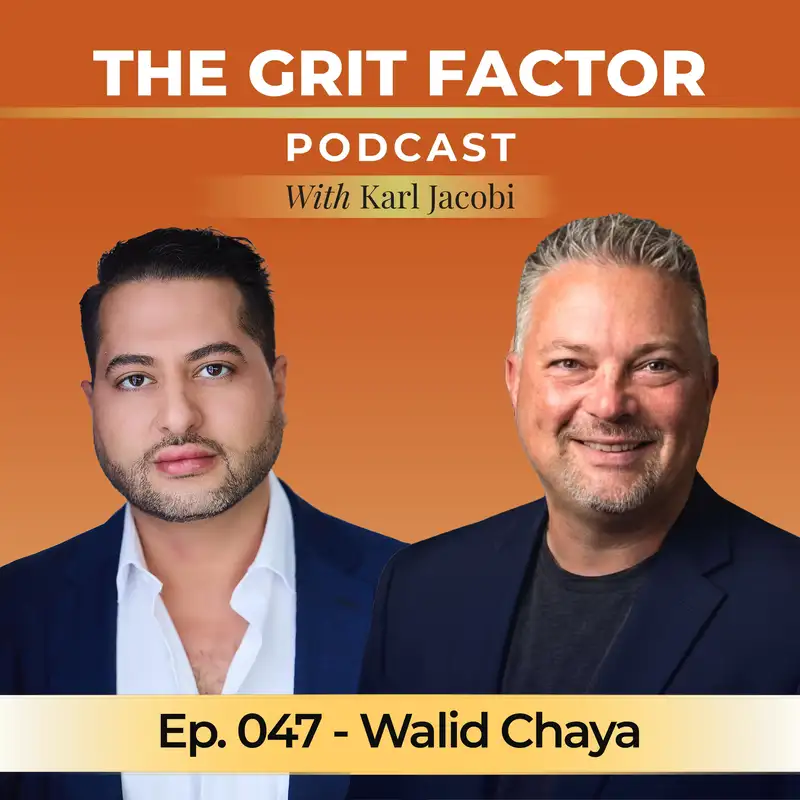
Episode 047: Bet on Yourself Before Anyone Else Sees It with Walid Chaya.
TGFP Ep 47 Audio
00:00:00 Speaker: Average is the enemy of greatness. Comfort is the enemy of growth. Welcome to the Grit Factor podcast, where we strip away the highlight reel and get into the darkness beneath it. The real stories, the real battles, and the battle plans used to conquer them. I'm your host, Carl Jacobi, combat vet, entrepreneur, resilience and performance coach, keynote speaker, husband and father. I've built, scaled, and exited multiple companies totaling over forty million in revenue. But here's what that highlight reel doesn't show you. Life has been smacking me in the face with a two by four since I was just five years old. Broken home. Constant chaos. No playbook. No safety net. Just grit. And if you're anything like me. You know, you've got another level in you, in your business, your career, your faith, your leadership. You're just not sure how to get there. That's exactly why we're here. Be sure to follow me for more great content, and check out my website success with Karl dot com. Now that's Karl with a K. Now let's get to work. All right. Welcome back for another episode. Today, I'm joined by a guy whose face you've probably seen on quite a few films. We're not going to dive into all of them just yet. He has written and directed his own award winning films, and built an acting school that trains the next wave of actors in Hollywood. Botrytis jamming in the green room, talking about some LA when when I spent there. But my friends, that is not the reason why I want you to listen to him today. I want you to listen because his whole story is about bet on yourself before anyone else sees it. Walid grew up as the son of Lebanese immigrants who crossed an ocean and worked every job you can name so he could be safe or have a safe in certain life. They pictured him as a doctor, as a lawyer, something of that caliber. However, he chose the opposite. A path with no map, no salary, and no promise that would ever pay off. Then he lived the part that nobody warns you about. Years of doing everything right. The training, the auditions, the long hours. While almost nothing and I mean nothing moved. This is the moment most people would quit. However, he kept building. He kept going. So if you ever have given anything or everything to something and nothing to show for it, quietly wondering if you're crazy to keep going. This hour, my friends, is just for you. And what he learned in this gap will hit home. Walid, my dude, welcome to the show, my man. Thanks, Carl. Thank you so much for having me. And wow, what an introduction. Man, thank you so much. I'm so excited for this because, you know, I love these, these, these stories, right where, um, well, we're going to give too much away, but I, I just love your story. And as I was building your intro and really learning more about you, especially this hearing about you in, in a green room, like, man, I'm really diving in really excited for this story because you come from a family who had this perception. And as a parent, I can relate to this, but a perception of who you're supposed to be, right? And, uh, and I can just kind of, you know, visioning the shock of how it's not going to happen. So. All right, man. Well, the funny thing is, Carl, I've told my parents, you know, I may not have been a be a doctor or a lawyer, but funny enough, I played a doctor. I've played a lawyer. I've played these characters in film, on TV, on stage. And, uh, funny enough, you know, maybe my parents prophecy did come true, just not in the exact way they thought it. You know, that's that's a great point. You can actually tell them that, right? Say, hey, I was a doctor. I was a lawyer. Right, right. So that's a great perspective. I love how you just said that, man. Willie man before the credits, before the acting school, before any of that. You're a kid in in the DC area, sitting in a, in a theater watching an Arabic version of Romeo Juliet. Me personally, I will actually love to see that. Um, so take us back there, man. What did you fall in love with that day? Uh, you know, take us back to that moment. Like what? What what caused this version that we sit today, man? Sure. Carl. So, um, my, my family immigrated to the States when I was just three years old. Uh, so I grew up in the DC area, just like you said, but every summer I'd get to go back to Lebanon and spend the summer with my grandparents. They're like a second set of parents to me. They're my grandparents, but we were very, very close as well. So that was just a really transforming childhood experience. Going back every summer up until my teenage years. Uh, you know, one reason practically was my parents didn't have to pay for childcare. They just put me on a ticket with a family member going that way. And my grandparents, you know, and I had the best time. And then another thing was culturally, like, it helped me learn and maintain speaking Arabic, staying close to my family, understanding my culture, and really defining and shaping who I am in a worldly, international way that I may not have just gotten. Staying in DC proper. Now, I grew up outside of the DC area and Fairfax County. And then one summer when I was away in Lebanon, I was about five years old. I saw in Lebanon a musical adaptation of Romeo and Juliet, and it's called Mais IL Reem. That's the name in Arabic. And it's actually told from the perspective of Rosalind, who's, you know, the character survived. They're a bit older and she's coming to town to, uh, you know, her car breaks down in Verona, essentially, and she's coming to try to help Romeo and Juliet get back together so she can get her car fixed and they can reopen the town. Uh, but obviously, Rosalind and Romeo have a love history. Now, I understood all this at age five. Okay. Yeah. But what was crazy and what blew my mind is when I went backstage at the end of the show because, um, my uncle's sister was playing Rosalind in it. And when I went backstage and I just saw pure organized chaos, it sparked something. And I thought, this is really cool. Like, what is this? People are wearing black with headsets, you know, pushing costume racks. People are carrying props. You know, there was in the show a bag of money. And I was like, oh, can I see the bag of money? They're like, sure. I looked in it. It was a deck of playing cards inside. There was no money. And I was like, what is this? They're playing cards like, well, yeah, it doesn't matter. You can't see it. It just has to be heavy. And I thought, wow, this is so interesting. So as a kid, that fascinated me. And then I learned every word. To this day, I still know it. A to Z, the libretto, the book, the lyrics. And I'm a musical theater kid and a film kid, as you might see if you're watching on video behind me. Yeah, some of my favorite film and Broadway posters and these are all movies I can quote. Film scores. I could sing along to A to Z grew up as like a musical theater kid, uh, film kid. So that was really the spark at a young age. And every summer from then, I wanted to do either a performing arts camp or put on shows for my community, leading to, you know, going to college to study this sort of thing. That's incredible man. As you're talking about your story, I'm just actually envisioning a kid full of curiosity, full of imagination, full of. Yeah. Just curiosity. Right. And passion and, uh, you know, going behind the scenes and looking at everything and, uh, finding out for the first time that what we see on TV or what we see isn't what we actually is, is there, right. And, um, and to this day, I even find out some things. It's like what we see on TV is not real, right? Um, right. You know, so, so inspiring to hear. So you, so you fall in love with making stories, right? Making stories. And you come from a family that cross an ocean, um, you know, from coming from safe, you know, a doctor, a lawyer. At some point you told them that you wanted to go a different way, right? So take us to that decision. Take us to that moment where you said, hey, mom. Hey, dad. I'm actually going to take a different path here. You know, especially in that culture, you know, walk us through those moments, man. What would that look like? How did that conversation go? Um, with what it actually feel like without really knowing what the roadmap was going to look like for you? Yes. Carl. So telling my parents I wanted to go to essentially acting and filmmaking school. Uh, it was not a major surprise to them because I was doing theater in elementary school and in middle school and high school, you know, locally in the DC area. I tried to find an agent to start for some smaller gigs. I, you know, my parents had helped me purchase headshots, little things. Uh, now when I say my parents, I must give credit. My parents were both incredible, although my mom was really the person taking blind risks at this case in point. And listen, we got scammed. You know, we signed up for John Robert Powers, and they want you to pay thousands of dollars and learn a runway and this and that. We, you know, come to this hotel. Nickelodeon, Disney are casting like I'm a kid. I hear it on the radio. I'm like, mom, call, call. And that's how the psychology of those works. It's the kids and you know, the parents, all they want to do is support their child. They'll take a risk. And my mom did. But we also found the right opportunities. We found the right people. I found people that, you know, um, did know the business and gave me some practical advice just to get moving. And I grew up in Fairfax County, which is, like I mentioned, outside of Washington, D.C. it's the sixth largest county in the nation. We have some of the best public schools. And we had an incredible and still to this day, they have an incredible performing arts and theater program. They even compete statewide and nationally In their high school theater shows. So I got to do some really great shows in high school and, you know, learned at a not a professional level by any means, but with that as the bar even, you know, trips to New York to see Broadway shows or in our backyard at Signature Theater or Arena Stage, which are big venues in DC that do some popular works, whether it's from Broadway or brand new work. So again, my parents were not strangers to the idea. But of course, you know, when it came down, push came to shove. It's time to go to college. My dad's just very simple. So what are you majoring in? You know, you've done all this fun stuff. You can still act. No one's going to stop you, but, like, what are you majoring in? You know, um, I told him essentially, uh, I said, theater and literature or in English, something like that, because it's not, not true. You know, theater is literature, but I did not get an English degree. Um, but you know, what's funny is alongside doing my theatre and acting degree. I did, you know, get a minor in English and a couple other credits. And I started at the time while I was in college in the summers, my production company that's also doubled as my acting school at the time and as an eighteen year old, my first year in college, you know, studying theater, no one wanted to, you know, hire me to lead a performing arts program at only age eighteen. I kept hearing, do you have someone twenty one and up that can be, you know, with you. And I found my high school, uh, final senior musical choreographer. She was a graduate from my high school, Jenna Lee, a couple years older than me. And she was choreographing our musical. So now a year later, I'm in college, I need someone over twenty one to run, you know, a program with me in our community while I'm on summer break from college, pursuing acting. And, um, they greenlit us to start a performing arts program for kids. So for those listening who are like, how do I get in leadership in the arts and entertainment world? A lot of the time, you start doing what you want to do with children because you give them those shows, those kids plays. Performing arts camps, those experiences because they're the same tools you're going to use to then work with adults. And funny enough, I've been teaching now for about twenty years and working as a, you know, actor and director. And my students are adults and they have agents and managers, those that stuck through. And now I work with them at a much more professional level. So my own career has evolved because of just time and age. That will happen. And I didn't know that my first few years doing that, I'm like, I'm going to be directing kids for the rest of my life, but the kids grow up. And what that started, and the reason I'm sharing this is because that started, which I didn't know, but my love for academia and for teaching, and it's really been, it's really been my backbone. And after just really quickly going from college, I kept the program going every summer. Now we're in our nineteenth season this summer, twenty twenty six. We're across eight venues in Fairfax County. In Herndon, outside of Washington, DC. Right now, today, June twenty ninth, they've kicked off a new session. They're putting on a bunch of shows. We're doing Willy Wonka Junior, Annie Junior, Pitch Perfection Junior this summer with our kids. It's a lot of fun. But after I finished, I moved to New York, you know, did the New York Hustle for eight years. And we'll talk a little more about that, I'm sure, in a little bit. And I taught there at a studio and helped them grow their programs, and they learned that I work with kids, so I help them build their kids programs. And this is all while still acting and directing because you're never getting a constant paycheck acting or writing and directing. And finally, I moved to LA, where I'm at now, to also expand that program in New York that I was helping with get to LA. And when Covid shut that down and I was here, I was like, well, I'm still going to remain here as a creative, but I have this education background. So I expanded my studio here and now my studio has been in LA for nearly six years, so my dad got what he wanted in terms of his like, be a teacher, be a principal, be a doctor, be a, you know, just something that we understand in our culture. And I was like, you know what? I'm all those things. I'm a principal of my own studio. I teach all these classes, I help oversee, I get to produce, um, and not to, uh, you know, talk down on my parents, you know, for what they want me to do. But I think culturally, you know, and you guys, the, the BFA, the BA, the acting degree did not get into colleges till the nineties. You know, it's not like people were studying acting like that's not like a thing until it became a thing. And I'm not quite sure if it's even a thing now, with the evolution of college and of the industry going digital and whatnot. So, um, it, it was a journey with my parents understanding what I do. I think my dad assumed he was doing what I wanted. He wanted me to do. And as long as I could help pay tuition and kind of pay my bills. And he was helping a lot and I had some scholarship and financial aid. It was, you know, good. We worked together. So, you know, there weren't red flags. It was, you know, a success. And, and I worked hard. I taught part time as well, um, while I was in school. And like I said, the summers I was teaching kids camps. But the cool thing was I was always doing musicals or writing scripts, whether it was with kids or adults or working with Co-teachers, if I wasn't on set. So constantly just practicing those tools. And so, man, that, that amazing, that is an amazing journey, man. Uh, just highlighting that real quick before we keep rolling, maybe life hit you hard. Business fell apart. Career isn't working out. Relationship ended, health took a dive. And now you're standing in the rubble trying to figure out what the next move even looks like. Or maybe nothing blew up at all. On paper, you're winning. Sure. But on the inside, something's off. If you're not in crisis, you're at a crossroads. And the playbook that built the life you have is not the playbook that builds the one you want. Either way, you're stuck. Not broken. Stuck between who you were and who you're becoming. Most self-help just piles more weight on the load you're already carrying. I do not want to do that. I put together a free video series called the Grit Code Exposed, and I want to invite you to check it out. Seven short videos. That's it. The five laws that change everything for me in every client I coach. The same five that every person who's ever come back from the fire has walked through where they had a name for it or not. No fluff, no ninety minute webinar. No bait, just the free video series. You can start it tonight. Grab it at grit. Code exposed dot com one more time. Grit code exposed dot com. It's free. You don't need any more hustle. You need the next version. And this is how you find it. Check it out. See if it speaks to you. And if it does, I'll see you on the inside. All right, let's get back to the conversation. Take us back for a moment, man. So you commit, right? You had this conversation with your parents. You made the commitment, all of this that you've seen. You've already kind of alluded to this, but you commit and then you proceed, right. You told there was a long stretch where you're doing everything right, man. The training, the auditioning, all this stuff, you know, nothing was moving, you know. So walk us in that season, what did an average week look like for you back then? And in the results that weren't matching up, what was going on in your mind in that moment? Man, what was going on where you were like quite maybe questioning everything, like, walk us into that season, if you don't mind. You know, the funny thing, Carl, is that that's still every day. Okay? It hasn't changed. It's just different levels of that. So, so, you know, earlier in my career, I'm like, Will I get an agent? Will I even book something in New York? Will I, will you know, someone recognize me? And you get a manager, you get an agent, you get a callback for something, you don't book it, but you got far in it and it gives you validation, right? And then you start to book things and then you're like, well, now I need bigger projects. I need a bigger agent or manager. So that's what I'm saying. So it's constantly that battle between you and yourself. But I think what's important is looking at, you know, I love looking at my resume, as silly as that sounds. This is the advice I give to any performer. I look at my resume before an audition to remind myself of all the great work I've done and the time that I've put into something I love. And those are all successes, and those are all things I'm proud of and I can talk about. And it's not just like, oh, here's my history and baggage. No, quite the contrary. This is like it. And so, um, and then also to just be present, you know, I can't get ahead of what's not here yet. And so you hear that for performers, for just anyone really just being present. Imagine, right? Imagine you're a doctor. You're not present operating on someone's heart. Like, you know, so it doesn't matter what profession you are, you have to be present. So, um, but ultimately there were, there was one that really stands out, Carl. A moment where I was just like, oh my gosh, is this even going to happen? And, um, it was when I moved from DC to New York. So at the time I had finished college, I was teaching and directing in DC with these kids programs and these, you know, adult community theater programs by that point. And I had been doing that with college for five years. And I said, okay, it's time to go to New York. And my parents also decided to sell our childhood home and retire and move back to Beirut and Lebanon. So, uh, they said, do you want to stay and keep the home in DC or do you want to do something else? I said, no, you know, I want to go to New York, start my life now as an adult. I wish I kept that home and had a property that, you know, I had an investment property. Right? Again, things you're not taught as a first generation immigrant, but I can teach that to my kids now. Lost a home. Like that's a sad thing. Like my dad didn't sit me down and really say, keep this. It's an investment, you know? Um, but no regrets. It's just like little life lessons like that. But it was a moment where I said, I'm going to New York. And so I was in New York. We had family living outside of New York City. And, um, I live, I lived with them for a couple months and I would drive twenty minutes to the train station. They were in Connecticut, and then I would take an hour and a half train into the city, and then I would take the train to the subway, to the financial excuse me, to Hell's Kitchen, to the film center where my job was. And that was another fifteen minutes. So door to door, it was like two and a half hours. And I did that almost every day. I didn't tell anyone. I wasn't living in New York because you have to put on this illusion, right? Like I'm in New York, like I'm here. And after doing that for a couple months, um, and always just, you know, and I was working little side gigs at the time I was tutoring students, you know, again, staying kind of within the teaching world. Um, a couple PA gigs, which is so much fun. You get to be on set as a production assistant. So you're doing random jobs. I'd find myself in the casting room often, or I'd find myself working alongside the first ad often, which is a lot of or second ad paperwork and administrative. Funny enough how my skills kind of led me to the same spots I end up leading now. But, um, I wasn't really getting a job job like I thought I would. Coming out of college in New York, it was so much harder than DC and the area I grew up in. It had my connections in and people were telling me like, for example, they're like, well, I'm at NBC and I can't get my resume to the seventh floor and I'm on the fifth floor and I'm like, well, how am I going to get onto the seventh floor if you can't get onto the seventh floor? Yeah. You know, and so I went back to DC on a bus from New York to get my car. And I was driving, going to drive from DC back to New York with my car to pack my stuff up after a couple of months to just go back to DC and reset and say, Maybe I'll try New York. If I get a bite, I'm not going to tell anyone I'm leaving. And as soon as I got on the highway, I got a text message from a friend who has an acting studio that I ended up teaching at for years who said, hey, would you be interested in helping at the front desk some evenings and weekends at the studio? And I was like, absolutely. I literally detoured right off the highway. I had just gotten on, parked my car back at home, and my family was like, what are you doing back? I said, I'm getting a bus ticket. I'm not leaving New York after all. And that literally changed within a moment after it was already decided I was going to pick up my bags and I ended up, you know, doing that. Coincidentally, my best friend had gotten a job at a theater called Sleep No More, um, doing behind the scenes and was moving to New York too. So we ended up doing the roommate situation. And that journey began, which was an eight year journey in New York. And, uh, you know, it's the anchor that I really needed to sustain and stay. And it was just a little, you know, boost. Um, but that was a moment where I thought, you know what? Like this city doesn't even want me. Uh, you know, I can't even get my foot in the door. Um, very, very challenging, especially like, you know, as a twenty something very excited. Um, and now, you know, and then I just got a little bit of hope. And so everything changed just from that one text message. That's man, that's so encouraging. And, and what you ended with right there was hope, right? And oftentimes that's exactly what we need is hope, right? It could be a text, it could be a call or anything email, anything in nature. When we've been grinding and grinding and grinding and grinding, and it's that one glimmer of hope. It may not lead anything, but it's that one piece of hope where we just go one more day, one more day, one more day. And for you, you went another day. And it was that final. I would say that final, but it was that one more swing of the axe. Where or the swing of the shovel where he hit gold. Right. It was that glimmer of hope. Yes. Yep. Absolutely. Man. How did that feel, man? Walk us in that like, how did that feel? Did you feel the sense of Proudness. Did you feel that sense of encouragement? Like, walk us back to that moment, man, where you're pulling in this, you know, on the side of the highway and making a U-turn? How did you feel in that moment, man? You know, more surprised than anything. Um, you know, at the time, especially because I did not want to leave and I had been in New York commuting every day, two hours, going back to my cousin's. And this was also between the months of November to February. Like I didn't do it at a cute, fun time. I did it in the in the darkness of winter. It is not fun. If you haven't done New York or you know, any of those kind of states. I know you know, it is so cold. My God. And I'm just. I live in LA now. It's been many years here and I love it. I love the sunshine as stereotypical as it is. You know, we do have great weather almost every day and it's something to be grateful for. And that's how we control production, right? Like that is one of the big factors. Uh, so, um, But you know how I felt. The unsurprising, uh, surprised, uh, because it was surprising. It was because I had made a decision. I'm like, I'm out. You know, I was literally hopping on the highway to go on my trip back to New York to pack my bags. And I wouldn't have made such a decision if I thought there was a little bit more in the tank. And so, you know, that moment of surprise was just adding a little bit of fuel to the fire that I needed. And things just started to unravel chapter by chapter from there. Um, that job, you know, and community and just, you know, having my roommate there, that's also a friend of the industry and then also putting myself out there, um, which was not easy, especially like going and networking events alone, um, meeting people, you know, not being nervous to like talk about yourself and having just moved there and being that guy. And what's funny enough, um, I have friends. My birthday was just a week and a half ago and I have friends that I thank you so much that I just had met during those years, uh, in New York, you know, putting myself out there that wished me a happy birthday. Now, many, many years later that, you know, I might have never connected with if I wasn't doing those things. So it literally fueled the fire. I was surprised, but, uh, it empowered me. I think that's really the best word now, you know, getting through that description. Carla. It was an empowering moment. Um, we need more of that. And that's why I think, you know, people say, you know, uh, it's who you know, you know. Sure. But it's also who knows you, you know, I can know whoever. But if they don't know me, you know, that's not going to help as much. So I love you know, that you are the network, the net worth of your network. You are the net worth of your network, you know, so you're the average of you who you surround yourself with. I mean, these are all things that come into play. And that's why that is part of my philosophy. If I can do that for anyone in my friend circle, I have my students to empower them, to help them just see the light. That's what we always want. Man, that is so good. I gotta ask you, man, because especially after trudging along for so long, you even said it to this even just a minute ago that it never went away. Right. In a sense of, uh, the doubts and fears and, uh, certainty, I guess, for lack of better saying it. What is your secret sauce, man? And when I say I love that you chuckled right here. What is your secret sauce? To continue to bet on yourself even when you're playing against the odds. MM. That is a great question, Carl. It wouldn't be a secret if I told you, but I'm going to tell you because I like you, Carl. Um, here's the thing. You know, I think it's a balance of a couple things. I think it's seeing my parents journey and commitment and resilience and knowing if they could come to America with two thousand dollars, not speaking English and get me and my sister through college running our own businesses and doing what we're doing today. They've succeeded. Like I could do this. So that's part of my secret sauce. It's just knowing that it's in me and I know it's in me because I'm part of my parents in their legacy. So, you know, the other half of it as an artist for the secret sauce, as an entertainment entrepreneur, creative, someone running their own business. I mean, these are all things you're taking risks on your own. Of course, the secret sauce is to take a risk. But ultimately, I think all the risks that I took, all the risks, but most of the risks that I take are calculated. I've built like a nice safety net for I, you know, talk to my mentors about I do my research on I ease into like, for example, my company now, um, moonlit wings in the DC area with our children's programs. I mentioned we're at eight locations now, but we weren't when we started, we were at one, you know, we had a staff of three. Now we have a staff of twenty. So it's just different. But it's nineteen years later. So it's, you know, and I say this to my students when I teach acting. It's like a clock. You just one tick at a time, one thing every day. And I think that's the secret sauce. It's doing things just in small, detailed increments. Because when you look at the big picture and this is the director in me, when I look at the big picture, it's so overwhelming. I see it, but how do I get there? Well, think about it. If you're directing a film or a stage show, the way you get there is by collaborating with each department. The lights gets this direction, the costumes gets this direction. So when you start to go into the detail and all the things that make the big picture, you're able to achieve the big picture in such a successful way. And that's a great metaphor for any career, for any person. So take things one little thing at a time. You want to open a small business, you want to put yourself to school. Well, what can you do today just to move it forward? It might be purchasing the wardrobe. It might be learning what sites to go on. It might be talking to your mentor. I think people really feel like when they have to take a risk, they have to jump off a cliff. but it might just mean, you know, taking a small step up or down. Your where you're currently at on that cliff, you know? Yeah. That's so, so good. As you're talking through the stats and everything, I'm reminded of the conversations. My, my oldest daughter, uh, Naomi, she was at Full Sail. Um, she went to full sail for, for a bit to do film production and, and so forth. And, um, and so we can't see a movie the same way ever since. Like she can't even see a movie the same way. Oh, yeah. It's a gift and a curse. Yeah. I know, uh, you know, and we love our death, you know, but it's like when we, when she comes over to visit, you know, and we sit and watch the movie, she's like, oh, that's so not real. Or that's, that's the backdrop. That's the same background extras earlier. The cup is now empty and it was full of sip ago. Of course. Yeah. Of course. Yeah. She must have a great eye. Yeah man. She. Yeah. She's incredible, but, uh, but man, that is so true though, man. It is consistently, you know, invest in yourself and consistently take risks, calculated risks. And it doesn't necessarily mean, you know, going off, off a cliff here. But you alluded to something that I really want to highlight here because a lot of people think at certain levels things get easier, right? Um, the, the risks or the, the devils, when I say the devils, the noises and so forth in our heads. Right. So being, being what you've accomplished, scaling into different locations and building what you've built, does it ever get easier? Does it ever go away? The fear, the noise, any of that? Does it ever go away? You know, yes, it actually does get easier in some ways in terms of like for me, expanding locations. If I'm hiring for one, I'm hiring for two or three or four. It's just more of a volume thing than you know. When you have volume, you need more attention. You can't just have volume people running around. So now you need more training, you need more oversight. So, you know, it gets harder in those ways, but it gets easier where if you've created something with a good formula where you can grow it and you're so confident with it, that's great. And I'll give you an example like this in the musical theater world, uh, if you're Fozzy and you're known for choreographing shows like Chicago Over My Shoulder here, and you're known for that style, so, you know, it doesn't get harder for you. Yeah, you do bigger shows. You get hired for bigger budgets. You're doing now a three hour extravaganza. So that's harder than doing an hour variety show. But like, your skills are so sharp. Like that's what you do. So I feel like it gets easier, especially like teaching acting when I get to teach, when I preach, it helps me maintain being a better actor. So a lot of things staying in it. It's like being a basketball player. If you play basketball every day, it will get easier. But then when you go to nationals and championships versus people that are, you know, just as talented as you, if not better, that's where the challenge comes to be. So I think the answer here is yes, no. And there's always growth. Yes. Yeah. Good answer. That's that's a good answer. But that's so true. Right. I mean, your skill sets definitely get refined. And so the task in itself that growth gets easier, right. But a lot of people have the perception of, you know, you know, getting to another level where you've got bigger budgets, you've got more locations, you've got more responsibilities that those that like life gets sees get easier at that point. It gets daunting. Carl. It gets daunting. And I'll tell you, I'm now at a level, a new level for myself, where I've worked on people's feature films and TV shows. I've gotten to do Madam Secretary and blacklist NBC and CBS. Some Hulu stuff for My Friends is indie films, features and documentaries, you know. But now I'm producing my own feature film that I, that I'm, you know, doing from, you know, top to bottom with an incredible team, of course. But, um, that's, you know, a new level for me personally, working for someone where they're taking all the risk is one thing, but it being something I wrote, created that I'm producing in and I have a director coming in for. Uh, so I think it's, you know, not that, you know, I'm like, oh, this is so hard because these are all pieces I've done before. I think it's just more daunting. Right? Um, it just sometimes feels bigger than me. So someone who, they get more, they have more of a budget now. They're expected to do more or, you know, imagine a doctor who moves from doing physicals to doing surgeries. Like just keep this vague for everyone. You know, I think the reality of it is, um, as long as you are utilizing the same skills, you know it'll move forward. But the daunting moments are always there. They always loom over me. They get overwhelming. I get a little anxious. I'm like, oh my gosh, this is bigger than me. But then I say that out loud and I hear and I say, yes, this is bigger than me, but I'm not alone. I'm doing it with a team. So I think when you as a creative or as an entrepreneur, you know, go back to the doctor reference, since we're on it, when you're doing that surgery now and you've elevated to that level, you're not doing surgeries alone. You have your, you know, surgeon assistants handing you your chapel and your knife, and you have nurses on standby and you have a whole team. So again, it's not just a filmmaking, right? It's not just to the arts, you know, um, the more success that comes around, the bigger things get. I can be strong, but it is going to be bigger than me and I have to have a team that's just as strong. So back to that factor of surrounding yourself by, you know, people that you know are going to lift you up. So good, I agree. Reminds me of a quote I said a long time ago. If your circle does not encourage you to grow, you're not in a circle. You're in a cage. Right? You're your circle needs to be elevating you and cheering you and supporting you and so forth in all facets, whether it's in your in your career growth, your business growth, your relationships, whatever those circles are. Right? And I'm, I stand by that. And too many times people seek validation of their ideas and so forth. And people, they don't see the vision. They don't see what you see right in your mind or in your heart. Like that's the whole thing I heard from you is a deep belief. Like you had a deep belief in what you were going to accomplish. You didn't know what exactly it was going to accomplish. Like you said, you don't know what, what that was, how it was and so forth, but you just had this deep sense of belief when you were talking to your parents or what it is that you want to attack, right? And oftentimes people can take other people's lack of validation as well. Okay, well, maybe this isn't my path because they don't see it, right. But for you, for my hearing is the deep sound belief in your in what is in your chest, what's in your heart. Um, and that's what you attacked Carl. That was, it was a thing. And, you know, funny you say that because I have family members, I have young students that I work with. I have, um, friends who have kids. And just to kind of talk about that moment in age where what do you believe in? What do you want to be? And honestly, you ask this generation, what do you want to be when you grow up? And they say influencers. Yeah, you know what I mean? And it's, it's, I don't think it's a good thing personally. Um, we've really kind of lost touch and got lost in not the secret sauce and some other sauce. Um, you know, and that does well because they believe in themselves. And I'm not saying everyone or anyone should or shouldn't be an influencer. You can still be other things, but, um, but I think ultimately, you know, believing in myself was some of it, but the, this is the point I'm truly trying to make. Carl. Um, I felt like I had some sort of a God given gift or just like a calling or, you know, I could hear Broadway saying my name not to, you know, sound cheesy when they say, can you see your name in lights? Yes, I can, you know, can I see myself, you know, over a body with a knife operating on a human? No, I can't, I hate blood, I hate being messy. I'm so type, you know, a like that is not, you know, my line of work. My mom worked at a hospital as a kid, and I would go to take your child to work day with her, and I'd, like, hold my breath and not touch the escalators. And she's like, hospitals are cleaned at the top of every hour. They have to be super clean for obvious reasons. Like germs can be good germs. Like, don't be scared. You know, she's trying to like get me to loosen up. And I was like, I don't like being here. Well, I think that's a good example for anyone listening who's thinking about their calling, where do you feel like you fit in comfortably? What's home for you? And that might be something to follow. So if someone doesn't see that in you, and it's not that my parents didn't see me being an artist in me, I think they did. It's that they literally just didn't know what to do with it. Right? Yeah. And they did their best to figure it out. And we figured it out. It might not have been as straightforward as some of the other options, but I really hope today's generation especially just considers what comes to you naturally. What do you like to do? What is a God given gift that you're good at, you know, and maybe you can find a way to make money off of that so you can live, you know? Yeah, that would be so helpful that that's such a good point. Thank you for saying that. You know, talk about the influencer, you know, uh, you know, spot, especially in, in the world that you live in too many people. You're right, man. I think there is a appropriate position for your influencers if it's coming from the right place, right purpose. All of that. Right. Um, and I do agree wholeheartedly that if you don't firmly see yourself in that capacity of what it is that you're seeking out to do, then that's not you. If it doesn't hit here, if it doesn't, if you can't see yourself in that situation in that other side, then it's it's not for you. And you can't expect other people to see that for you as well. Right? We can't expect our parents. We can't expect our loved ones to see it because it's only here for us to see. Right. And, and Carl. Carl, and just to demystify this, you know, there are people who go on these singing shows who cannot sing and I don't and I know me and you just to clear it up, we don't mean that kind of blind faith, like, again, rooted in some sort of realism. So good. I agree. Because because you can be delusional. And that happens to I have actors that come to my studio to train, um, that are just not ready yet for a general manager or to show up on set, but they think they are. And I think that gets in your own way. So we don't want that to happen either, because then it's just like, gosh, you can't get through these doors because you're an imposter. So that's, that's a whole other conversation. That's so good. I'm glad you brought that up. So no auditions for me then? Oh, man. All right, Carl, my man. I'm deflated now, man. I'm I'm. I'm just deflated. No, I'm totally kidding. That's a good point, though. There is a point where it is delusional, right? And, uh, you have to just, to some degree see the realistic side of that. So real quick before you go, if you're still with me this deep into the episode, something in it hits you. Maybe it was the guest, maybe it was one line. Either way, you're still here. And that feeling in your chest right now, That's the signal. Most people get a signal like that and do absolutely nothing with it. They close the app, life rushes back in. The moment's gone. Six months later, there are the exact same spot. I don't want that for you. So I put something together. I want to invite you to check out a free video series called the Grit Code Exposed. Seven short videos. The five laws. I walk every client through. The same ones that rebuilt me when everything else fell apart. And if you listen closely today, you heard them running underneath the entire conversation because everyone who's come back from the fire walks through these five laws. Some find them on their own, some get help, but the laws don't change. Free video series. You can start it tonight. No fluff. No ninety minute webinar. Just the series. If you're going to do something with what you heard today, do this before life talks you out of it. Go to grit Code Exposed dot com one more time. Grit Code Exposed dot com. And hey, before I let you go, thank you for riding with me this long. It means a lot more than you know. Thank you. Man, this has been so good. One of the things that you mentioned on your intake, man, and especially somebody who's accomplished so much, done so much and done so many amazing things that you've done that when life gets heavy, it's, it's burnout, right? So who is, who is Walid when the tank is empty and there's no proof or, you know, you just want to like say I'm done, right? Yeah, that's every day at like six thirty seven p m I'm like, I'm, I'm done. I don't want to do any more work today. Or like I'm reading a script and I'm like, oh my God, the amount of times right now where, as I mentioned, working on my feature, it's called crazy Rich Arabs. The amount of, you know, I have a revision when I finish with you, I think we're almost done to unlocking the script, but the amount of time that that tank is almost on empty, it's like almost there's a daily version of it, you know, because every day counts, you know, especially when you're producing a feature or fundraising for an X amount of days, then we shoot for a finite amount of days, then it's all over. So you give it everything you know. But ultimately, on those days when I'm done, it's just like, I'm ready for a good meal and I'm ready to spend time with my dogs. And like, that's what it looks like. I'm a foodie. I love Asian food, sushi. I'm Lebanese, so Mediterranean food. I love all food. I'm in LA, we have the best Mexican food, you know, so if I, if I have the energy to cook, that's something fun. Otherwise, you know, it's dinner, it's snuggles with the pups, a movie I'm just winding down. And then if I really, like, hit the wall, like if it's like, I don't want to do any more work for the next bit of time, I plan my trips and vacations for that reason. It's like rejuvenating with friends. It's, you know, just being able to unplug for a weekend or just having a dumb day where like, I don't have these often, but days where I feel like a couch potato, where I just like, stay on my couch, snack, walk the dogs, order in and like, you know, I'm like, okay, now I'm feeling lethargic. It's a success. Now let me be productive because you know, when you're in go, go, go, you know, I was just telling my friends yesterday, I was like, you guys, even my dreams are about my film right now, which is very normal. It happens to me during projects like I'm doing accounting and, you know, and I'm doing like invoices in my head. I'm doing rewrites, you know, in dreamland. So when you want to unplug and need to unplug, it's so important. And for me, you'll find me like either with friends doing something like at a music scene or show dinner or something like that. Or on a beach, like any beach, I don't care. That sounds perfect. That's I agree, man. I agree with you one hundred percent. I thank you for saying that because I think every person, every high performer that's listening to you right now, um, you know, they, they need take your advice, right? Or take what you just said because too many of us, they, they grind to grind to grind. We run ourselves into the ground. But right, we, we do it because we think it's the noble thing to do, right? We do it because if we don't, there's this noise in our mind. It's lazy or you're trying to be lazy or you're, you know, you're, you're not productive. I think there is a counter effect to that. If we're not unwinding, if we don't unplug ourselves, um, we're only going to make the situation worse. Right? Um, we have to unplug. We have to, um, yeah, decompress, especially if you're a creative person, man. Um, you just can't be creative and be able to think creatively and critically if you're always in the thick of things. You know, when you're working on your projects and they're your passion projects, and you're lucky enough that they're your bread and butter, they're your job. So you're treating them professionally too, you know? And listen, that was probably Carl, one of my biggest struggles as an entrepreneur and creative, more so in the last five years is as things we're talking about getting bigger, getting busier. Um, when is the disconnect? Because I love what I do. I could work all day. It doesn't feel like work. Some, some of the tasks do some, you know, I'm like, oh, this is like Excel spreadsheets and me doing my pitch decks and da da da, you know, verse like me actually showing up on set. That's a lot more fun. You know what I mean? Yeah. So you have your days, but, you know, it's just really finding that line to like, just be a person, you know, like just be me here in my community, enjoying the little things that are all around me. Because if you miss those little things, one day you're going to be like, damn, I never stopped to smell the flowers. And that's not the experience you want either. You want to smell the flowers? Agree man, unless you have allergies, right? Take your Claritin and then smell the flowers. Yes. Yeah. No, that's that's such a great point, man. Life's too short, dude, to not, you know, stop. Take a Claritin and go smell the flowers, man. That's so good, man. Thank you for saying that. Well, fast forward to today, man. Fast forward to today. You're building a studio for performing arts LA, you know, into a full platform for actors. You're doing so many different things, but what are you most fired up about right now that the world has not yet seen from you? Man, the world has not yet seen crazy Rich Arabs. It's the title of my feature film. We're currently fundraising. We're fundraising till the end of August. So if you're listening to this and it's not yet the end of August twenty twenty six, please consider supporting anywhere from like a couple bucks to whatever you can. Or if you're a business or company and want to help sponsor our project, come on, indie film like this is real life. Like this is, you know, the grit and the, you know, not the glam side of it. We're going in hard here, Carl. And what that means for me is, um, you know, I am in pre-production right now, so we do casting in August. Uh, we are locking down our locations. We're fundraising so we can afford our talent and our crew and our locations. And then in October, we'll shoot through November. Uh, then we go into editing and it'll hit the film festival circuit later next year and the year after. And hopefully by twenty twenty seven or twenty twenty eight, you'll either see it in the movies or on demand somewhere. Um, you know, so it has its life and journey ahead. And some of it's a mystery, you know, similar to everything we've been talking about here earlier, even this project that we know and are making, we just don't know where it'll go. Maybe it'll win an Oscar. Who knows. But, um, that's for sure. Thank you Carl. We're going to hope for the best. So that's what's up. And then you know, studio for performing arts LA my acting studio here in Los Angeles. We are the official partners with the city of West Hollywood. So we provide their acting classes and programs for adults and kids. Um, we also run our own programs that are boot camps. And I do career consultations online with actors. We get on and we help you get an agent or manager or refine your tools, or if you have a rep, find how you can get seen by casting, uh, a bit more seamlessly. So these are all things we provide. There a lot of new things coming up at studio for performing arts LA, including, for example, integration, where students that are going to be in the fall classes that I teach will have a first hand opportunity to come on set for crazy rich Arabs and be extras or work as production assistants, or do mentorships with the director or the different crew members on set or the lead actors so that they can, you know, learn from some professionals, which I think is really cool. So I always try to do some community integration. You can all look out for that. So you can find me on Instagram. Carl. Uh, at Walid dot it's W a l I'd dot C h a y a. You can also find my acting studio at studio for Performing Arts or visiting studio for performing arts dot com. And if you want to stay up to date with the crazy Rich Arabs film, check out our Instagram and follow us for updates. We have a teaser for the fundraiser up now, where you'll get to see me in a little teaser of the film, and that's at crazy Rich Arabs movie, so lots to look forward to in the next few months. Heck yeah man, thank you so much. Actually, you beat me to my next question because that was one of my next question is how can people connect with you? How can they support you in the movies? Yes, everything you're working on. So thank you for, you know, reading my mind. What's coming up next? Um, definitely be dropping this. All of this in the show notes. And so guys, you know, support the mission. Uh, just this the title alone, crazy Rich Arabs, uh, definitely is thought provoking and definitely intriguing. I definitely want to check this out, see how we can support it. So yes, and just, you know, for those curious, what the heck could this film be about? Uh, it's a hotshot lawyer living in Los Angeles, reunites with his long lost twin, a sheltered musician living, uh, visiting from Beirut for an arranged marriage, setting off a wild identity swap, romantic chaos, and a family showdown. It's kind of like The Parent Trap with Lindsay Lohan, uh, meets crazy Rich Asians or meets Mrs. Doubtfire. You know, it's that kind of comedy. They're twins, and they switch spots, and the Middle Eastern one has to be American. The American has to be Middle Eastern. There's a love story. It's very funny. And I happen to play the twins. Uh, so I'll get to, you know, do both parts. And like I said, if you check out our socials, you'll see some trailers right now for the fundraiser where I'm doing a little excerpt from the show are so awesome, dude. You had me at Mrs. Doubtfire. I love Robin Williams. I'm a huge fan of Robin Williams legend. Same. Same. Yes. Comedy. Gold. They don't make em like that anymore. I agree, man. I agree. He was so fast with it, right? None of it. It was so fast. So quick. Oh my gosh. Yeah. So fast. Yeah I agree man. Dude. So you can expect that. You can expect that the film is upbeat. It's really quick. It's mistaken identity. It's romance, it's culture. But at the end of the night and this is the most important thing, Karl. It's not just for Arabs, it's for everyone. Um, you know, it takes place between Beirut and LA and it's a lot of fun. Awesome, dude. Well, I'm definitely looking forward to seeing it, man. I'm definitely gonna be checking out the trailer and definitely want to support you in any way you can, dude. So awesome. Yeah, one hundred percent. Well, as we're wrapping up, man, I got a couple of questions as we wrap up. Unfortunately, we do have to wind this up. But, uh, in this season that you're building, man, in this season of doing everything you're doing, ramping up this, this film for crazy rich Arabs and everything else you're doing in this season. What is your personal definition of grit? Like, what does that personally mean for you? I think my personal definition of grit is like hanging on till the end. So, so that's what it means for me. It's just like, you know, showing up and being here through the thick and thick through and through, you know, until the day that, you know, you can let go, you can just step back and take a deep breath and let it out and say, wow, you know, I did this. So that's what that's what my grit is at this time. That's awesome man. Cool. All right. Last two questions. When you're in the thick of it, lights are out and maybe noise is coming in or what have you. What is a quote or directive that you tell yourself to pull you out of those moments. Sure. You know, as cheesy as it is, I, you know, say like this too shall pass, you know. Um, or I say, um, to myself, there's a Beyonce song. She says, you won't break my soul, you know. Um, and I heard it and it was like, you won't break my soul. And I was like, oh, that sounds cheesy, but fun. But one day when someone really had upset me, it came on the radio. And like, I was like, yeah, they won't break my soul. F them. Why am I feeling this way about someone who said X, Y, and z? And so it was just a moment where I was like, no, like, you won't have that power over taking control of my emotions, you know, or my mental state of peace. And so I think, you know, both of them are there. That's so good, man. That might be the title of this episode actually won't break my soul. Yes, exactly. Well, I don't want to get in trouble with Beyonce, so I might have to tweak that a little bit. So awesome man. All right. Last question comes in two parts, my friend. And for those that are watching or listening, I'd love to give my guests an opportunity to challenge my next guest with a question of their own. And the lineup is completely anonymous. I have no idea. And so far these questions have landed perfectly. Has there ever been or in the end, this comes from Matthew Stafford, a previous guest. Do you feel like if you figure this out, that you will be okay, whatever the season is, whether this chapter that you work on could be this movie that you're working on. Do you feel that you'll be okay and how is that working for you? Yeah, I will be okay. I'm okay now. I'm going to be okay later. Um, you know, it's okay. That's that's fine. Okay is an easy place for me to be, especially with my standards. So does that answer it more or less? Yes. I love that you mentioned standards. I'm pretty sure it's like, I'm okay. You know, I'm okay. I'm getting my I'm doing it. And here's the thing, Carl, I have a lot to be grateful for. You know, it's like I'm an ambitious person. I want more, I want to do this. I want to do this with my friends. I want to do this for my family. I want to blah, blah, blah. Take advantage of every minute an hour. But at the end of the night, and this is what we're talking about with smelling the flowers like things are okay. Things are perfect today. I'm alive. I have clothes on my shoulders. I have a meal that I can look forward to. I don't have to worry too much about finance or anything crazy. I'm free to come and go as I please. I mean, with all that's happening in the world, it's just like, wow, like we are beyond okay. So thank you. Was it Michael who gave that question? Matthew Stafford? Matthew. I remember it was an M name. Thank you. Matthew Stafford yes, I'm okay. I hope you are okay and that we can all just find a way to find that peace. Yes. Agree man. Agree wholeheartedly. Well executed. What would you love to challenge my next guest with was a question of your own that you would love to ask him. Let's see. Let's see. Give me like five seconds. I can think of something really good. I'll do the jeopardy! Okay, I have one, I have one, I have one, I have one. Okay. Um, I would love to ask your next guest, Carl, if they could give a piece of advice to their younger self, what would they say? I'd be curious to know that. That's so good, man. That's a good question for sure. That is good. Carl. Before we wrap wrap, I want to just invite you on my podcast. We'll be picking up, I think, after the film wraps. So it's called lights, camera conversation. And I'd love to have you on there, talk about your journey and do a little flip flop. And those of you that are listening, we have three seasons of it. We've also been on iHeart radio with one of our seasons. It's called lights camera conversation. Um, and it's for entrepreneurs. It focuses on entertainment, but it covers everything under the sun. And it's with guest stars from Hollywood casting directors, actors, managers, and more. Man, I'd be honored to for sure. I'd love to have you. Yeah, I would love to, man. Yeah. Thanks for the invitation, man. For sure. Well awesome man. Well, well, thank you for coming in here and really talking about your journey, talking about everything you've experienced, the growth and really just inspiring so many people that want to follow your path, right? Because so many people right now, they're on the path, but they, they are, or maybe they're not on a path, but they're, they want to chase the same, the things that you've chased and they want to reach some of the things you've chased, but they don't know if it's for them or any of that. So thank you so much for coming here, sharing your wisdom, sharing your your journey in hopes that so many other Walid's out there hear you and they can execute. So thank you man. Cheers. Thank you, Carl, for doing this and providing the platform. I appreciate it. Absolutely absolutely man. It's my honor, man. It's my honor. All right. Those that are watching and listening, the gap between average and excellence is just action. My friends. Don't just listen to Walid. Take something he talked about today and implement the next twenty four hours. He talked about deep belief. He talked about evidence of accomplishment, pulling your resume, looking at that look guys, just do it the next twenty four hours. That is the cost of listening today. Take one thing and do it today and be the reason someone doesn't quit today. Share this episode. Don't just keep it to yourself. Someone needs it. Send it to them. Yes, Walid, thank you again, my man. It was so amazing. Such an honor to have you. Thank you, thank you, thank you Carl. Thanks, Garrett.
Creators and Guests