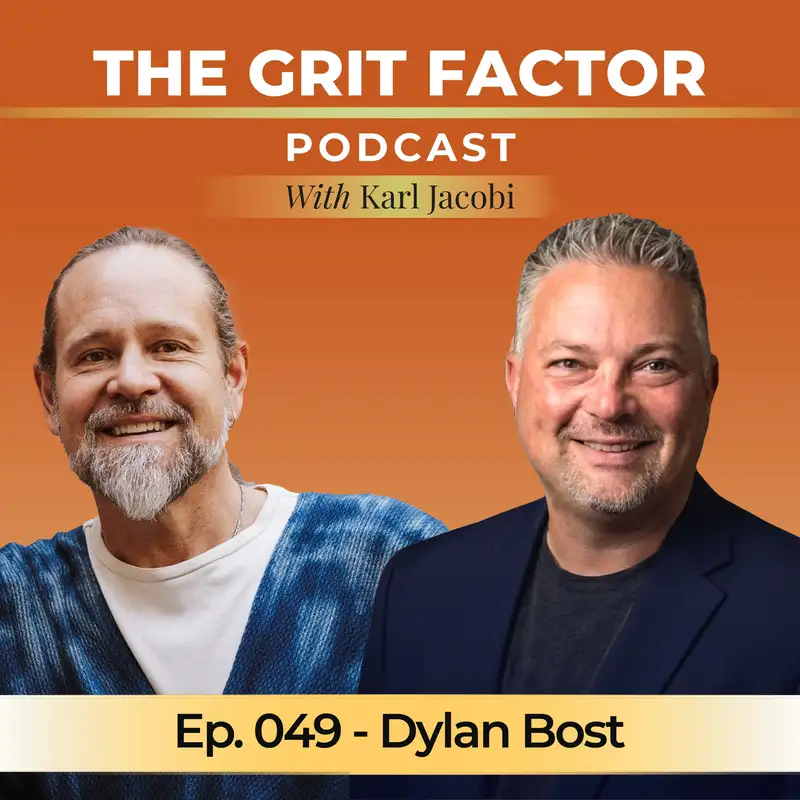
Episode 049: Thirty Years of Winning. Then His Wife Said Call the Bankruptcy Attorney with Dylan Bost.
Episode Summary
Dylan Bost spent thirty years building things. Architecture first. Then Disney. Then his own agency. And for a long stretch, it felt exactly like it was supposed to. Two houses, a Range Rover, a burgeoning business, the spikes of winning clients and finishing projects. From the outside, everything looked like a man who had it figured out. From the inside, he was running a pattern he had never examined. Provider. Producer. The person everyone calls when something goes wrong.
The question that cracked it open was not dramatic. He was standing in his office on a Tuesday afternoon, sun coming through the window, and he looked at a painting on the wall and thought: what am I doing this for? He could not answer it. He did not know who to ask. And instead of investigating it, he did what the pattern said to do. He pushed it down, went to work the next morning, and let the drink creep a little earlier in the afternoon. Tomorrow was always the plan.
Then 2008 hit. The housing market took a third of his annual revenue in one move. He kept everyone employed when scaling back might have saved the company. He kept riding it out when a mentor conversation might have changed the math. He kept refusing to see what his wife was already watching. And then one day she looked at him across the dinner table and told him it was time to call the bankruptcy attorney.
What came apart was not just a business. It was the identity he had spent thirty years constructing on a foundation he had never actually looked at. The rebuild took time, integration, and the willingness to ask a question he had avoided since his twenties: what do I actually want my life to look like? Not what do I want to do. What do I want my life to look like?
Today Dylan runs Sony HQ, an AI and technology consultancy. He is launching a coaching platform built on Claude Code, trained on his book and methodology, that allows people to work through his framework at their own pace without losing the reflective quality of real conversation. His book Seven Mirrors is a recognition practice for people who look successful on the outside and quietly feel off course on the inside. He has been building more in the last five years than in the previous twenty. He now lives in Mexico. He is learning Spanish. He finds being a beginner delightful.
This episode is for the person who has been riding it out, hoping something beautiful will happen, and has not yet made the decision to make something happen instead.
In This Episode, You'll Discover:
- What Dylan was actually experiencing in the years before the crash, the pattern of a provider running on autopilot, the existential question that came on a Tuesday afternoon that he had no framework to investigate, and why he chose drink over investigation
- What it felt like to watch a third of annual revenue disappear in 2008, why he kept everyone employed when scaling back might have saved the company, and how he rode it out until his wife finally said the words he had been refusing to hear
- Why the actual breakdown was not operational but a core alignment problem, and what Dylan means when he says he had put all his eggs in the work basket without ever asking if the basket was going the right direction
- The integration process of rebuilding that did not come in a single moment, the Buddhist philosophy of contentment over the roller coaster of highs and lows, and what it actually means to live in the equal state instead of chasing the next spike
- The framework Dylan used to launch his second company, Sony HQ, by writing eighty to ninety individual tasks into a document and chunking them into an eight week daily process, and why celebrating micro-progress is the only psychology that actually sustains long term effort
- Why Dylan looks at new skills, new countries, and new projects he has no business doing as deliberate training of his nervous system toward comfort with change, and why learning ballet for one afternoon was one of the hardest physical experiences of his life
- What Seven Mirrors is, why Dylan calls it a recognition practice rather than a framework or therapy, and the core premise that people are not broken but have simply forgotten who they are
- The AI coaching platform Dylan built on Claude Code, trained on his book and methodology, and why he designed it for reflective conversation rather than video content and worksheets
Key Takeaways:
- You Are Not Running Your Life. You Are Running a Pattern. Dylan did not choose to be unhappy. He was running a program. Provider does this. Provider gets up and works. The feedback at work is clear and binary. The feedback at home is not. He had no model for what a present husband or father actually looked like beyond the mechanics. The pattern felt like success until the question on a Tuesday afternoon made him realize he did not know why he was running it.
- Riding It Out Is Not a Strategy. Dylan drove the business into bankruptcy hoping something wonderful would turn it around. That is not resilience. That is reaction without ownership. At some point the difference between grit and avoidance is whether you are making decisions or waiting for circumstances to make them for you. Take ownership before the decision gets made for you.
- Ask What You Want Your Life to Look Like. Not What You Want to Do. This is the question Dylan built his rebuild on. The dinner party question is always what do you do. That becomes your identity. The more important question is what does a life I actually want look and feel like, and does what I am doing every day connect to that answer. If you cannot answer it, start there.
- Joy Is the Diagnostic. Dylan's simple test for alignment is a single question. In the last week, can you say you experienced genuine joy at least once? Not a win. Not a dopamine spike. Joy. If the answer is no, something is misaligned. You do not have to change everything to address it. But you have to be honest enough with yourself to answer the question truthfully.
- The Brain Invents Problems If You Do Not Give It One to Solve. Empty headspace is dangerous. The brain's only job is to solve problems. If you do not give it a direction, it will manufacture catastrophe. Get everything out of your head and into a document. Chunk it into daily tasks. Focus on one thing at a time. The brain will work for you or against you depending on what you point it at.
- Celebrate the Process. Not Just the Outcome. The book took Dylan through months where he could not see any progress. What kept him going was projecting forward to the moment after it was done, imagining telling himself he got through the hardest part, and letting that future satisfaction pull him through the day. The joy is in the doing. The destination fades in a week. Build the capacity to feel good about the work itself.
- Try Things With Low Stakes First. You do not have to quit your job to start practicing change. Try pottery. Try ballet. Try learning a language. Train your nervous system to experience discomfort as a positive signal rather than a threat. Every time you try something you are bad at and survive the awkwardness, you lower the threshold for everything bigger. Be okay with being the person who knows the least in the room.
- People Are Not Broken. They Have Forgotten Who They Are. This is Dylan's operating premise for everything he builds, the book, the coaching, the AI platform. You were born with something intact. Life conditions it out of you between birth and whenever you wake up. The work is not to become something new. It is to recognize and return to what was already there before it got covered over.
Timestamps:
- [00:00] Karl introduces Dylan Bost: thirty years in architecture, Disney, agency life, bankruptcy in 2008, now running Sony HQ with a book and AI coaching platform
- [03:00] The pattern: what life looked like before the question arrived, running the provider program, the highs and lows of agency life, and the Tuesday afternoon that cracked it open
- [08:00] Two selves: the one who knew what to do publicly and the one who had no idea what to do with the question underneath
- [12:00] Why the question got buried: ego, lack of vulnerability, no framework, and the drink that turned the question into a tomorrow problem
- [16:00] Karl's ad break: The Grit Code Exposed at https://gritcodeexposed.com
- [17:00] When 2008 hit: losing a third of revenue, refusing to scale back, refusing to let people go, riding it out to the point of no return
- [22:00] The bankruptcy conversation with his wife and what was really coming apart underneath the business failure
- [26:00] The core alignment problem: eggs in the work basket, no model for being a husband or father, the provider identity with no depth underneath it
- [30:00] The roller coaster versus the equal state: Buddhist contentment, the problem with living for the highs, and what becomes possible when you stop chasing the spike
- [35:00] What do I want my life to look like: the question that rebuilt everything and why it is more important than what do I want to do
- [39:00] Karl's ad break: The Grit Code Exposed at https://gritcodeexposed.com
- [40:00] Reframe fear: Mel Robbins, scared and excited as the same chemical, and why acknowledging fear without surrendering to it is the whole move
- [44:00] The Sony HQ launch: eighty to ninety tasks in a document, eight weeks chunked into daily lists, and celebrating every check-off
- [49:00] Why celebrating the process matters psychologically and what projecting yourself to the finish line does when the daily work feels invisible
- [53:00} Being a beginner on purpose: ballet, Spanish, the pottery defense, and why training the nervous system to tolerate discomfort in low stakes areas changes everything else
- [58:00] Seven Mirrors: recognition practice, not therapy, the premise that people are not broken but have forgotten who they are
- [01:03:00] Respond versus react: two words that look the same and could not be further apart, and why you cannot respond until you have recognized the pattern driving the reaction
- [01:07:00] The AI coaching platform built on Claude Code: why video content and worksheets never stuck, what reflective conversation does differently, and what early users are experiencing
- [01:12:00] What Dylan is most fired up about: seeing people heal themselves and hearing them say man, Dylan, I am doing this now
- [01:15:00] Grit defined: the willingness to look at your patterns and your failures honestly and keep moving differently
- [01:16:00] The directive: this is not permanent, smile, take a breath, walk slowly
- [01:18:00] Evan Poling's question from Episode 48: imagine your funeral. What will people say about you? Is that the legacy you are currently building?
- [01:20:00] Dylan's answer: that he helped people heal themselves, and the emotion behind knowing that is one hundred percent the path he is on today
- [01:22:00] Dylan's question for the next guest: if you could change one thing about the world in the blink of an eye, what would it be and what do you think the effect would be?
- [01:23:00] Where to find Dylan, the book, and the first chapter giveaway
Resources & Links:
- Book: Seven Mirrors by Dylan Bost (a recognition practice for people who look successful on the outside and feel off course on the inside)
- Challenge: The Grit Code Exposed at https://gritcodeexposed.com
Connect with Dylan Bost:
- Website: https://dylanbost.com
- Instagram: https://www.instagram.com/dylanclaytonbost/
- Facebook: https://www.facebook.com/DylanClaytonBost
- LinkedIn: https://www.linkedin.com/in/dylanbost/
- X (Twitter): https://x.com/dylancbost
- YouTube: https://www.youtube.com/dylanbost
Connect with Karl Jacobi:
- Website: https://successwithkarl.com
- LinkedIn: https://www.linkedin.com/in/karljacobi
- Facebook: https://www.facebook.com/karl.jacobi
- Instagram: https://www.instagram.com/successwithkarl
- YouTube: https://www.youtube.com/@KarlJacobi
- TikTok: https://www.tiktok.com/@successwithkarlj
Creators and Guests
Host
Karl Jacobi
Host of The Grit Factor Podcast, Resilience & Performance Coach, Founder, Entrepreneur, Combat Veteran