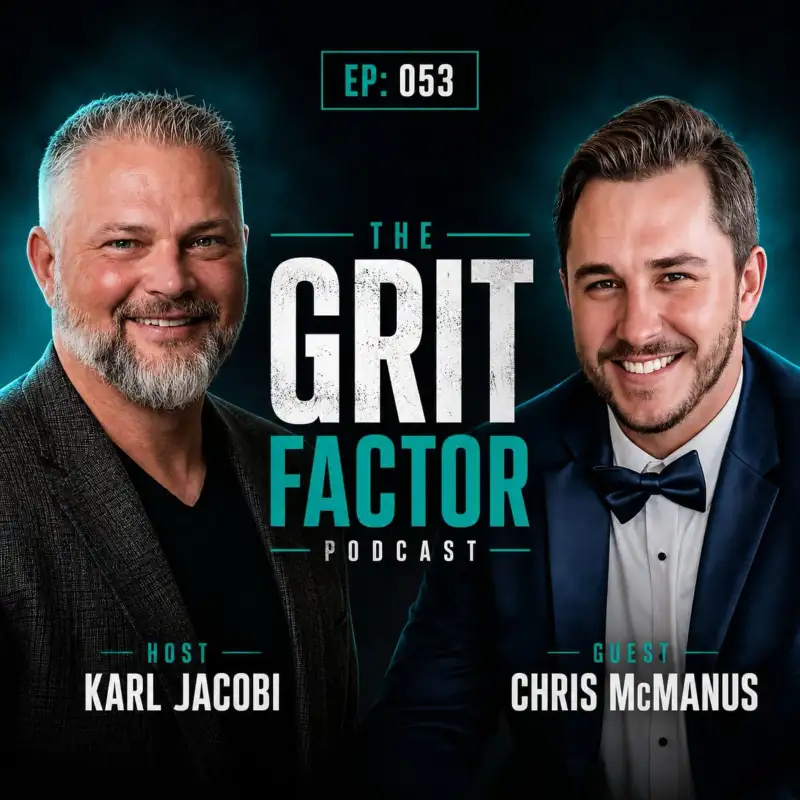
Nearly Went Bankrupt Three Times, Now Chasing Twenty-Five Million with Chris McManus
Episode Summary
Chris McManus graduated high school, skipped college, and put grass in the ground because it was flexible enough to keep racing motocross while he figured out what else to do. He was not building a company. He was buying time. Then one Sunday afternoon in Pennsylvania he worked fifty hours that week and got smoked at the racetrack and cried the whole way home in his van and knew. He sold the bikes, the van, the gear, all of it. And turned back to the little landscaping operation that had been snowballing while he was not paying attention.
What followed was seven years of building GC Landscaping from nothing into a multiple seven-figure operation, picking up trade licenses along the way, stacking a real estate company on top, and now chasing a twenty-five million dollar valuation with two or three more locations on the horizon. But the version of that story that does not make the highlight reel includes the acquisition that nearly broke him. He doubled the size of the company overnight buying a competitor doing a million in revenue. Then the bank backed out of the SBA refinancing they had promised.
Then he underbid a major project by eighty thousand dollars. Then another project was mismanaged and the customer left a thirty-five to forty thousand dollar balance unpaid. All in the same month, sitting on top of a large debt service from the acquisition that had already wiped out his cash reserves. Then he went to the Caribbean with his wife and came home to find out five of his six managers had walked or been walked out while he was gone.
Then he underbid a major project by eighty thousand dollars. Then another project was mismanaged and the customer left a thirty-five to forty thousand dollar balance unpaid. All in the same month, sitting on top of a large debt service from the acquisition that had already wiped out his cash reserves. Then he went to the Caribbean with his wife and came home to find out five of his six managers had walked or been walked out while he was gone.
Chris was twenty-three years old. He did not have a plan B. He called a few customers, apologized for the delay, and went back to work.
That stubbornness is not recklessness. It is a philosophy that was drilled into him on a dirt bike from the age of eight: you crash, you get back on, you go again. Not because you feel ready. Because there is no other option that makes sense. And every time things have gotten that bad, they have eventually turned. He now has the evidence. The bad months no longer break him the same way. They almost feel familiar.
This episode is for the builder who has never once felt like quitting but has wanted to a thousand times and kept going anyway.
In This Episode, You'll Discover:
- How Chris started a landscaping company straight out of high school as a side hustle to fund his motocross racing career, and the specific Sunday afternoon in Pennsylvania when he cried driving home and decided it was time to let the racing dream go and go all in on the business
- The acquisition that nearly ended everything, buying a competitor, the bank backing out of the SBA refinancing, two projects going wrong simultaneously to the tune of a hundred and twenty thousand dollars in losses, a depleted cash reserve, and five of six managers gone within a week
- What that season actually cost him beyond the finances: the sleep, the strain on his marriage with his high school sweetheart who did not sign up for any of this, and the gray hair that started arriving at twenty-seven and twenty-eight years old
- Why Chris kept going when he had every reason to stop, the faith underneath the stubbornness, and the cheat code he has developed from surviving enough hard stretches to know the next one will also eventually turn
- The eighty percent principle Chris uses for delegation, why he shows up for the first ten percent and the last ten percent of every project and trusts his team with the eighty in between, and how that principle freed him from being the one wearing every hat
- What Chris learned from letting problem employees stick around too long, why he always knew who needed to go and always waited, and what changed when he finally decided cancer gets cut immediately with no ifs ands or buts
- The foundation year he deliberately took, pulling back on revenue growth to fix the systems, the cash flow management, and the infrastructure that would not have survived the next scaling push without it
- Why Chris believes most people are not dreaming big enough, the conference that made him realize he had already blown through every number he had ever set for himself, and where the twenty-five million dollar exit goal actually came from
Key Takeaways:
- There Is No Plan B. That Is the Plan. Chris never had an exit ramp from the business. Not because he was fearless but because he could not picture what else he would do. When you remove the option to retreat, forward is the only direction. Not every person is built for this and Chris acknowledges that. But for the person who genuinely cannot see themselves working for someone else, that clarity is a competitive advantage in disguise.
- Get Back on the Bike. Chris raced motocross from age eight. The lesson from that sport is not about pain tolerance. It is about the automatic response to a crash. You do not ask whether to get back on. You get back on. That same nervous system wiring is what kept him showing up after the acquisition nearly broke him. You cannot teach this without the repetition of actually crashing and getting up again.
- Cut the Cancer Immediately. Chris let problem employees stay too long on multiple occasions because he did not want to deal with the pain of replacing them. Every single time it cost him more to wait than it would have cost to act. He now has a clear rule. If someone is a cancer or a bad fit, they are gone. The short-term pain of the gap is always less than the long-term damage of the presence.
- Eighty Percent Times Three People Is Better Than One Hundred Percent Once. You are not going to find someone who does it as well as you. You are going to find someone who does it eighty percent as well. Three people doing it at eighty percent in their lane, while you come in at the first and last ten percent, produces a better outcome than you doing it at a hundred percent alone every time. Let go of the hundred. Compound the eighty.
- Slow Down to Fix the Foundation Before You Scale. Chris pulled back on growth deliberately for over a year because he recognized he was building higher floors on a foundation that could not hold them. Revenue growth feels like winning. Scaling broken systems faster is just a faster route to a bigger crash. Know when to pause and rebuild before you push.
- The Problems Do Not Go Away. You Get Better at Handling Them. Chris says this directly and from experience. A thirty million dollar company is not easier to run than a three million dollar company. It has harder problems. What changes is the operator's capacity to handle them. The problems you are struggling with today will eventually feel like brushing your teeth. That is not a promise that things get easier. It is a promise that you get better.
- Your Goals Are Probably Not Big Enough. Chris walked into a conference in his first year in business and set goals he thought were enormous. He obliterated every single one of them. The twenty-five million dollar exit target came from a reset that only happened because someone asked him whether he had dreamed big enough. The number that feels scary enough to intimidate you is probably the right starting point.
- Giving Back Is the Fuel That Outlasts Every Material Goal. Chris has the nice things he dreamed about as a kid. They delivered less than he expected. What actually gets him out of bed now is the number he is chasing and what it would make possible for his community. The material goals are fine. The mission is what sustains the drive when the material goals stop moving the needle.
Timestamps:
- [00:00] Karl introduces Chris McManus: no degree, no investors, a truck and a trailer, seven years building GC Landscaping from zero to multiple seven figures, a real estate company, a retail store, and a twenty-five million dollar valuation in his sights
- [03:00] Motocross from age eight, running nationally, racing pro locally, parents letting him chase it, and the farm that gave him land to train and a work ethic built in by default
- [07:00] The Sunday in Pennsylvania: fifty-hour week, smoked at the racetrack, crying the whole way home, and the decision to sell everything and go all in on landscaping
- [11:00] The first thousand dollars in the checking account at twenty-one, the feeling of making it, and how that benchmark has evolved since
- [15:00] The acquisition that nearly broke everything: doubling overnight, the bank backing out of the SBA refinancing, two major projects going wrong simultaneously, losing a hundred and twenty thousand dollars and the cash reserve in the same month
- [19:00] Coming home from the Caribbean to find five of six managers gone in a week, what Chris did next, and why he has never had a plan B
- [23:00] Karl's ad break: The Grit Code Exposed at https://gritcodeexposed.com
- [24:00] What that season actually cost: sleep, the marriage, the gray hair at twenty-seven and twenty-eight, and carrying payroll stress through the front door
- [28:00] Hanging the stress on the truck before walking inside: the habit Chris has been actively building since his son was born
- [31:00] Two types of faith working together: faith in God and faith in your own ability to figure it out, and why having both is a cheat code
- [35:00] New levels new devils: why the problems do not go away and how you get better at handling them instead
- [39:00] The micro versus macro shift: what running a business under a million actually looks like versus what it demands north of that
- [43:00] The eighty percent principle: showing up for the first and last ten percent and trusting the team with the eighty in between
- [47:00] Letting go of control: why the older generation of business owners struggles with this the most, and why eighty percent from the right person in their lane beats a hundred percent from the wrong person every time
- [51:00] Cutting the cancer immediately: the lesson Chris had to learn multiple times before it finally became a non-negotiable
- [55:00] Building the foundation: the deliberate year of pulling back on growth to fix systems, cash flow, and infrastructure before the next push
- [01:00:00] What Chris is most fired up about: the second and third locations, the twenty-five million valuation, and what getting there makes possible for his community
- [01:05:00] Chasing acceptance and validation versus chasing something bigger than yourself: the distinction Karl draws and why Chris's community goal is the fuel that outlasts every material target
- [01:08:00] Grit defined: when it's tough, don't quit. That is it.
- [01:09:00] Hadley Nightingale's question from Episode 41: if you could go back and start your business again, what two things would you set up differently?
- [01:11:00] Chris's answer: systems and processes, financial benchmarks, and three to ten year plans from day one
- [01:13:00] Chris's question for the next guest: are your goals big enough?
- [01:14:00] The context behind the question: blowing through every number he had ever set for himself and what that conference in year one taught him about dreaming bigger
- [01:16:00] Where to find Chris and Karl's close
Resources & Links:
- Reference: Grant Cardone ten times principle (referenced by Chris in the context of dreaming bigger and setting goals that feel out of reach)
- Challenge: The Grit Code Exposed at https://gritcodeexposed.com
Connect with Chris McManus:
- Website: https://gclandscapinginc.com
- Instagram: https://www.instagram.com/gclandscapinginc/
- Facebook: https://www.facebook.com/gclandscapinginc
- Personal Instagram: https://www.instagram.com/chrismcmanus151/
Connect with Karl Jacobi:
- Website: https://successwithkarl.com
- LinkedIn: https://www.linkedin.com/in/karljacobi
- Facebook: https://www.facebook.com/karl.jacobi
- Instagram: https://www.instagram.com/successwithkarl
- YouTube: https://www.youtube.com/@KarlJacobi
- TikTok: https://www.tiktok.com/@successwithkarlj
Creators and Guests
Host
Karl Jacobi
Host of The Grit Factor Podcast, Resilience & Performance Coach, Founder, Entrepreneur, Combat Veteran